
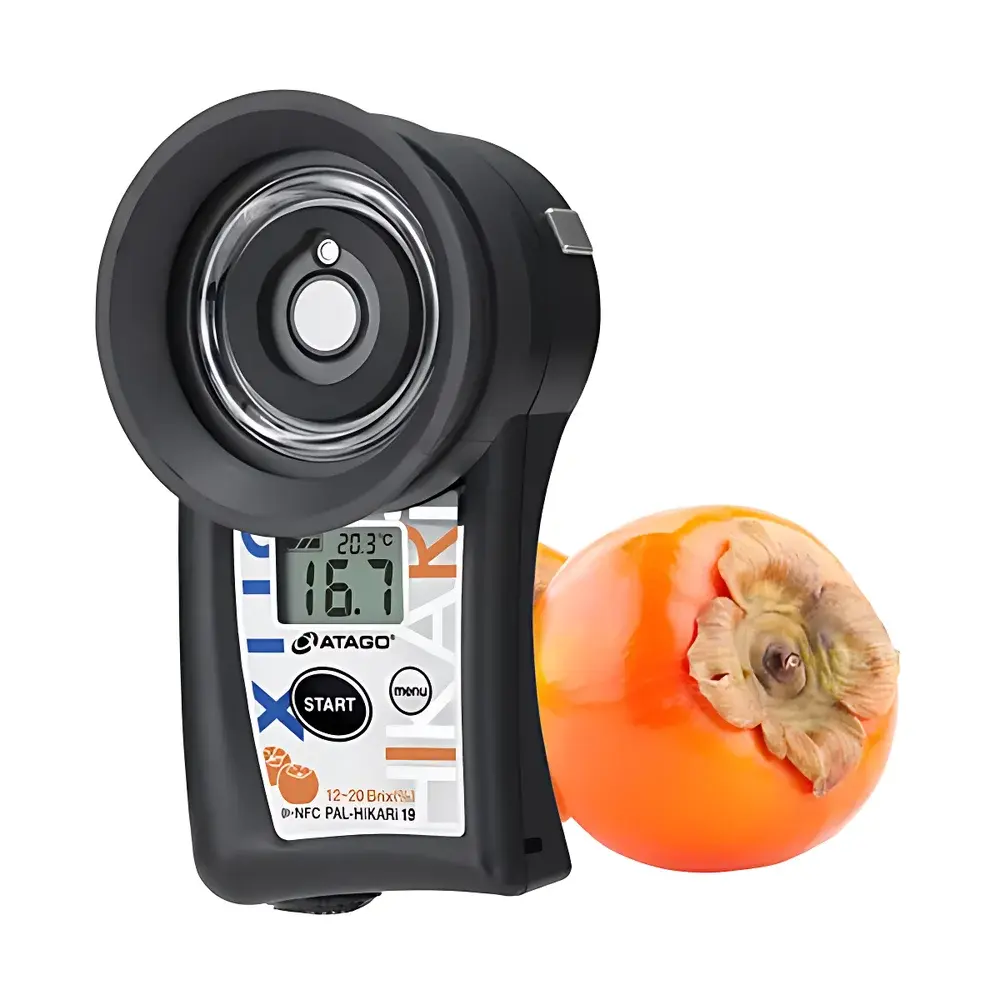
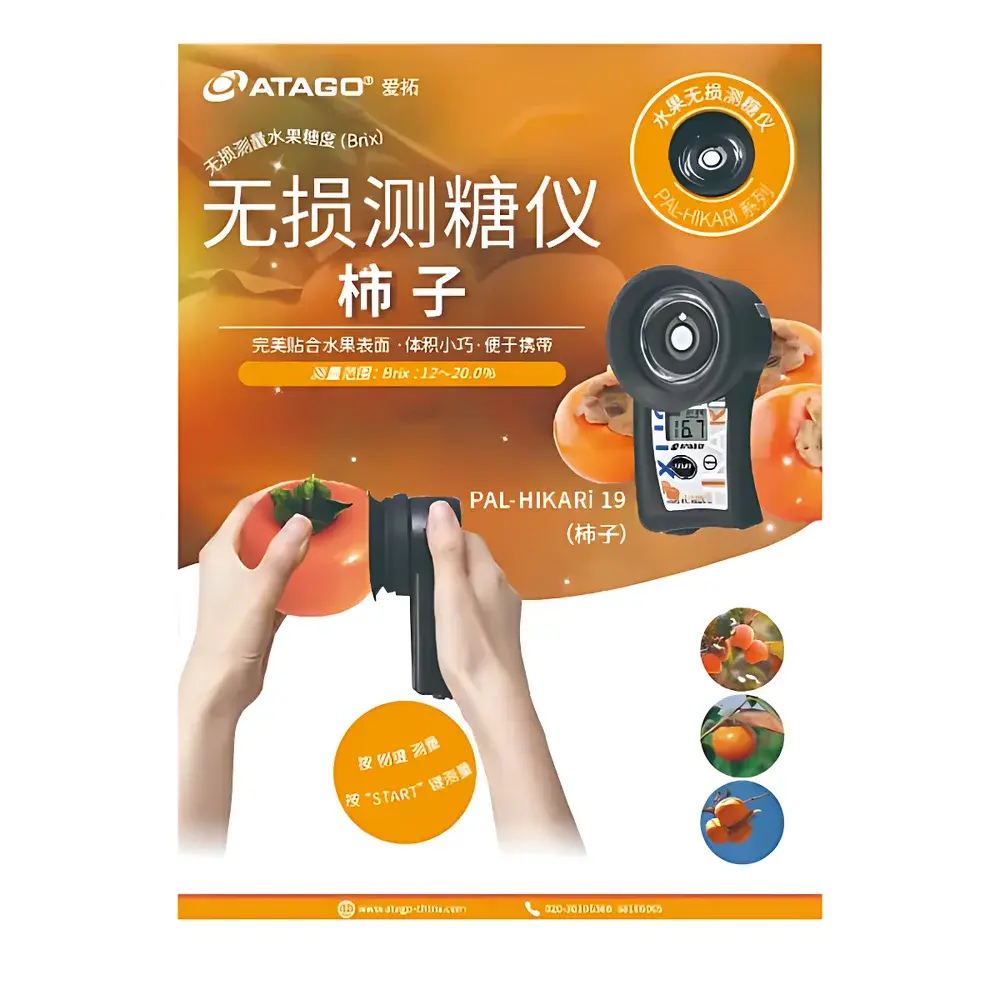
ATAGO PAL-HIKARi 19 Non-Destructive Fruit Refractometer
| Brand | ATAGO |
|---|---|
| Origin | Japan |
| Model | PAL-HIKARi 19 |
| Instrument Type | Non-Destructive |
| Measurement Principle | Near-Infrared (NIR) Reflectance Spectroscopy |
| Output Unit | °Brix (0.0–32.0 range, typical for intact fruit) |
| Response Time | ≤3 seconds |
| Temperature Compensation | Automatic (5–40 °C operating range) |
| Portability | Handheld, Battery-Powered (AAA × 2) |
| Compliance | Designed per JIS Z 8015 (optical measurement instruments), compatible with GLP documentation workflows |
Overview
The ATAGO PAL-HIKARi 19 is a handheld, non-destructive fruit refractometer engineered for rapid, in-situ quantification of soluble solids content (SSC) — expressed as °Brix — in intact fruits without physical sampling. Unlike conventional benchtop refractometers requiring juice extraction or destructive tissue preparation, the PAL-HIKARi 19 employs near-infrared (NIR) reflectance spectroscopy: an integrated NIR LED emits light at specific wavelengths (typically 700–1100 nm), which penetrates the fruit epidermis and scatters within the subcutaneous tissue. The sensor captures intensity-modulated reflected light; spectral absorption features correlated with C–H and O–H bond vibrations in sucrose, glucose, and fructose are analyzed via embedded calibration algorithms to estimate SSC. This optical method eliminates sample preparation artifacts, preserves fruit integrity for longitudinal monitoring, and supports real-time decision-making across horticultural value chains — from orchard phenotyping to postharvest logistics.
Key Features
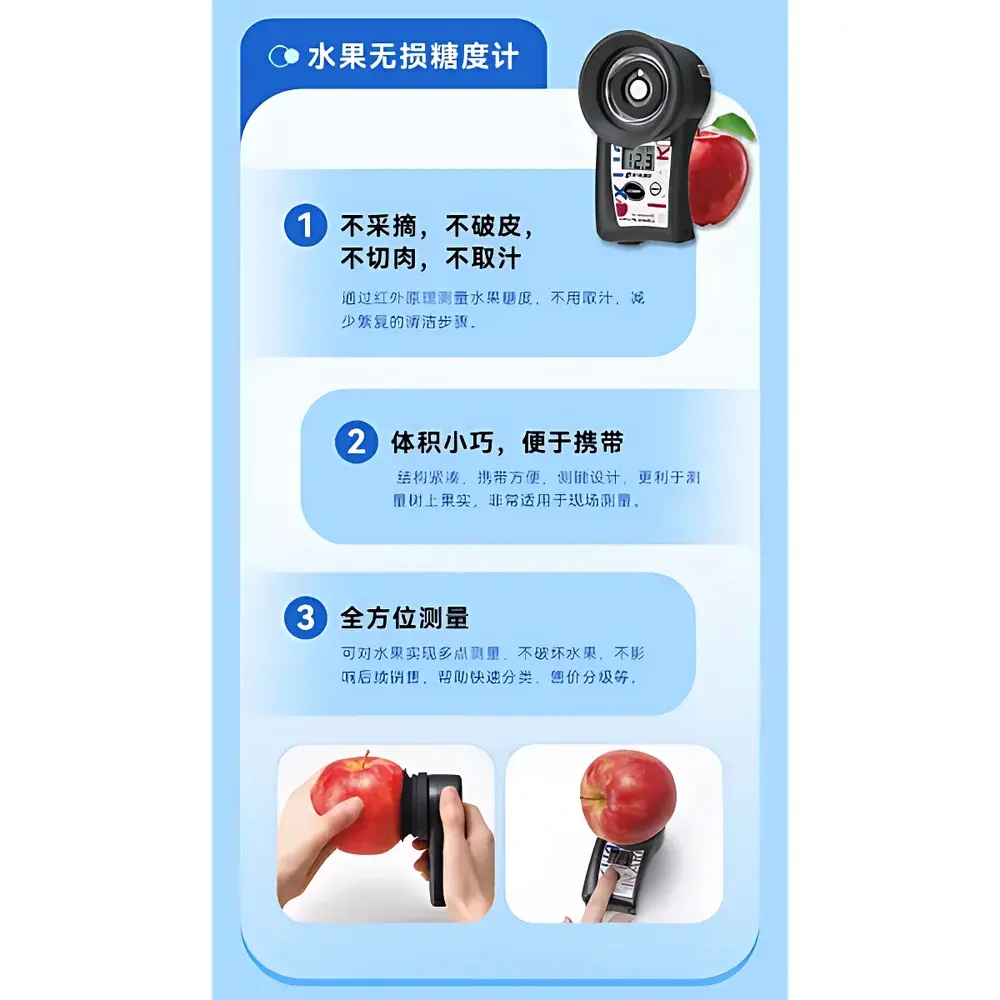
- True non-invasive measurement: No fruit puncturing, peeling, slicing, or juice expression required — ideal for premium cultivars, breeding trials, and export-grade fruit inspection.
- NIR-based optical architecture: Optimized for high signal-to-noise ratio on heterogeneous fruit surfaces (e.g., fuzzy kiwifruit skin, waxy apple cuticle, or tannin-rich persimmon epidermis).
- Real-time digital readout: °Brix values displayed within ≤3 seconds after probe contact; resolution 0.1 °Brix, repeatability ±0.2 °Brix under controlled ambient conditions.
- Automatic temperature compensation (ATC): Compensates for sample surface temperature drift (5–40 °C) using integrated thermistor, ensuring metrological consistency across field environments.
- Field-deployable ergonomics: Weighs <150 g; powered by two AAA batteries (≥5,000 measurements per set); IP54-rated enclosure resists dust and incidental moisture.
- User-configurable averaging: Supports up to 10 consecutive measurements per fruit location with automatic mean calculation and standard deviation output.
Sample Compatibility & Compliance
The PAL-HIKARi 19 is validated for use on intact, unblemished fruits with smooth-to-moderately textured skins — including persimmons (Diospyros kaki), apples, pears, grapes, citrus, and stone fruits. It is not intended for highly fibrous (e.g., pineapple core), translucent (e.g., lychee aril), or heavily bruised specimens where subsurface light scattering deviates significantly from factory calibration matrices. Device firmware incorporates traceable calibration against NIST-traceable sucrose reference standards (0–32 °Brix). While not certified to ISO/IEC 17025, its measurement protocol aligns with ASTM D6920-22 (Standard Practice for Field Use of Portable NIR Analyzers) and supports data integrity requirements for Good Agricultural Practice (GAP) and GlobalG.A.P. certification audits. Export documentation complies with Japan’s METI export control regulations for optical instrumentation.
Software & Data Management
The PAL-HIKARi 19 operates as a standalone instrument with no Bluetooth or USB connectivity. All measurement data remain on-device: users may manually record readings in field logs or integrate outputs into external LIMS or farm management software (e.g., FarmLogs, AgriWebb) via manual entry. Calibration verification reports and instrument serial number metadata are accessible via built-in service mode (activated by OEM technician). For regulated environments requiring audit trails, users are advised to pair the device with GLP-compliant electronic lab notebooks (ELNs) that capture operator ID, timestamp, GPS coordinates (via paired smartphone), and environmental notes alongside each reading — satisfying FDA 21 CFR Part 11 principles when implemented with appropriate procedural controls.
Applications
- Orchard maturity mapping: Quantify spatial and temporal °Brix gradients across tree canopies to optimize harvest windows and reduce pre-harvest drop.
- Varietal screening: Accelerate breeding programs by non-destructively tracking SSC accumulation kinetics during fruit development stages.
- Postharvest quality assurance: Verify lot-level consistency prior to cold storage or ripening chamber loading, minimizing spoilage risk.
- Retail grading compliance: Support price-tiering based on objective SSC thresholds (e.g., ≥14.0 °Brix for premium persimmons per JAS Standard No. 128).
- Supply chain traceability: Generate batch-specific sugar profiles for export documentation, particularly for markets requiring phytosanitary and quality attestation (e.g., EU, South Korea, Singapore).
FAQ
Can the PAL-HIKARi 19 measure sugar content in fruits with thick or hairy skins, such as kiwifruit or peach?
Yes — the NIR optics are optimized for penetration through common epidermal layers; however, consistent probe contact pressure and surface cleanliness are critical. Calibrate using representative fruit lots grown under local conditions.
Does the device require annual recalibration by an authorized service center?
ATAGO recommends verification against certified sucrose standards every 12 months or after 10,000 measurements; full recalibration is performed only at ATAGO-certified facilities in Japan or designated regional support hubs.
Is the °Brix value reported equivalent to laboratory-grade HPLC or AOAC Method 932.12 results?
No — it provides a rapid, field-correlative estimate aligned with traditional refractometry of expressed juice. Correlation coefficients (R²) typically exceed 0.92 against benchtop methods when applied to homogeneous cultivars under stable temperature conditions.
Can measurements be affected by fruit temperature extremes?
The ATC system compensates between 5–40 °C; measurements outside this range may yield non-linear deviations. Avoid direct sunlight exposure during operation.
What maintenance is required for long-term accuracy?
Clean the optical window with lens-grade tissue and isopropyl alcohol after each use; inspect for scratches quarterly; replace AAA batteries before voltage drops below 1.2 V per cell.





