
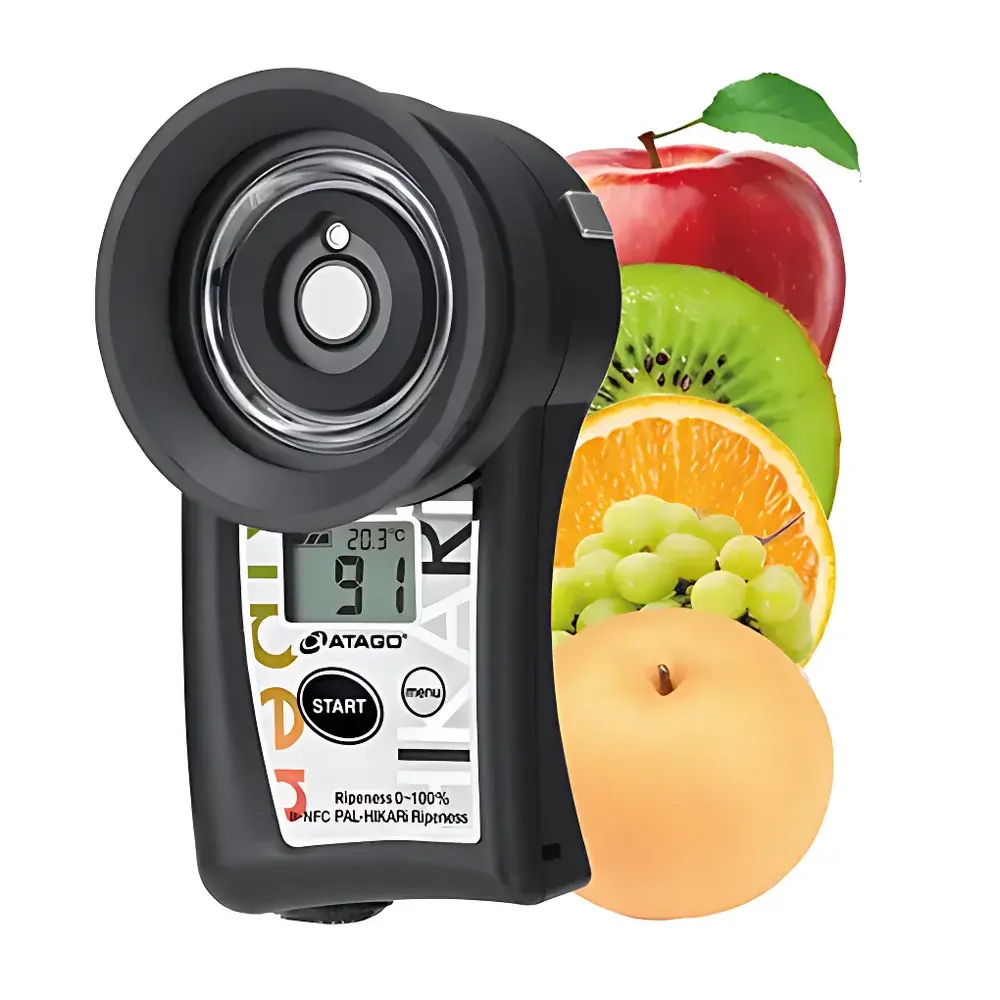
ATAGO PAL-HIKARi Ripeness Non-destructive Fruit Maturity Analyzer
| Brand | ATAGO |
|---|---|
| Origin | Japan |
| Model | PAL-HIKARi Ripeness |
| Measurement Principle | Near-Infrared (NIR) Absorption Spectroscopy |
| Measurement Range | Maturity 0–100% (unitless index), Temperature 5.0–35.0 °C |
| Resolution | Maturity 1%, Temperature 0.1 °C |
| Accuracy | ±5% for maturity (varies by fruit species and measurement conditions), ±1 °C for temperature |
| Auto Temperature Compensation | 5.0–35.0 °C |
| Power Supply | 2 × AAA alkaline batteries |
| Ingress Protection Rating | IP64 |
| Dimensions | 6.1 × 4.4 × 11.5 cm |
| Weight | 120 g (instrument only) |
| Data Storage | Up to 100 measurements |
| Data Transfer | NFC-enabled (to smartphones or PCs) |
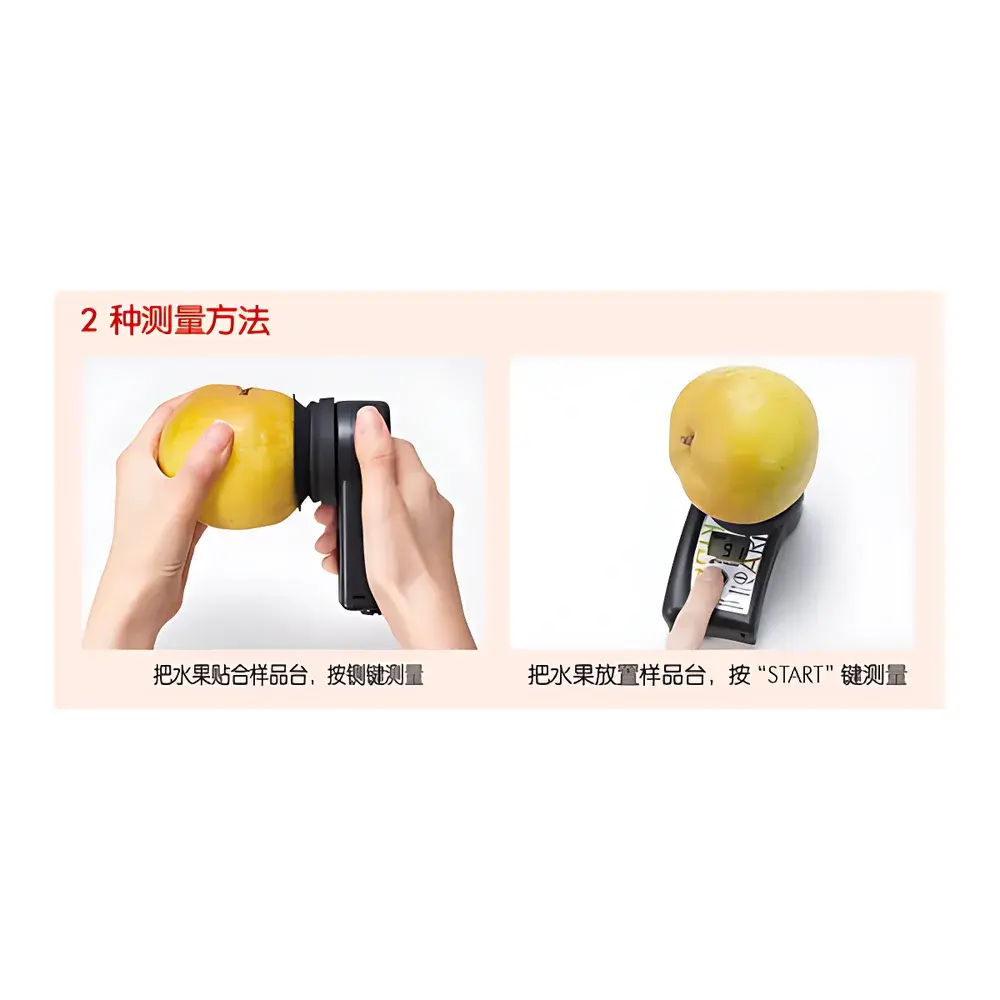
| Sample Interface | Contact-type optical sensor with light-shielding gasket |
Overview
The ATAGO PAL-HIKARi Ripeness is a handheld, non-destructive fruit maturity analyzer engineered for rapid, in-situ assessment of ripeness across a broad spectrum of horticultural commodities. Unlike destructive sampling methods requiring tissue excision or juice extraction, the PAL-HIKARi Ripeness employs near-infrared (NIR) absorption spectroscopy—specifically targeting characteristic absorption bands associated with chlorophyll degradation, sugar accumulation, and cell wall structural changes during maturation. The device delivers a normalized maturity index (0–100%), calibrated against reference datasets derived from extensive empirical correlation studies across multiple cultivars and growing conditions. Its compact form factor (120 g, 6.1 × 4.4 × 11.5 cm), IP64-rated enclosure, and battery-powered operation enable reliable field deployment in orchards, packing houses, cold storage facilities, and research greenhouses without dependency on external power or lab infrastructure.
Key Features
- Contact-based optical measurement: No fruit damage—no cutting, peeling, piercing, or juice expression required.
- Integrated light-shielding gasket: Minimizes ambient light interference and ensures consistent optical coupling regardless of measurement angle or surface curvature.
- Real-time temperature compensation: Built-in thermistor enables automatic correction of NIR signal drift across 5.0–35.0 °C operating range.
- NFC data transmission: Secure, touch-initiated transfer of up to 100 stored measurements—including timestamp, maturity value, and ambient temperature—to iOS/Android devices or Windows/macOS computers.
- Robust industrial design: IP64-rated housing resists dust ingress and water splashing, supporting daily use in humid, dusty, or temperature-variable agricultural environments.
- Low-power architecture: Operates continuously for >10,000 measurements per set of two AAA alkaline batteries under typical usage conditions.
Sample Compatibility & Compliance
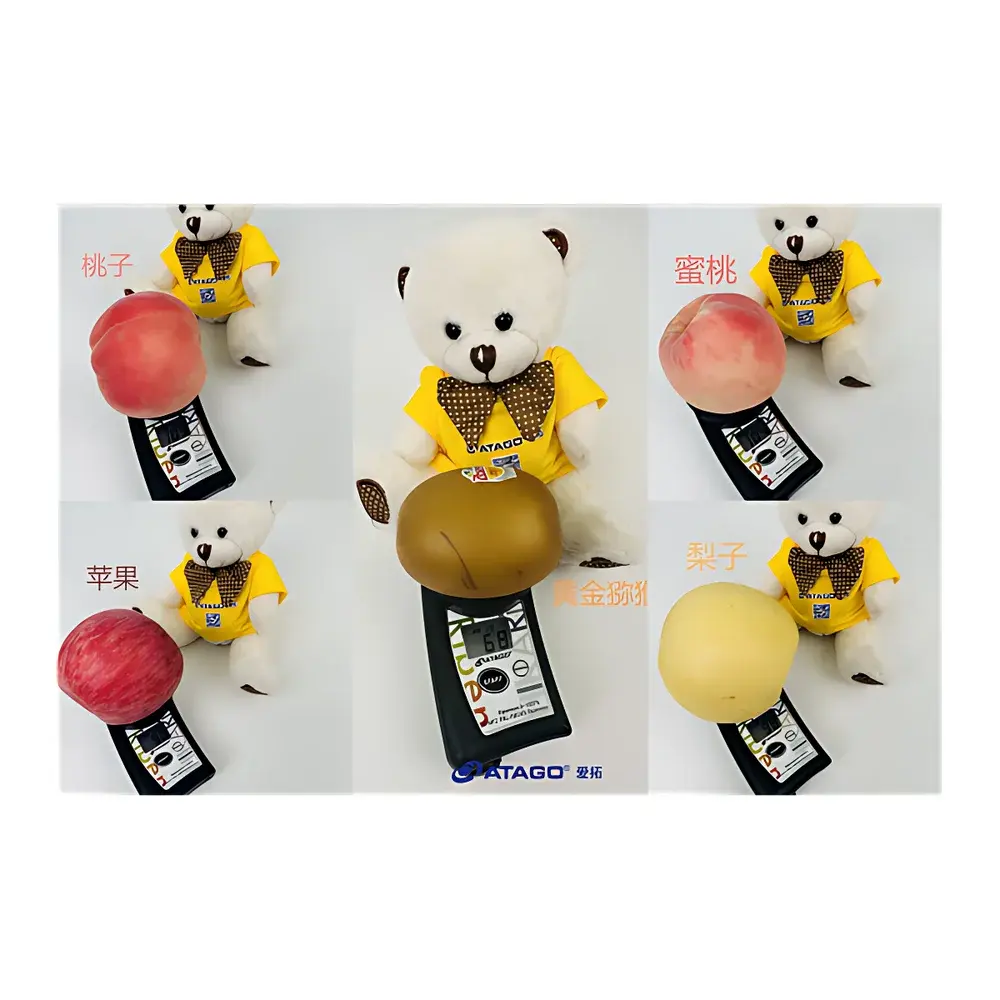
The PAL-HIKARi Ripeness has been validated for use with commercially relevant fruits including kiwifruit (gold variety), muscat and Delaware grapes, peach, mandarin orange, persimmon, pear, lime, tomato, apple, plum, and onion. Calibration models are optimized for intact, unblemished fruit surfaces with minimal wax or debris; measurement repeatability is maintained within ±5% maturity units when applied per manufacturer protocol. While not certified to ISO/IEC 17025 as a standalone metrological instrument, the device supports Good Agricultural Practice (GAP), Good Manufacturing Practice (GMP), and HACCP-aligned quality control workflows. Its non-destructive nature facilitates longitudinal monitoring of individual fruit batches, enabling harvest scheduling optimization and postharvest quality tracking in accordance with FAO/WHO Codex Alimentarius guidelines for fresh produce.
Software & Data Management
No proprietary desktop software is required. NFC-transferred data export as CSV files permits direct import into Excel, JMP, R, or Python-based analytics pipelines. Each record includes: measurement ID, UTC timestamp, maturity index (%), measured surface temperature (°C), and device firmware version. Audit-trail integrity is preserved through immutable timestamping at acquisition—no post-hoc editing capability exists within the instrument or NFC interface. For regulated environments requiring electronic record retention (e.g., USDA GAP audits or EU Commission Regulation (EC) No 852/2004 compliance), users may integrate exported logs into validated LIMS or ELN systems with full 21 CFR Part 11-compliant user authentication and change control.
Applications
- Harvest timing optimization: Quantify physiological readiness across orchard blocks to align picking windows with market demand and shelf-life targets.
- Postharvest quality assurance: Screen incoming lots at receiving docks to reject under- or over-mature shipments prior to cold storage.
- Varietal performance evaluation: Compare ripening kinetics across cultivars or rootstocks under controlled trial conditions.
- Supply chain traceability: Embed maturity metrics into digital batch records for downstream transparency with retailers and certification bodies.
- Agronomic research: Correlate NIR-derived maturity indices with conventional assays (e.g., titratable acidity, soluble solids content, firmness) to refine predictive models.
- Educational use: Demonstrate non-destructive sensing principles in horticulture, food science, and precision agriculture curricula.
FAQ
What physical property does the PAL-HIKARi Ripeness actually measure?
It measures relative absorption intensity in the near-infrared spectral region (approximately 700–1100 nm), which correlates empirically with biochemical and structural changes associated with fruit ripening—not a direct chemical concentration.
Can it be used on fruits with thick cuticles or heavy wax coatings?
Surface cleanliness and uniformity significantly affect signal consistency; waxy or dusty skins should be gently wiped prior to measurement to ensure optical contact and minimize scattering artifacts.
Is calibration required before each use?
No routine recalibration is needed; factory calibration remains stable over time and across environmental fluctuations due to internal reference stabilization and temperature compensation.
Does the maturity index correspond to any international standard scale?
No—it is an ATAGO-specific, instrument-derived index optimized for comparative ranking within a given species and cultivar; it is not interchangeable with USDA grade standards or ISO 8587 sensory scales.
How does ambient lighting affect measurement accuracy?
The integrated light-shielding gasket and pulsed LED source design effectively suppress ambient photonic noise; measurements remain stable under direct sunlight, shaded outdoor, or indoor fluorescent lighting conditions.



