
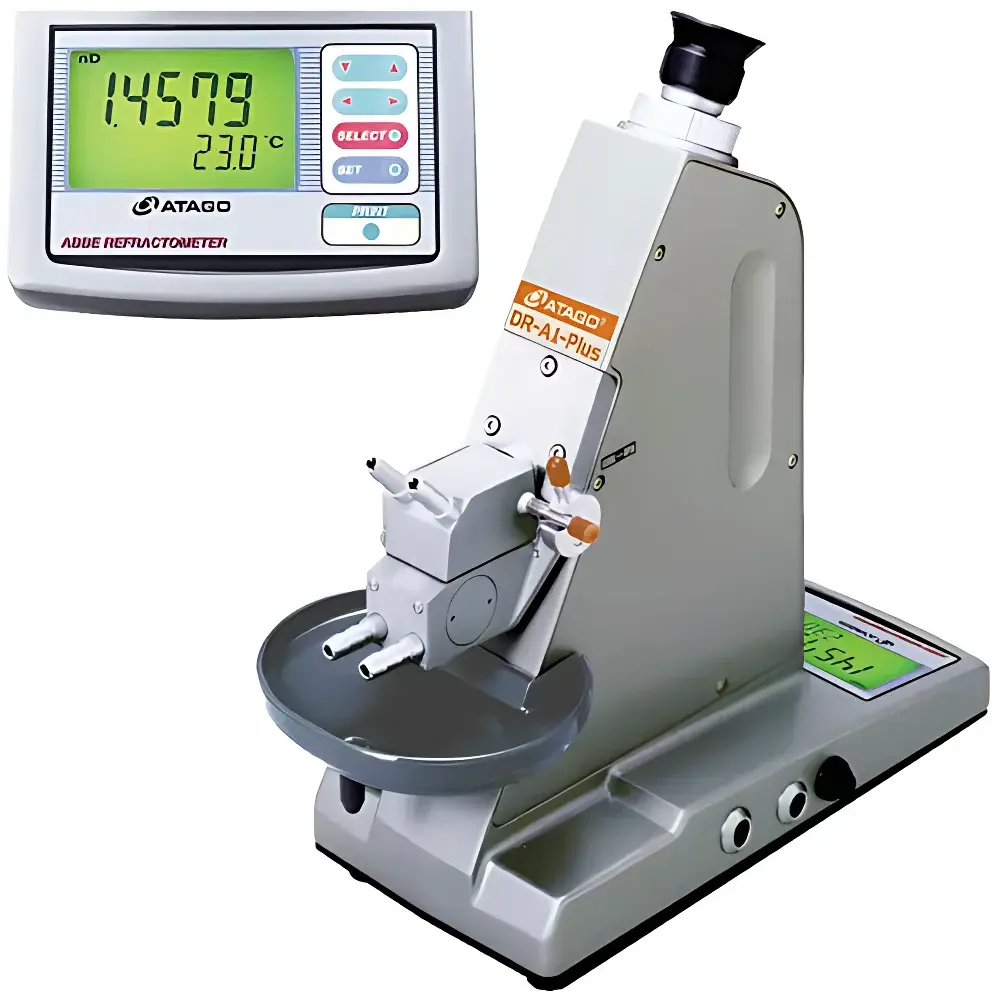
ATAGO DR-A1-PLUS Digital Abbe Refractometer
| Brand | ATAGO |
|---|---|
| Origin | Japan |
| Model | DR-A1-PLUS |
| Type | Benchtop Abbe Refractometer |
| Display | Digital LCD |
| Temperature Control | None |
| Refractive Index Range (nD) | 1.3000–1.7100 |
| Brix Range | 0.0–100.0% (with Automatic Temperature Compensation) |
| Resolution | nD: 0.0001, Brix: 0.1% |
| Accuracy | nD: ±0.0002, Brix: ±0.1% |
| Temperature Measurement Range | 5–50 °C |
| Temperature Accuracy | ±0.2 °C |
| Interface | RS-232C for printer or PC connection |
| Power Supply | AC adapter (100–240 V, 50/60 Hz) |
| Power Consumption | 16 VA |
| Dimensions (main unit) | 13 × 29 × 31 cm |
| Weight (main unit) | 6.0 kg |
| Optional Accessories | Circulating water bath (Model 60-C5), Digital printer DP-63(C) |
Overview
The ATAGO DR-A1-PLUS Digital Abbe Refractometer is a precision benchtop optical instrument engineered for high-reproducibility measurement of refractive index (nD) and related concentration parameters—primarily Brix—in liquid and semi-liquid samples. Based on the classical Abbe principle, it employs collimated white light passing through a double-prism assembly (illuminating and measuring prisms), where the critical angle of total internal reflection is optically detected and converted into a digital refractive index value. Unlike analog eyepiece-based models, the DR-A1-PLUS integrates a high-contrast LCD display that simultaneously reports nD, Brix (% w/w sucrose equivalent), and sample temperature (°C), eliminating parallax and observer-dependent interpretation errors. Its extended nD range (1.3000–1.7100) accommodates not only aqueous solutions but also organic solvents, adhesives, resins, and polymer precursors—making it especially suitable for quality control in adhesive formulation, coating development, and specialty chemical manufacturing.
Key Features
- Dual-parameter digital readout: simultaneous real-time display of refractive index (nD), Brix (%), and temperature (°C)
- High-resolution detection: 0.0001 nD resolution and 0.1% Brix resolution, with certified accuracy of ±0.0002 nD and ±0.1% Brix
- Automatic temperature compensation (ATC) algorithm compliant with ISO 21748 and ASTM D1218 standards for refractive index reporting at 20 °C
- Broad spectral compatibility: optimized for sodium D-line (589.3 nm) illumination, ensuring traceability to internationally accepted reference conditions
- Robust optical architecture: precision-ground sapphire-coated measuring prism, corrosion-resistant housing, and anti-fog design for stable operation in ambient lab environments (5–40 °C)
- RS-232C serial interface for direct data export to LIMS, Excel, or statistical process control (SPC) software—supports FDA 21 CFR Part 11-compliant audit trails when paired with validated data acquisition systems
Sample Compatibility & Compliance
The DR-A1-PLUS is validated for homogeneous liquids, viscous adhesives, dyed formulations, and turbid suspensions where conventional digital handheld refractometers fail due to limited depth-of-field or signal attenuation. Its large prism surface (30 mm × 15 mm) and bright-field illumination enable reliable measurements of dark-colored industrial glues, epoxy prepolymers, and UV-curable monomers—samples commonly encountered in automotive bonding, electronics encapsulation, and fiber-optic coating QA. The instrument conforms to ISO 1042 and JIS K 0061 for refractometer performance verification, and its measurement uncertainty budget is documented per ISO/IEC 17025 requirements for accredited calibration laboratories. While not intrinsically temperature-controlled, optional integration with the 60-C5 circulating water bath enables isothermal measurement at user-defined setpoints (±0.1 °C stability), satisfying GLP/GMP method validation protocols requiring thermal equilibration.
Software & Data Management
Data output via RS-232C supports ASCII-formatted transmission at 9600 baud, enabling seamless integration with third-party laboratory informatics systems. Standard output includes timestamped nD, Brix, temperature, and instrument ID—structured to align with ASTM E2500-21 electronic record integrity guidelines. When used with ATAGO’s optional DP-63(C) thermal printer, hard-copy reports include operator ID, sample ID, and environmental conditions—fulfilling minimum documentation requirements under ISO 9001 Clause 8.5.2. For regulated environments, the instrument’s firmware version, calibration date, and last verification status are accessible via menu navigation, supporting retrospective review during internal audits or regulatory inspections (e.g., USP , EU GMP Annex 11).
Applications
- Adhesive R&D and QC: monitoring resin dilution ratios, solvent content, and crosslinker concentration in cyanoacrylates, epoxies, and polyurethane dispersions
- Coating & ink manufacturing: verifying binder solids content and pigment dispersion stability in automotive clearcoats and flexographic inks
- Pharmaceutical excipient testing: quantifying glycerin, propylene glycol, and PEG concentrations in topical gels and ointment bases
- Petrochemical analysis: assessing hydrocarbon purity and aromaticity indices in solvent blends and cleaning agents
- Academic research: teaching optical physics principles, calibrating spectroscopic models, and validating empirical correlations between nD and molecular polarizability
FAQ
Does the DR-A1-PLUS support multi-wavelength measurement?
No. It operates exclusively at the sodium D-line (589.3 nm), consistent with standard Abbe refractometry practice. For spectral dispersion analysis, consider ATAGO’s DR-M2/M4 series.
Is temperature control built into the instrument?
No. The DR-A1-PLUS lacks integrated Peltier or fluidic temperature regulation. However, it accepts external thermostatic control via the optional 60-C5 circulating water bath.
Can this refractometer measure opaque or highly colored samples?
Yes—its high-intensity LED illumination and wide-aperture optical path allow reliable nD determination in deeply pigmented adhesives and carbon-black-loaded polymers where traditional handheld units yield inconsistent results.
What calibration standards are recommended?
Certified refractive index standards traceable to NIST SRM 1484 (water, nD = 1.3330 at 20 °C) and SRM 1483 (benzene, nD = 1.5011 at 20 °C) are advised for dual-point verification per ISO 21748 Annex B.
Is the RS-232C interface compatible with modern Windows/macOS systems?
Yes—using a USB-to-RS-232 adapter and standard terminal emulation software (e.g., Tera Term, CoolTerm), raw data can be captured and parsed without proprietary drivers.




