
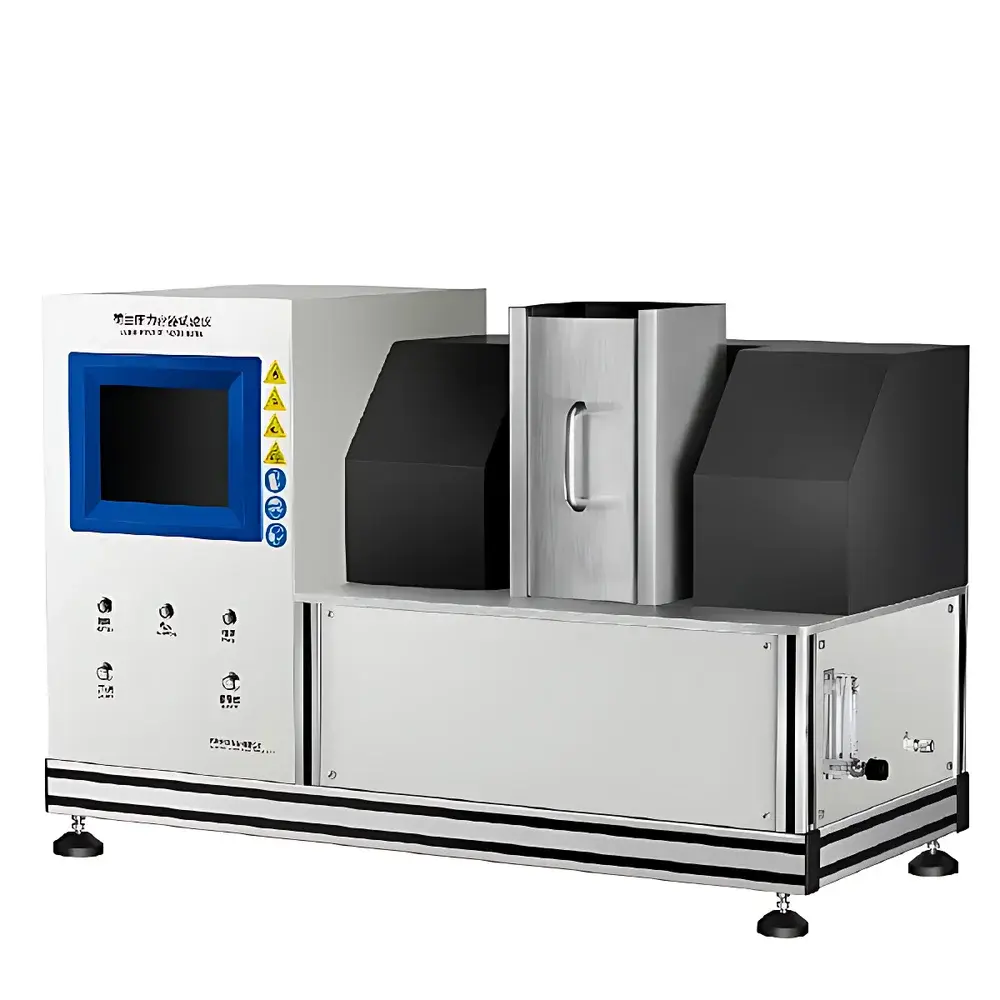
Young Instruments HWP34-10S Dutch Pressure Vessel Test Apparatus
| Brand | Young Instruments |
|---|---|
| Origin | Zhejiang, China |
| Manufacturer Type | Manufacturer |
| Country of Origin | China |
| Model | HWP34-10S |
| Price | Upon Request |
| Operating Environment | (-5–45)°C, <95% RH |
| Heating Rate | (3.5 ± 0.3) K/s |
| Vessel Internal Dimensions | Φ50 mm × 94.5 mm |
| Vessel Material | 316 Stainless Steel |
| Burst Disc Material | Aluminum Plate, Ø38 mm |
| Burst Pressure | 620 ± 60 kPa @ 22°C |
| Orifice Plate Diameters | 1.0, 2.0, 3.5, 6.0, 9.0, 12.0, 16.0, 24.0 mm |
| Orifice Plate Thickness | 2.0 ± 0.2 mm |
| Temperature Resolution | ±0.1°C |
| Temperature Sensor Response Time | 0.5 s |
Overview
The Young Instruments HWP34-10S Dutch Pressure Vessel Test Apparatus is a fully automated, CE-compliant thermal hazard assessment instrument engineered for the standardized evaluation of thermal sensitivity in self-reactive substances and organic peroxides under confined heating conditions. It implements the internationally recognized Dutch Pressure Vessel (DPV) test method—designated as Test E.2 in Section 25.4.2 of the UN Recommendations on the Transport of Dangerous Goods: Manual of Tests and Criteria. The apparatus subjects a precisely weighed sample to controlled, rapid resistive heating inside a sealed, high-strength 316 stainless steel pressure vessel (Φ50 mm × 94.5 mm internal volume), while monitoring real-time temperature rise and pressure development. When internal pressure exceeds the calibrated burst threshold of the aluminum rupture disc (620 ± 60 kPa at 22°C), the disc ruptures, releasing gases through one of eight interchangeable orifice plates (1.0–24.0 mm diameter). This controlled venting enables quantitative analysis of gas evolution kinetics, time-to-rupture, maximum pressure, and pressure rise rate—key parameters required for UN classification, transport category assignment, and process safety screening per ICH Q5C and CCPS guidelines.
Key Features
- Embedded Windows CE operating system with deterministic real-time control architecture for repeatable thermal ramp execution
- 8-inch industrial-grade capacitive touchscreen interface with intuitive workflow navigation and live dual-parameter (temperature/pressure) trend visualization
- Three operational modes: Standard Mode (pre-configured UN/GA/GB protocols), Custom Mode (user-defined heating profiles, burst thresholds, and orifice selection), and Calibration Mode (traceable heating rate verification using certified reference materials)
- Remote ignition system integrated with HD IP camera feed—enabling operator supervision from outside the blast shield enclosure without line-of-sight exposure
- Mass flow-controlled inert gas (N₂ or Ar) regulation for precise modulation of convective heat transfer and reproducible (3.5 ± 0.3) K/s heating rates
- Self-diagnostic firmware with hardware-level fault detection, audible/visual alarms, and automatic emergency cooldown initiation upon sensor anomaly or overpressure event
- Full-digital video capture synchronized with thermobaric data acquisition; MP4 recordings timestamped and indexed to experimental metadata for forensic review and audit readiness
- Automated post-test reporting: generates PDF/CSV outputs compliant with GLP documentation requirements, including raw data traces, derived metrics (Tonset, Pmax, (dP/dt)max), and pass/fail determination against UN criteria
Sample Compatibility & Compliance
The HWP34-10S accommodates solid, liquid, and paste-like samples up to 10 g mass, with compatibility validated for Class 5.2 organic peroxides (e.g., benzoyl peroxide, MEKP), Type B and C self-reactive substances (e.g., cumene hydroperoxide, azobisisobutyronitrile), and formulated mixtures containing reactive functional groups. All test configurations adhere strictly to the geometric and material specifications outlined in UN Manual of Tests and Criteria Rev.7 (2021) and GB 19521.12–2004. The 316 stainless steel pressure vessel meets ASME BPVC Section VIII Div. 1 design standards for cyclic pressure service, while the aluminum burst disc complies with ISO 4126-2:2013 requirements for rupture disc devices. Instrument validation includes IQ/OQ documentation templates aligned with FDA 21 CFR Part 11 electronic record controls and EU Annex 11 computerized system validation principles.
Software & Data Management
Data acquisition and instrument control are managed via Young Instruments’ proprietary DPV-Soft v3.2 software suite, installed on the embedded CE platform. The software enforces role-based access control (operator, supervisor, administrator), maintains full audit trails for all parameter changes and test executions, and supports digital signature capture for report approval. Exported datasets include ASCII-delimited time-series logs (sample ID, ambient T/P, vessel T/P, heating power, camera status) and structured XML metadata conforming to ASTM E2500-18 “Standard Guide for Specification, Design, and Verification of Pharmaceutical and Biopharmaceutical Manufacturing Systems.” Backups are automatically archived to encrypted internal storage and optionally mirrored to network drives via configurable SMB/CIFS protocols. Software updates are delivered via signed firmware packages with SHA-256 hash verification.
Applications
- Determination of thermal stability class (Type A–F) for organic peroxides per UN ST/SG/AC.10/11/Rev.5
- Classification of self-reactive substances under GHS Category 1–4 (H240–H242)
- Screening of reaction calorimetry surrogates for process hazard analysis (PHA) and layer-of-protection analysis (LOPA)
- Verification of thermal decomposition onset temperatures prior to DSC or ARC testing
- Regulatory submission support for REACH registration dossiers and EPA TSCA pre-manufacture notices (PMNs)
- Quality control release testing for peroxide initiators used in polymerization processes
FAQ
What standards does the HWP34-10S directly support?
It executes Test E.2 per UN Manual of Tests and Criteria (Rev.7), GB 19521.12–2004, and aligns with ASTM E2070–21 for thermal runaway screening.
Is the heating rate independently verifiable?
Yes—the built-in Calibration Mode uses NIST-traceable reference materials (e.g., potassium hydrogen phthalate) to validate ramp rate accuracy to ±0.3 K/s per ISO/IEC 17025 calibration procedures.
Can test data be exported for third-party statistical analysis?
All raw and processed data export to CSV, Excel (.xlsx), and generic ASCII formats; metadata follows ASTM E2500-18 schema for interoperability with JMP, MATLAB, or Python-based analytics pipelines.
How is operator safety ensured during burst events?
The unit operates within a Class 1 blast-resistant enclosure rated to 10 bar peak overpressure; remote ignition, real-time video monitoring, and automatic post-burst purge cycles eliminate direct handling risks.
Does the system support multi-user environments with audit compliance?
Yes—role-based permissions, electronic signatures, immutable audit logs, and 21 CFR Part 11-compliant electronic records are fully implemented in DPV-Soft v3.2.



