
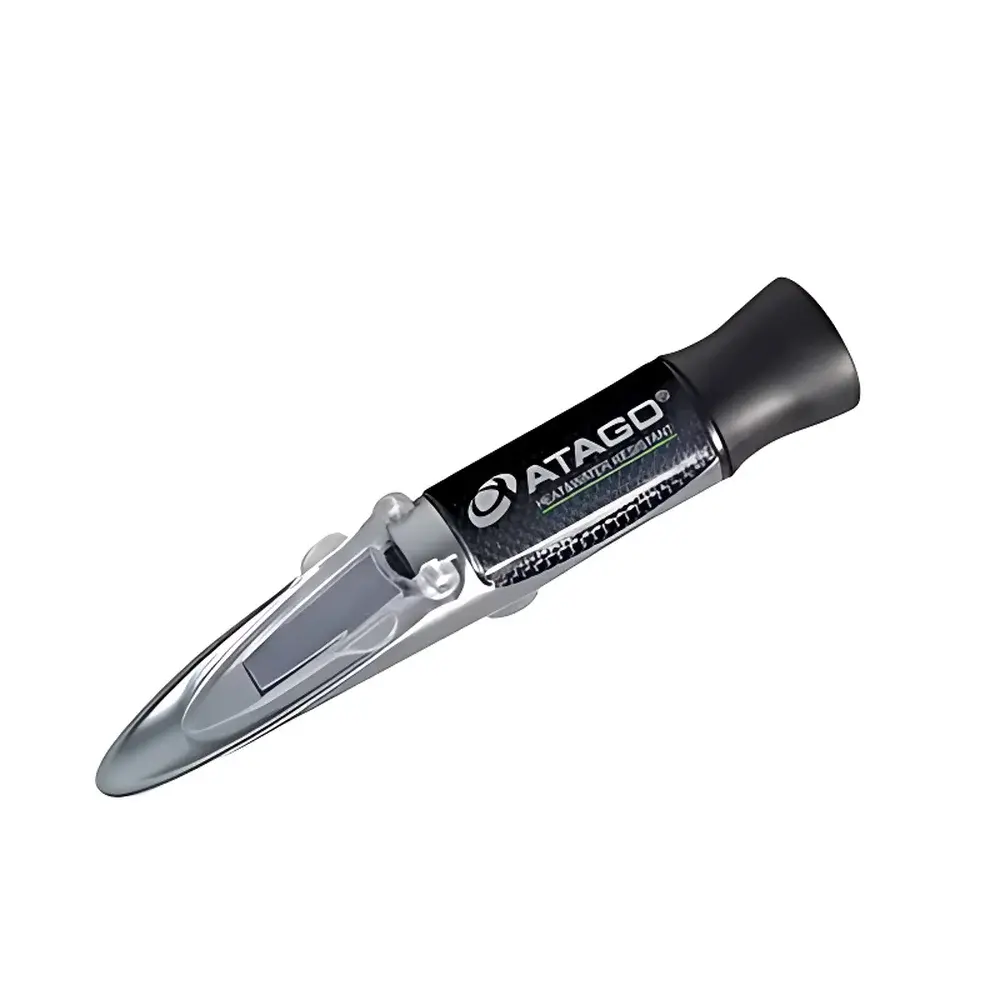
ATAGO MASTER-80H High-Temperature Analog Refractometer for Viscous Food Pastes
| Brand | ATAGO |
|---|---|
| Origin | Japan |
| Model | MASTER-80H |
| Measurement Range | 30.0–80.0% Brix (ATC) |
| Resolution | 0.5% Brix |
| Accuracy | ±0.5% Brix (±25°C ATC range) |
| Dimensions | 3.2 × 3.4 × 16.8 cm |
| Weight | 130 g |
| Instrument Type | Destructive (sample-contact refractometer) |
| Optical System | Analog scale with reinforced prism assembly |
| Temperature Compensation | Automatic (ATC), calibrated to 25°C reference |
Overview
The ATAGO MASTER-80H is a precision-engineered analog refractometer specifically designed for rapid, on-site Brix concentration measurement of high-viscosity, thermally stable food pastes—including mayonnaise, custard, jam, red bean paste, and other heated semi-solid formulations. Unlike digital or benchtop instruments requiring sample dilution or cooling, the MASTER-80H employs Abbe-type critical-angle refractometry with a thermally robust sapphire-reinforced prism, enabling direct measurement of samples at elevated temperatures up to 80°C. Its optical design complies with ISO 2173:2003 and AOAC Official Method 932.12 for refractive index-based soluble solids determination in food matrices. The instrument operates without batteries or external power, ensuring reliability in production lines, R&D kitchens, and quality control environments where portability, repeatability, and thermal stability are critical.
Key Features
- Reinforced sapphire-coated prism assembly engineered for mechanical durability and resistance to thermal shock and chemical abrasion from acidic or oily pastes
- Optimized optical path geometry for enhanced readability of viscous, low-transmittance samples—minimizing parallax error through precisely aligned ocular scale and internal illumination system
- Automatic temperature compensation (ATC) mechanism integrated into the prism block, maintaining calibration accuracy across a 10–50°C ambient operating range (±25°C deviation from 25°C reference)
- Compact handheld form factor (130 g, 16.8 cm length) with ergonomic rubberized grip for one-handed operation in humid or greasy industrial settings
- Analog scale with 0.5% Brix resolution and engraved reference markings—designed for long-term metrological stability without software drift or firmware updates
- No consumables, no calibration fluids required beyond standard sucrose reference solutions (e.g., 40.0% and 60.0% Brix certified standards)
Sample Compatibility & Compliance
The MASTER-80H is validated for direct contact measurement of non-homogeneous, high-Brix food pastes exhibiting Newtonian or mildly shear-thinning rheology. It accommodates samples with particle sizes <100 µm and oil content up to 85% w/w—common in commercial mayonnaise and emulsified sauces. Due to its destructive sampling method (requiring 0.3–0.5 mL per test), it is not suitable for sterile or ultra-low-volume applications. The instrument meets ISO/IEC 17025 traceability requirements when used with NIST-traceable sucrose standards and documented operator training. It supports GLP-compliant QC workflows when paired with paper-based logbooks recording date, operator ID, sample ID, ambient temperature, and observed Brix value—fully auditable for FDA 21 CFR Part 11-aligned documentation systems.
Software & Data Management
As an analog optical instrument, the MASTER-80H does not incorporate embedded electronics, wireless connectivity, or data logging capabilities. This architecture eliminates firmware vulnerabilities, electromagnetic interference risks, and battery-related downtime—making it ideal for use near ovens, steam tunnels, or high-EMI processing zones. All measurements are manually recorded and entered into LIMS or Excel-based QA databases. For laboratories requiring digital traceability, ATAGO recommends pairing the MASTER-80H with the PAL-α series digital refractometers (for comparative validation) or using ATAGO’s optional RS-232 interface adapters on compatible benchtop models. Calibration verification logs must be retained per ISO 9001:2015 clause 7.1.5.2 for monitoring measurement uncertainty.
Applications
- Real-time Brix verification during hot-fill jam and marmalade production (pre-canning, post-cooking)
- In-process control of emulsion stability in egg-yolk-based sauces subjected to thermal holding at 65–75°C
- Batch release testing of sweetened bean pastes (e.g., azuki, white kidney bean) prior to freezing or packaging
- R&D formulation trials involving sugar substitution (e.g., maltitol, erythritol blends) where refractive index correlates linearly with total soluble solids
- Supplier qualification audits for incoming raw materials such as concentrated fruit purees and hydrolyzed starch syrups
- Compliance checks against Codex Alimentarius STAN 212-1999 (fruit preparations) and JAS Standard No. 27 (Japanese Agricultural Standards for confectionery fillings)
FAQ
Is the MASTER-80H suitable for measuring low-viscosity liquids like fruit juice or syrup?
No. Its optical calibration and prism geometry are optimized for opaque, high-Brix pastes (30–80% Brix). For clear liquids, ATAGO recommends the PAL-1 or PR-101 series.
Does ATC compensate for sample temperature or ambient temperature?
The ATC system compensates for ambient temperature changes affecting the prism block; it assumes the sample is at thermal equilibrium with the instrument. Pre-warming the unit to process temperature improves accuracy for hot samples.
Can the prism be cleaned with acetone or ethanol?
Yes—use lint-free lens tissue and analytical-grade ethanol. Avoid chlorinated solvents or abrasive cleaners that may degrade the sapphire coating.
What is the recommended recalibration frequency?
Daily before first use when deployed in continuous production; otherwise, per shift or after exposure to extreme thermal cycling (>20°C/h change).
Is this instrument compliant with FDA or EU food safety regulations?
While the device itself is not “certified,” its measurement principle and usage protocol align with FDA Guidance for Industry: “Analytical Procedures and Methods Validation for Drugs and Biologics” and EU Regulation (EC) No 852/2004 Annex II Section II.1.1 for food processing controls.



