
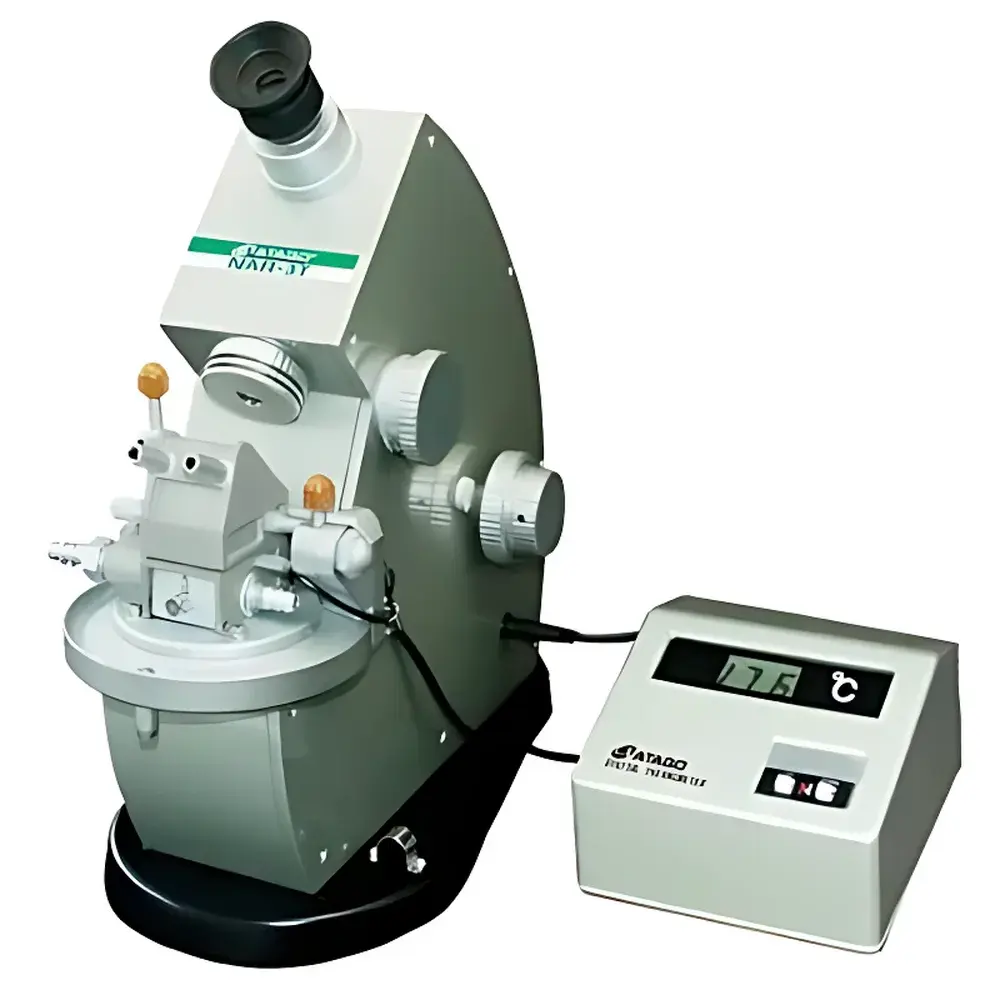
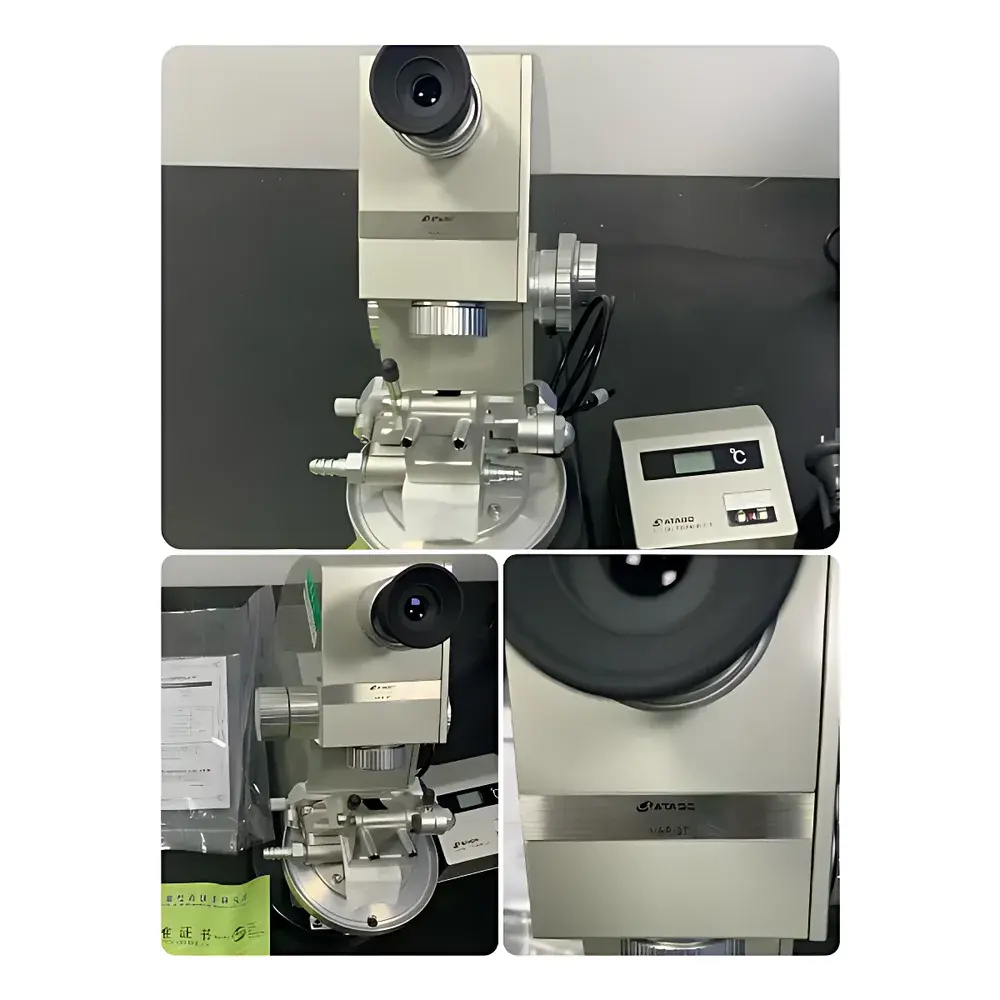
ATAGO NAR-3T High-Precision Abbe Refractometer
| Brand | ATAGO |
|---|---|
| Origin | Japan |
| Model | NAR-3T |
| Type | Benchtop Abbe Refractometer |
| Temperature Control | Yes |
| Display | Analog (Scale View) |
| Refractive Index Range | 1.30000–1.71000 |
| Brix Range | 0.00–95.00% |
| Refractive Index Accuracy | ±0.0001 |
| Brix Accuracy | ±0.05% |
| Compliance | ISO 21748, ASTM D1218, JIS K 0061 |
Overview
The ATAGO NAR-3T High-Precision Abbe Refractometer is a benchtop optical instrument engineered for accurate and repeatable measurement of refractive index (nD) and Brix concentration in transparent or translucent liquid samples—particularly suited for quality control of edible oils, including camellia oil (tea seed oil), vegetable oils, essential oils, and related lipid-based formulations. Based on the classical Abbe principle, the instrument utilizes total internal reflection at the prism-sample interface to determine the critical angle of refraction, which is directly converted into refractive index values via calibrated optical scale interpolation. Its robust mechanical design integrates a high-intensity tungsten-halogen light source and an enlarged, finely engraved analog scale optimized for visual acuity—enabling precise manual alignment without digital dependency. The NAR-3T is not a digital device; its analog readout eliminates electronic drift and ensures long-term calibration stability under laboratory or production-floor conditions where electromagnetic interference or software validation requirements may constrain digital instrumentation.
Key Features
- High-precision Abbe optical system with ±0.0001 refractive index accuracy—meeting stringent metrological requirements for ISO/IEC 17025-accredited laboratories.
- Extended refractive index range (1.30000–1.71000) accommodates low-refractive-index solvents (e.g., hexane, ethanol) and high-refractive-index viscous oils (e.g., camellia oil, castor oil, rosin derivatives).
- Integrated thermostatic sample stage compatible with external water baths (recommended operating temperature: 20 °C ±0.1 °C), ensuring thermal equilibrium per ASTM D1218 and ISO 21748 protocols.
- Dual precision adjustment knobs enable rapid coarse and fine focusing of the boundary line—minimizing operator-induced parallax error and improving inter-user reproducibility.
- Mechanically stabilized prisms (BK7 glass, polished to λ/4 surface flatness) and anti-reflective coated optics reduce stray light and enhance contrast for unambiguous endpoint detection.
- No firmware, no battery, no software dependencies—designed for GLP-compliant environments requiring audit-trail-free, hardware-only traceability.
Sample Compatibility & Compliance
The NAR-3T accepts 0.1–0.3 mL sample volumes applied directly onto the main prism surface. It is routinely validated for use with refined and unrefined edible oils—including camellia (tea seed) oil, olive oil, sunflower oil, and coconut oil—where refractive index serves as a critical indicator of purity, fatty acid composition, adulteration, and oxidative stability. The instrument conforms to international standard test methods including ASTM D1218 (Standard Test Method for Refractive Index of Petroleum Liquids), ISO 21748 (Guidance for the use of repeatability, reproducibility and trueness estimates in measurement uncertainty evaluation), and JIS K 0061 (Testing methods for refractive index of chemical products). While not electronically compliant with FDA 21 CFR Part 11, its analog architecture inherently satisfies GMP Annex 11 principles for instruments where manual recording and observer-signed logs constitute the primary data capture mechanism.
Software & Data Management
The NAR-3T operates without embedded software, firmware, or digital interfaces. All measurements are recorded manually in laboratory notebooks or LIMS-compatible log sheets. Calibration verification is performed using certified reference standards traceable to NIST SRM 1484 (water at 20 °C, nD = 1.3330) and SRM 849a (cane sugar solutions). Users maintain calibration records per ISO/IEC 17025 clause 6.4.10, documenting date, standard used, observed value, correction factor, and technician signature. No audit trail, electronic signature, or data export functionality is provided—consistent with its classification as a Class I passive optical measuring instrument under IEC 61010-1.
Applications
- Quantitative assessment of camellia oil authenticity and detection of dilution with lower-cost oils (e.g., soybean or palm olein) via refractive index deviation outside 1.464–1.472 range (typical for pure tea seed oil at 20 °C).
- In-process monitoring of degumming, neutralization, and deodorization stages in edible oil refining lines.
- Raw material acceptance testing for incoming oil batches against supplier specifications and Codex Alimentarius limits.
- Supporting AOAC Official Method 952.03 (Refractometric Determination of Total Solids in Vegetable Oils) and national standards such as GB/T 5527–2010 (China) and INAO specifications for premium-grade oils.
- Research applications in lipid oxidation kinetics, where incremental nD shifts correlate with conjugated diene formation and hydroperoxide accumulation.
FAQ
Does the NAR-3T support automatic temperature compensation (ATC)?
No. Temperature control is achieved externally via circulating water bath connected to the instrument’s thermal jacket. ATC is not implemented; users must record ambient and prism temperature separately and apply correction tables per ISO 21748 Annex B.
Can it measure opaque or highly colored oils?
It requires optically clear samples. Strongly pigmented or turbid oils (e.g., unfiltered cold-pressed varieties) must be pre-filtered through 0.45 µm PTFE membranes or centrifuged to eliminate scattering particles prior to analysis.
Is calibration verification required before each use?
Per ISO/IEC 17025 Section 6.4.8, calibration verification using at least one reference standard is recommended at the start of each analytical session—or whenever environmental conditions deviate by >±0.5 °C from nominal calibration temperature.
What prism cleaning protocol is recommended for high-viscosity oils?
Use spectroscopic-grade toluene or chloroform followed by anhydrous ethanol; avoid acetone for BK7 prisms. Wipe gently with lens tissue—not cotton swabs—to prevent micro-scratching of the optical surface.
Is the NAR-3T suitable for regulated pharmaceutical excipient testing?
Yes, for non-sterile lipid-based excipients (e.g., medium-chain triglycerides, sesame oil USP), provided refractive index is listed in the monograph and measurement follows USP guidelines for refractometers.





