
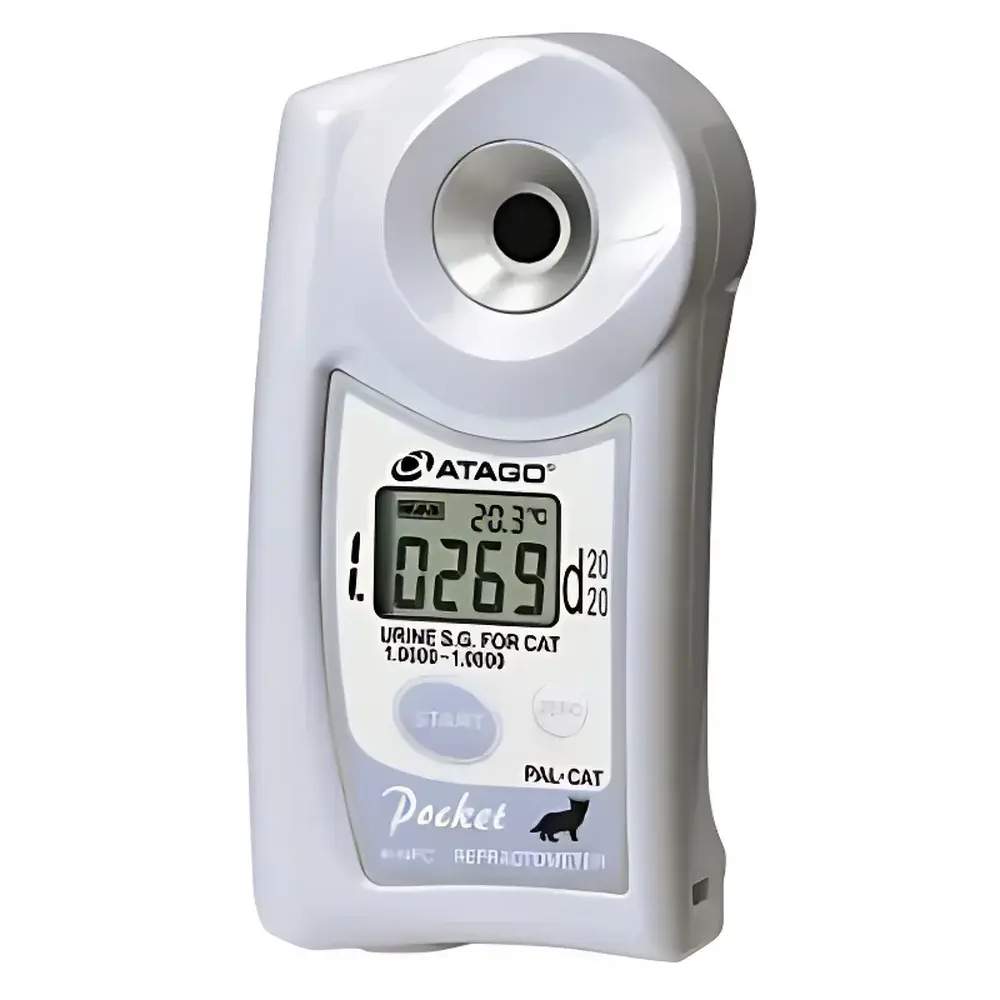
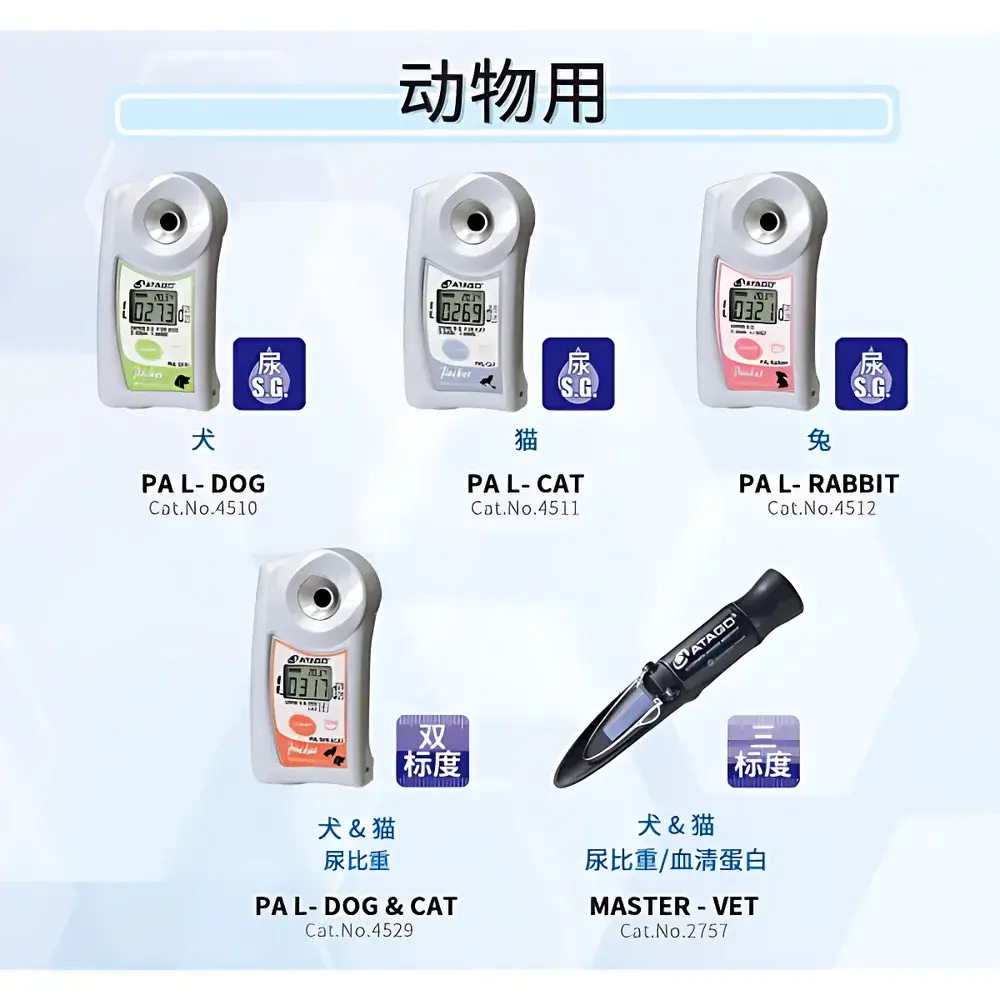
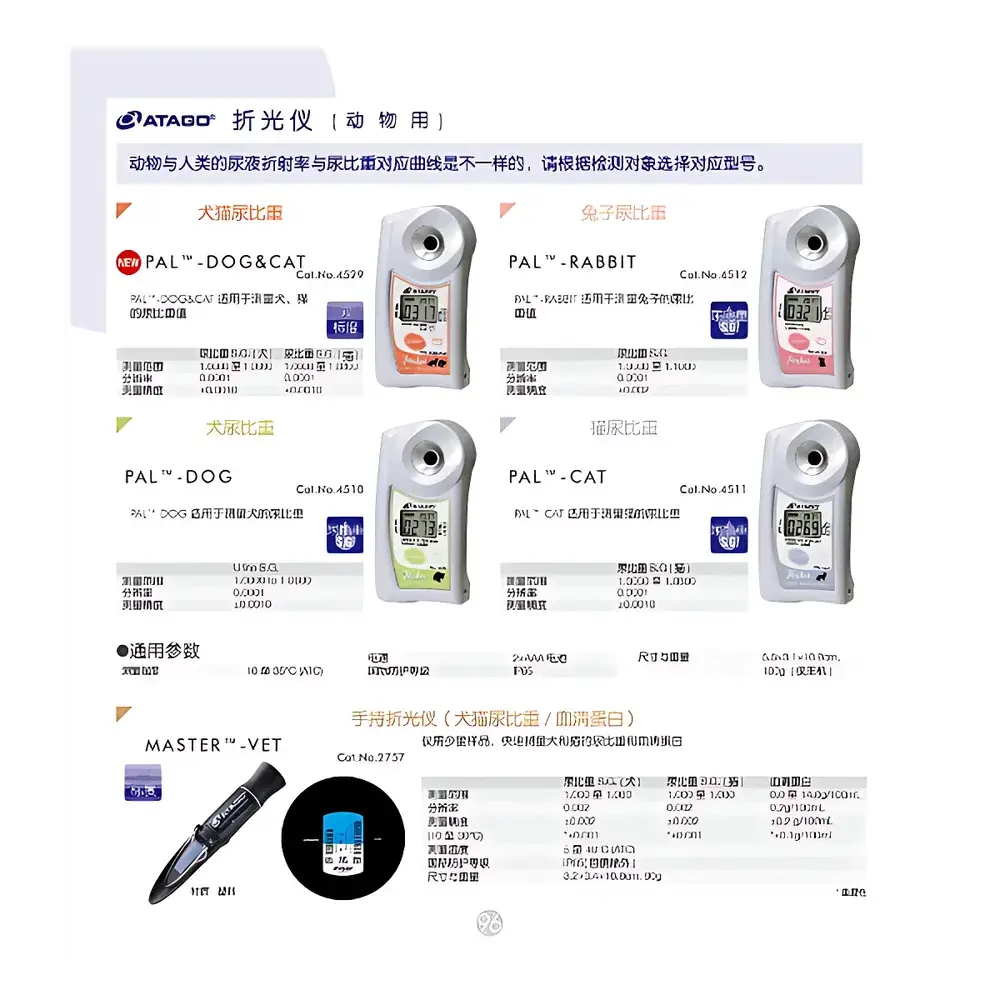
ATAGO PAL-CAT Digital Urine Specific Gravity Refractometer for Feline Urinalysis
| Brand | ATAGO |
|---|---|
| Origin | Japan |
| Model | PAL-CAT |
| Product Type | Handheld Digital Refractometer |
| Temperature Compensation | Yes (Automatic, 10–35°C) |
| Display | Digital LCD |
| Measurement Range | 1.0000–1.0800 (Urine Specific Gravity) |
| Resolution | 0.0001 |
| Accuracy | ±0.0010 |
| Measurement Time | 3 seconds |
| Power Supply | 2 × AAA batteries |
| IP Rating | IP65 |
| Dimensions | 55(W) × 31(D) × 109(H) mm |
| Weight | 100 g (instrument only) |
Overview
The ATAGO PAL-CAT Digital Urine Specific Gravity Refractometer is a purpose-engineered handheld optical instrument designed exclusively for rapid, reliable, and repeatable measurement of urine specific gravity (USG) in feline patients. It operates on the fundamental principle of critical-angle refractometry: light passing through a urine sample undergoes refraction at the prism-sample interface, with the degree of bending directly correlated to the solute concentration—primarily electrolytes, urea, and creatinine. This optical signal is converted into a precise specific gravity value using a pre-calibrated algorithm optimized for the physiological range and composition of cat urine (1.0000–1.0800). Unlike generic clinical refractometers, the PAL-CAT incorporates species-specific calibration derived from empirical correlation between refractive index and USG in feline urine matrices, minimizing systematic bias associated with high-protein or acidic/alkaline samples. Its compact, ergonomic design and robust mechanical architecture make it suitable for daily use in veterinary clinics, mobile practice units, and shelter-based triage settings where portability, speed, and contamination control are essential.
Key Features
- Species-optimized optical calibration for accurate feline urine specific gravity determination across the clinically relevant range (1.0000–1.0800)
- Automatic temperature compensation (ATC) over 10–35°C, eliminating manual correction and ensuring measurement stability under variable ambient conditions
- Digital LCD display with 0.0001 resolution and ±0.0010 accuracy—meeting ISO 11541 and CLSI EP10-A3 guidelines for point-of-care urinalysis instrumentation
- IP65-rated enclosure provides protection against dust ingress and low-pressure water jets, supporting rigorous cleaning protocols between patient uses
- 3-second measurement cycle enables high-throughput screening during wellness exams or acute renal assessments
- Battery-powered operation (2 × AAA) ensures uninterrupted functionality without dependency on mains power or docking stations
- Ergonomic form factor (55 × 31 × 109 mm; 100 g) facilitates one-handed operation and minimizes operator fatigue during extended clinical sessions
Sample Compatibility & Compliance
The PAL-CAT accepts native, uncentrifuged feline urine specimens (minimum volume: 0.3 mL). It is compatible with fresh, refrigerated, or room-temperature samples but not recommended for frozen-thawed specimens due to potential crystal precipitation affecting optical homogeneity. The instrument complies with IEC 61010-1 for electrical safety and meets EN 60529 requirements for ingress protection (IP65). While not classified as an IVD device under EU IVDR 2017/746, its performance characteristics align with CLIA-waived testing criteria when used within defined operational parameters. Data output adheres to GLP documentation standards when integrated into laboratory information management systems (LIMS) via manual entry; audit trails and electronic records require external software validation per FDA 21 CFR Part 11.
Software & Data Management
The PAL-CAT operates as a standalone, firmware-based measurement system with no onboard data logging, Bluetooth, or USB connectivity. All readings are displayed in real time on the integrated LCD screen and must be manually recorded. This architecture intentionally avoids digital storage to eliminate cybersecurity vulnerabilities, simplify regulatory alignment in non-CLIA-certified environments, and ensure deterministic response latency. For practices requiring traceable documentation, ATAGO recommends pairing the PAL-CAT with validated LIMS templates or paper-based logbooks that capture operator ID, sample ID, date/time stamp, and measured USG—supporting ISO 15189 and CAP accreditation requirements for manual result transcription workflows.
Applications
- Routine wellness screening to assess renal concentrating ability in geriatric or chronically ill cats
- Monitoring therapeutic response in patients receiving diuretics, fluid therapy, or nephrotoxic medications
- Differentiating prerenal azotemia (elevated USG) from renal failure (isosthenuria, USG ~1.008–1.012) or post-renal obstruction
- Supporting diagnosis of diabetes insipidus, hyperthyroidism, and chronic kidney disease (CKD) staging per IRIS guidelines
- Field-based triage in multi-cat households or rescue operations where rapid hydration status assessment is critical
- Quality assurance in diagnostic laboratories performing concurrent urinalysis and sediment evaluation
FAQ
Is the PAL-CAT calibrated for canine urine as well?
No—the PAL-CAT’s optical calibration curve is empirically derived from feline urine samples and is not validated for dogs, rabbits, or other species. For canine applications, ATAGO recommends the PAL-10S or PAL-α models.
Can the PAL-CAT measure urine protein or glucose?
No—it measures only specific gravity via refractometry. Quantitative analysis of protein, glucose, ketones, or pH requires dedicated dipstick readers or benchtop analyzers.
What maintenance is required to ensure long-term accuracy?
Daily cleaning of the prism surface with lens tissue and distilled water is mandatory. Annual recalibration by an ATAGO-authorized service center is recommended to maintain traceability to NIST-traceable reference standards.
Does the instrument require user training prior to clinical deployment?
Yes—ATAGO provides standardized operator qualification protocols covering sample application technique, interpretation of error codes (e.g., “LO” for low volume), and recognition of environmental interference (e.g., condensation on prism). Documentation of competency is advised per JCAHO and AAHA standards.




