
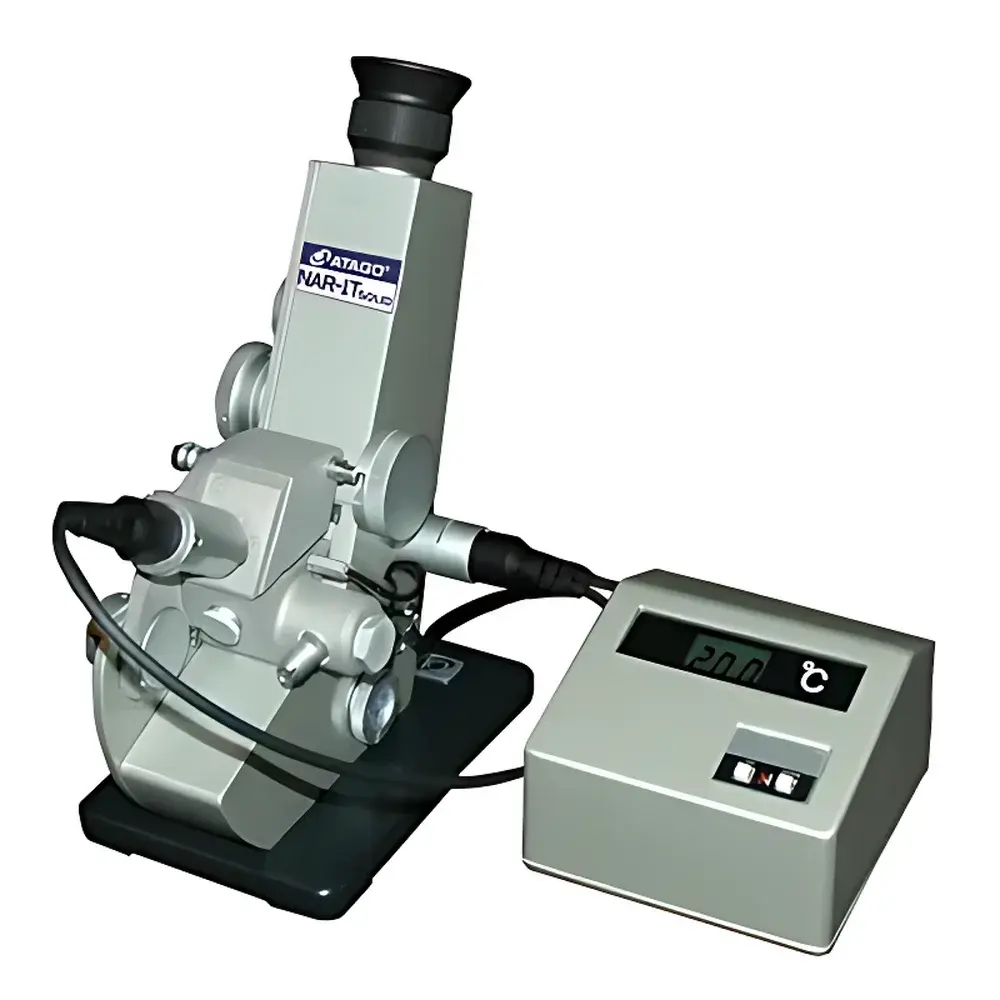
ATAGO NAR-1T SOLID Abbe Refractometer Model 1212
| Origin | Japan |
|---|---|
| Manufacturer Type | Authorized Distributor |
| Origin Category | Imported |
| Model | NAR-1T SOLID (1212) |
| Price | Upon Request |
| Refractive Index (nD) Range | 1.3000–1.7000 |
| Brix Range | 0.0–95.0% |
| nD Resolution | 0.001 |
| Brix Resolution | 0.5% |
| nD Accuracy | ±0.0002 |
| Brix Accuracy | ±0.1% |
| Temperature Display Range | 0.0–50.0°C (Accuracy: ±0.2°C |
| Resolution | 0.1°C) |
| Measurement Temp. Range | 0–50°C |
| Light Source | LED |
| Power Supply | 115/220/240 V, 50/60 Hz |
Overview
The ATAGO NAR-1T SOLID Abbe Refractometer (Model 1212) is a precision optical instrument engineered for high-reproducibility refractive index (nD) and Brix measurements of both transparent solids and homogeneous liquids. Based on the classical Abbe principle—utilizing critical angle measurement at the interface between a high-refractive-index prism and the sample—the instrument delivers traceable, temperature-compensated results compliant with ISO 21748, ASTM D1218, and JIS K 0061 standards. Its robust mechanical design, sealed optical path, and LED-based illumination ensure long-term stability in laboratory, QC, and educational environments. Unlike conventional handheld or analog Abbe refractometers, the NAR-1T SOLID integrates digital temperature sensing, automatic zero-point calibration logic, and dual-scale readout (nD and %Brix), enabling direct quantification of total soluble solids (TSS) in dairy products—including milk, whey, and condensed milk—without dilution or empirical conversion.
Key Features
- Dual-mode measurement capability: optimized for solid samples (e.g., polymer films, glass substrates, crystalline lenses) and liquid samples (e.g., milk, syrups, brines, glycol solutions) using interchangeable prism assemblies (RE-1104 main prism and RE-1111 auxiliary prism).
- High-precision digital temperature control: integrated Pt100 sensor (±0.2°C accuracy) with real-time compensation algorithm ensures nD values are reported at standardized 20°C, meeting GLP documentation requirements.
- Extended optical range: nD from 1.3000 to 1.7000 supports characterization of low-index dairy emulsions and high-index thermoplastics (e.g., PMMA, polycarbonate) without prism replacement.
- LED light source (RE-1171): eliminates filament degradation, provides consistent spectral output at 589.3 nm (sodium D-line equivalent), and complies with IEC 62471 photobiological safety classification.
- Compliance-ready interface: supports external water bath circulation (via standard 6-mm tubing ports) for ISO 1042-conformant thermal equilibration during extended measurements.
Sample Compatibility & Compliance
The NAR-1T SOLID accommodates flat, polished solid specimens ≥10 mm × 10 mm × 1 mm thickness and liquids ≥0.5 mL volume. For milk and dairy-derived samples, surface homogeneity is maintained via optional RE-1498 film-mounting adapter, preventing scattering from fat globule interfaces. All measurements adhere to AOAC Official Method 932.12 (for Brix in dairy products) and USP refractometry guidelines. The instrument’s metrological traceability is validated through factory calibration using certified reference materials: NIST-traceable sucrose standards (RE-110010, RE-110030, RE-110050) and monobromonaphthalene (RE-1196) for nD verification across the full range. Optional polarizing eyepiece (RE-1145) enables birefringence screening of anisotropic solids per ISO 11431.
Software & Data Management
While the NAR-1T SOLID operates as a standalone benchtop instrument, its analog voltage output (0–5 V DC, proportional to nD) permits integration into LIMS or SCADA systems via optional DAQ modules. All displayed parameters—including real-time temperature, nD, Brix, and calculated dispersion (nF–nC)—are logged manually per GLP record-keeping protocols. Calibration history, operator ID, and environmental conditions (room temp/humidity) must be documented externally; the unit itself retains no internal memory to comply with FDA 21 CFR Part 11 audit-trail requirements for non-electronic records. Certificate of Calibration (CoC) includes uncertainty budget per GUM (JCGM 100:2018) and is supplied with each unit.
Applications
- Quantification of total solids in raw and processed milk (including ultrafiltered and lactose-reduced variants) per IDF Standard 11A:2020.
- Quality assurance of transparent packaging polymers (PET, PS, PC) during extrusion and thermoforming processes.
- Verification of optical adhesive refractive index matching in display manufacturing (LCD/OLED module assembly).
- Educational demonstration of dispersion relations and Cauchy equation fitting in undergraduate physics laboratories.
- In-process monitoring of sugar concentration in whey permeate streams during membrane separation operations.
FAQ
Can the NAR-1T SOLID measure undiluted whole milk directly?
Yes—its high dynamic range and anti-scatter prism geometry allow direct measurement without centrifugation or filtration, provided the sample surface is clean and free of air bubbles.
Is temperature control mandatory for dairy analysis?
Yes. Milk refractive index varies by ~0.0001 per 0.5°C; the built-in sensor and optional water bath coupling ensure compliance with ISO 5725 repeatability criteria.
How often should calibration verification be performed?
Before each analytical session when used for regulatory reporting; daily for routine QC per ISO/IEC 17025 Clause 7.7.
Does the instrument support measurement of opaque or turbid liquids?
No—it requires optically homogeneous, translucent samples; turbid milks must be clarified via centrifugation or microfiltration prior to analysis.
Are calibration standards included with shipment?
No—certified sucrose solutions (RE-110010/30/50) and prism cleaning kits (RE-1195, RE-1197) are optional accessories ordered separately.




