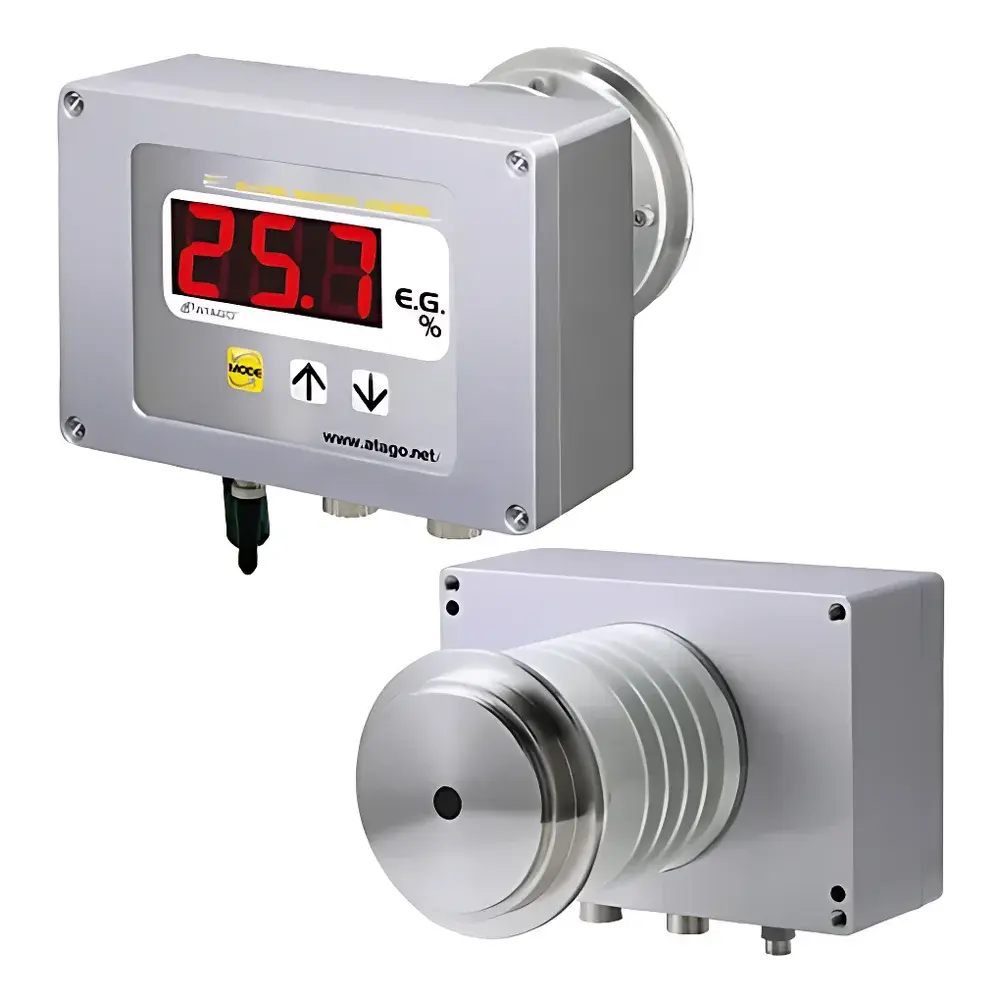
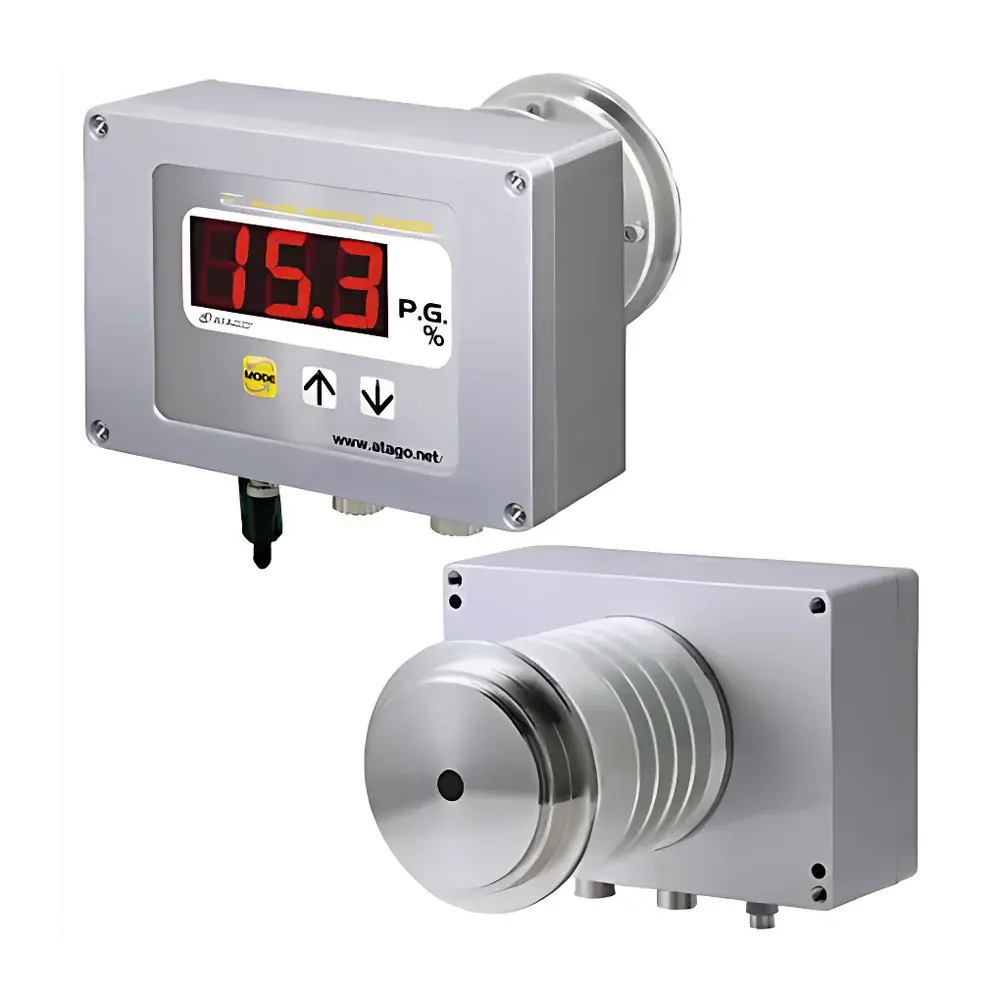
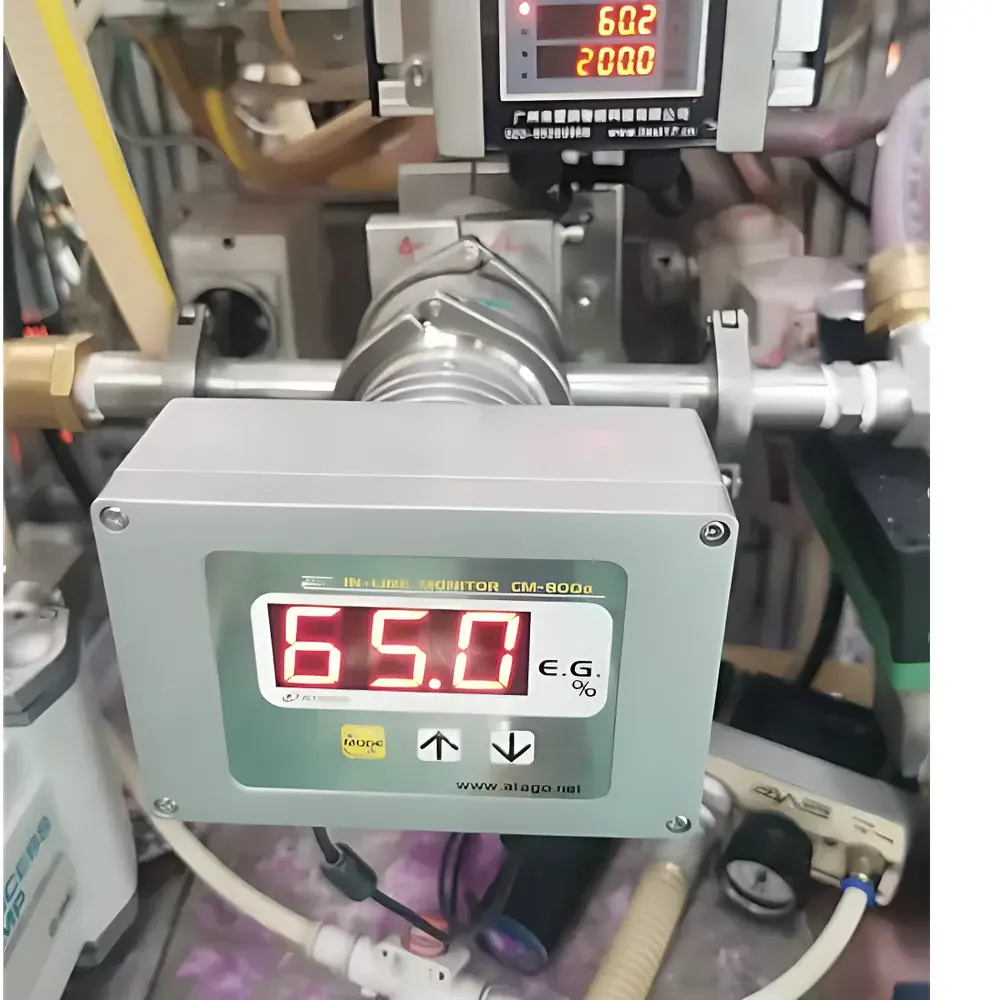
ATAGO CM-800α-EG Online Ethylene Glycol Concentration Meter
| Brand | ATAGO |
|---|---|
| Origin | Japan |
| Model | CM-800α-EG |
| Measurement Principle | Refractometry |
| Output Signals | 4–20 mA analog + RS-232C digital |
| Installation Type | In-line or wall-mounted on pipe/tank |
| Compliance | Designed for industrial process environments per IEC 61000-6-2/6-4 EMC standards |
| Enclosure Rating | IP65 (standard) |
| Operating Temperature | 0–60 °C (process fluid), –10–50 °C (ambient) |
| Material Contact | SS316L prism and wetted parts |
| Calibration Support | Factory-calibrated for ethylene glycol/water solutions |
Overview
The ATAGO CM-800α-EG Online Ethylene Glycol Concentration Meter is an industrial-grade refractometer engineered for continuous, real-time monitoring of ethylene glycol (EG) concentration in aqueous coolant and antifreeze formulations. It operates on the fundamental optical principle of refractometry: measuring the refractive index (RI) of a liquid medium as a function of its solute concentration. Within the EG–water binary system, RI exhibits a monotonic, highly reproducible relationship with mass percentage over the operational range of 0–60% w/w — enabling precise, non-invasive concentration determination without sample extraction or chemical reagents. The instrument integrates a temperature-compensated sapphire prism sensor directly into process lines or tank walls, eliminating manual sampling, reducing operator intervention, and ensuring measurement stability under dynamic flow conditions. Its robust architecture supports uninterrupted 24/7 operation in demanding manufacturing and automotive coolant blending environments.
Key Features
- High-stability sapphire prism sensor with SS316L housing, resistant to corrosion from glycol-based fluids and cleaning agents
- Integrated Peltier temperature control and high-precision RTD sensing for automatic real-time temperature compensation (±0.1 °C resolution)
- Dual-output interface: isolated 4–20 mA analog signal (HART-compatible) for PLC/DCS integration and RS-232C serial port for configuration, diagnostics, and data logging
- Modular mounting design supporting flanged (DN25–DN50), sanitary clamp (Tri-Clamp®), and welded pad options — compliant with ASME B16.5 and DIN 11851 standards
- Zero and span calibration accessible via onboard keypad or PC-based ATAGO RefractoLink™ software, supporting multi-point verification per ISO 5725 guidelines
- Self-diagnostics including prism fouling detection, signal integrity monitoring, and sensor drift alerting — configurable via alarm relay output
Sample Compatibility & Compliance
The CM-800α-EG is validated for use with ethylene glycol–water mixtures across the full industrial concentration range (0–60% w/w), including formulations containing common additives such as corrosion inhibitors, dyes, and pH buffers. It is not intended for use with strongly oxidizing agents (e.g., nitric acid), hydrocarbon solvents, or suspensions containing >5 µm particulates. The device conforms to electromagnetic compatibility requirements per IEC 61000-6-2 (immunity) and IEC 61000-6-4 (emissions), and meets mechanical safety standards per IEC 60529 (IP65 ingress protection). While not certified for hazardous area installation (e.g., ATEX/IECEx), it may be deployed in Zone 2 environments when installed with appropriate barrier systems. Documentation supports traceability per ISO/IEC 17025 laboratory quality management frameworks.
Software & Data Management
Configuration, calibration, and historical data review are managed through ATAGO’s RefractoLink™ PC software (Windows 10/11 compatible), which provides audit-trail logging compliant with FDA 21 CFR Part 11 requirements — including electronic signatures, user access levels, and immutable change records. Raw RI and temperature values, along with calculated EG concentration, are timestamped and exportable in CSV or Excel format. The 4–20 mA output is scalable to match DCS historian tags, enabling seamless integration with PI System, Ignition SCADA, or Siemens Desigo CC platforms. Optional Modbus RTU firmware upgrade (CM-800α-EG-MB) supports direct communication with Allen-Bradley ControlLogix or Schneider EcoStruxure systems.
Applications
- Real-time concentration control during automotive antifreeze blending operations in OEM and Tier-1 coolant manufacturing facilities
- In-process monitoring of EG-based heat transfer fluids in HVAC chiller plants and data center cooling loops
- Quality assurance in pharmaceutical clean steam generator feedwater systems where glycol traces must remain below 10 ppm
- Batch consistency verification in battery electrolyte additive preparation lines (e.g., Li-ion thermal management fluids)
- Preventive maintenance support by trending long-term sensor drift and correlating with maintenance logs for predictive prism cleaning schedules
FAQ
What is the measurement uncertainty of the CM-800α-EG under standard operating conditions?
Typical repeatability is ±0.1% w/w EG at 20 °C; overall system uncertainty (including temperature compensation and calibration drift) is ±0.25% w/w over 6 months with quarterly verification.
Can the same unit measure propylene glycol (PG) concentration?
No — the CM-800α-EG is factory-calibrated specifically for ethylene glycol/water. For PG applications, the dedicated CM-800α-PG model must be used due to differing refractive index–concentration curves.
Is field recalibration possible without returning the unit to ATAGO?
Yes — zero and span adjustments can be performed in situ using certified EG reference standards (e.g., NIST-traceable 10%, 30%, and 50% w/w solutions) and RefractoLink™ software.
Does the device support automatic temperature compensation for non-standard fluid velocities?
Yes — the integrated RTD and Peltier system maintains prism surface temperature within ±0.2 °C regardless of flow rate (0.1–3 m/s) or ambient fluctuation, ensuring RI stability per ASTM D1152 specifications.
How is prism fouling detected and reported?
The instrument continuously monitors signal-to-noise ratio and baseline RI offset; deviations exceeding user-defined thresholds trigger relay alarms and diagnostic flags in RefractoLink™, indicating potential coating or scaling.
Related Products