
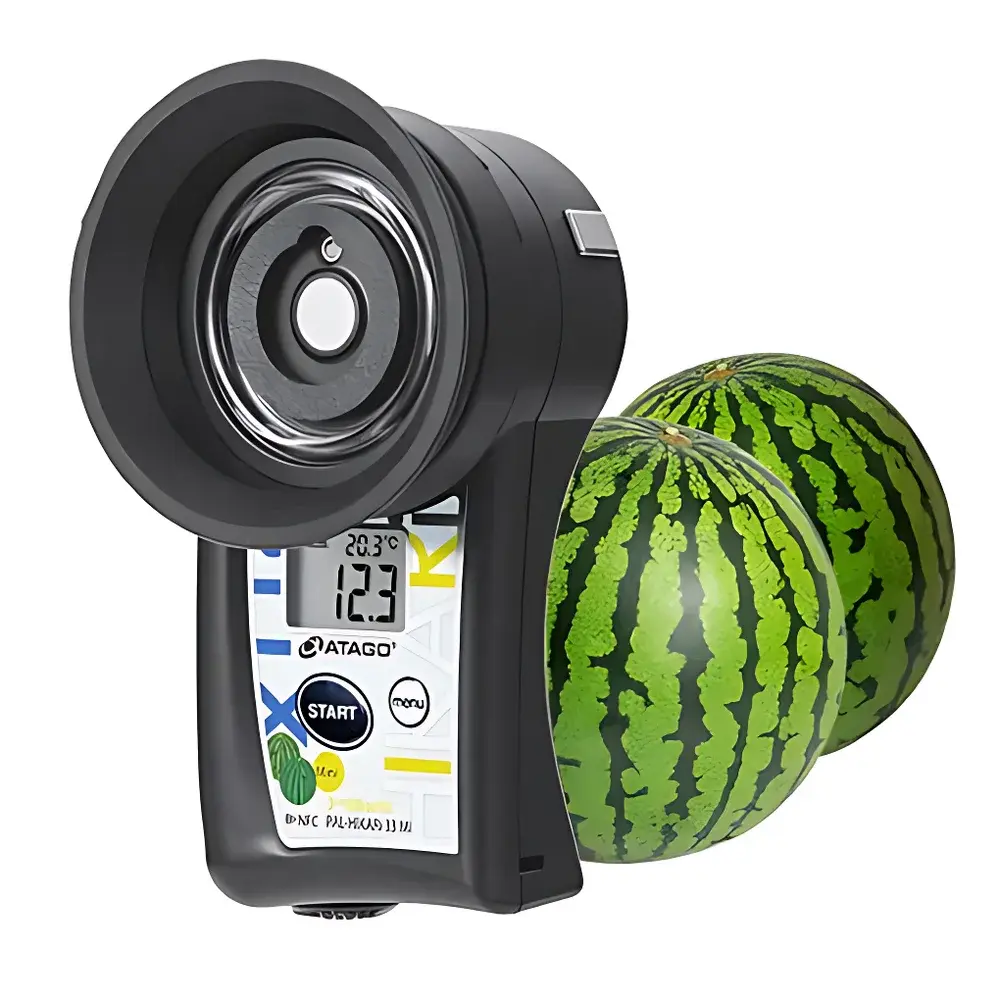
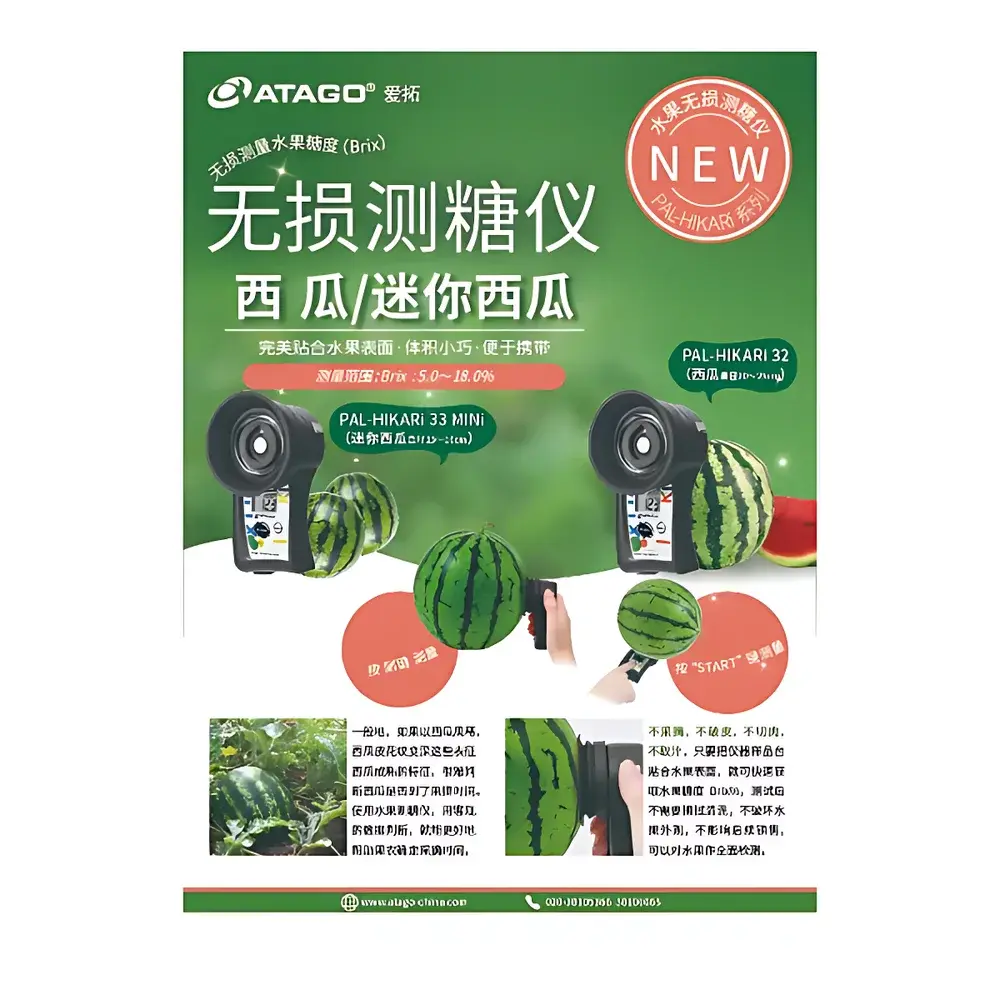
ATAGO PAL-HIKARi 33 MINi Non-Destructive Portable Refractometer for Mini Watermelon
| Brand | ATAGO |
|---|---|
| Origin | Japan |
| Model | PAL-HIKARi 33 MINi |
| Instrument Type | Non-Destructive |
| Measurement Principle | Near-Infrared (NIR) Reflectance |
| Measuring Range | Brix 5.0–18.0% |
| Accuracy | ±2.0% Brix (varies by fruit variety and ambient conditions) |
| Resolution | 0.1% Brix |
| Automatic Temperature Compensation | 10.0–40.0°C |
| IP Rating | IP64 |
| Power | 2× AAA alkaline batteries |
| Dimensions | 6.1×4.4×11.5 cm |
| Weight | 115 g (host only) |
| Target Sample | Mini watermelon (diameter 13–16 cm) |
| Compliance | Designed for field-deployable GLP-aligned routine monitoring |
Overview
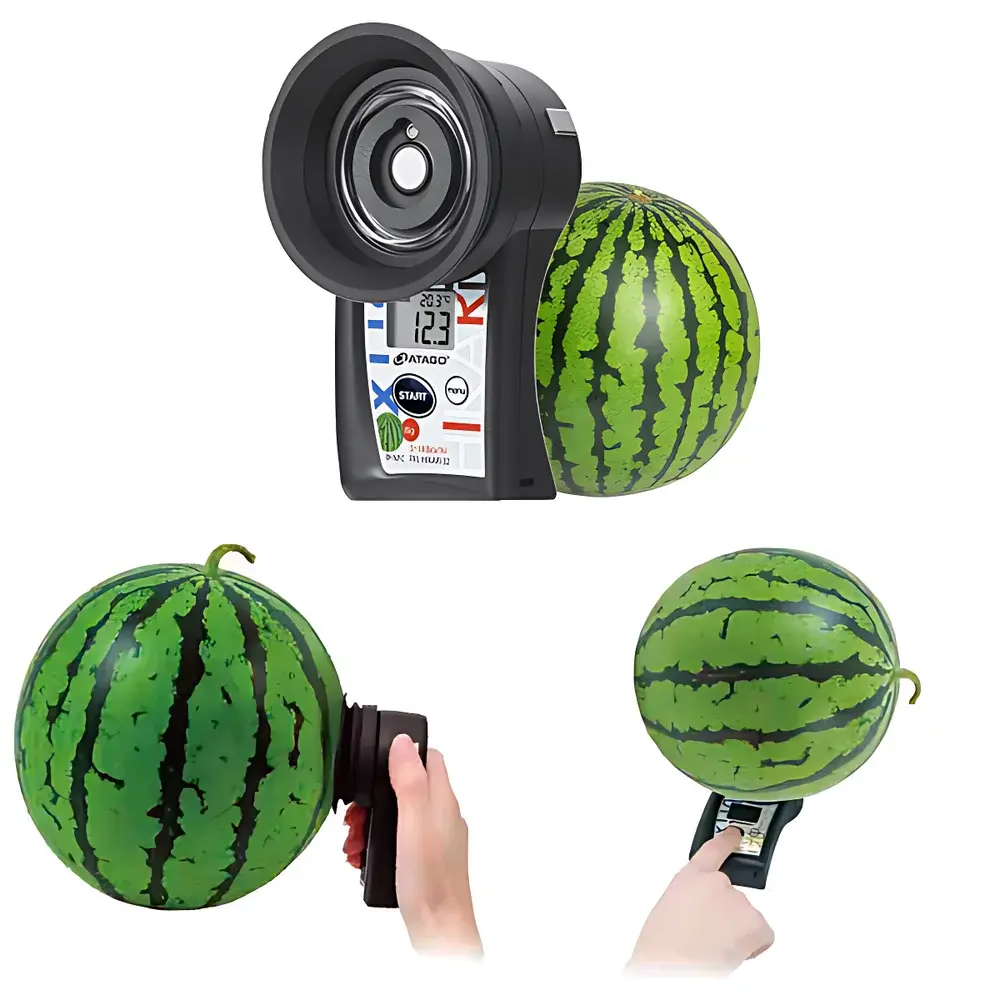
The ATAGO PAL-HIKARi 33 MINi is a handheld, non-destructive near-infrared (NIR) refractometer engineered specifically for in-situ Brix measurement of mini watermelons (13–16 cm diameter). Unlike conventional destructive methods requiring juice extraction or tissue homogenization, this instrument operates on the principle of NIR reflectance spectroscopy: a calibrated infrared light source emits photons into the fruit’s epidermis; the spectral signature of backscattered radiation—modulated by soluble solids concentration—is captured by an integrated photodetector array and converted to Brix (%) via a factory-validated multivariate regression model. The device is not a contactless scanner but requires firm, consistent optical coupling via its proprietary soft silicone gasket—ensuring minimal air-gap interference and reproducible path-length geometry. Its compact architecture (115 g), low-power design (2× AAA), and IP64-rated enclosure enable reliable operation in orchard, packinghouse, cold storage, and distribution center environments—without compromising measurement traceability or operator safety.
Key Features
- True non-destructive analysis: No fruit puncture, slicing, or juice expression required—preserves marketability and enables longitudinal tracking of individual fruits.
- Dedicated optical interface: Patented compressible silicone gasket conforms to curved surfaces of mini watermelons, minimizing ambient light intrusion and positional variability.
- Rapid quantification: Stable Brix reading displayed within ≤3 seconds after probe contact; real-time digital output with 0.1% resolution.
- Integrated temperature compensation: Automatic correction across 10.0–40.0°C operational range—critical for field measurements where fruit surface temperature fluctuates.
- Robust field usability: IP64-rated housing resists dust ingress and incidental water splashing; ergonomic side-button layout supports one-handed operation on ladders or uneven terrain.
- Statistical functionality: On-device averaging of up to 10 consecutive measurements—reducing intra-fruit heterogeneity bias and improving repeatability.
Sample Compatibility & Compliance
The PAL-HIKARi 33 MINi is validated exclusively for mini watermelons with diameters between 13 and 16 cm. Its optical calibration accounts for typical rind thickness, flesh density, and chlorophyll absorption profiles of this cultivar group. While not intended for regulatory compliance testing per se, the instrument supports Good Agricultural Practice (GAP) and Good Manufacturing Practice (GMP)-aligned quality workflows—including harvest readiness assessment, post-harvest ripening profiling, and pre-distribution grading. Data generated are suitable for internal SOP documentation and can be referenced against ASTM D7929 (Standard Guide for Use of Handheld Refractometers in Fruit Quality Assessment) and ISO 2173:2003 (Fruit and vegetable products — Determination of soluble solids content — Refractometric method), though users must validate correlation to destructive reference methods for their specific growing conditions and cultivars.
Software & Data Management
The PAL-HIKARi 33 MINi operates as a standalone field instrument with no Bluetooth, USB, or cloud connectivity. All data remain stored locally on the device display only—no memory buffer or export capability is provided. This architecture prioritizes simplicity, battery longevity (>5,000 measurements per battery set), and immunity to firmware vulnerabilities or network dependencies. For traceable recordkeeping, users are advised to log readings manually or integrate with external digital notebooks compliant with FDA 21 CFR Part 11 requirements (e.g., electronic signatures, audit trails) when used in regulated supply chains. ATAGO provides calibration verification protocols and traceable NIST-traceable standard solutions (Brix 5.0%, 10.0%, 15.0%) for periodic performance checks.
Applications
- Harvest timing optimization: Monitoring Brix accumulation curves across developmental stages to identify optimal picking windows for sweetness consistency.
- Varietal screening: Comparing sugar accumulation kinetics among experimental mini watermelon lines under controlled irrigation or fertilization regimes.
- Post-harvest logistics: Verifying sugar stability during cold chain transport and short-term storage—detecting premature senescence or chilling injury.
- Quality assurance at receiving docks: Rapid lot-level screening prior to repacking or retail distribution—supporting grade-based pricing per USDA or national fruit standards.
- Educational & extension use: Demonstrating non-destructive phenotyping principles in horticultural science curricula and grower training programs.
FAQ
Is the PAL-HIKARi 33 MINi suitable for standard-sized watermelons or other fruits?
No. It is optically and algorithmically calibrated solely for mini watermelons (13–16 cm diameter). Using it on larger melons, apples, or grapes introduces unquantified systematic error due to differences in scattering depth, rind-to-flesh ratio, and spectral absorption coefficients.
Does the device require annual recalibration by ATAGO or an authorized service center?
While no mandatory recalibration schedule exists, ATAGO recommends verification against certified Brix standards at least quarterly—or before critical harvest periods—to ensure continued accuracy alignment with destructive reference methods.
Can measurements be affected by surface moisture or wax coatings?
Yes. Excess surface water, condensation, or commercial wax films attenuate NIR signal penetration. Users must wipe the measurement site dry and avoid coated fruits unless wax type and thickness have been validated against the instrument’s calibration matrix.
What is the expected service life of the NIR LED source?
The near-infrared emitter is rated for ≥100,000 actuations under normal usage conditions—equivalent to approximately 5 years of daily field operation at 50 measurements per day.
How does temperature compensation function in practice?
The built-in thermistor measures fruit surface temperature at the point of contact; the microprocessor applies a polynomial correction factor derived from empirical Brix–temperature–variety datasets collected during factory validation—distinct from simple linear offset correction.




