
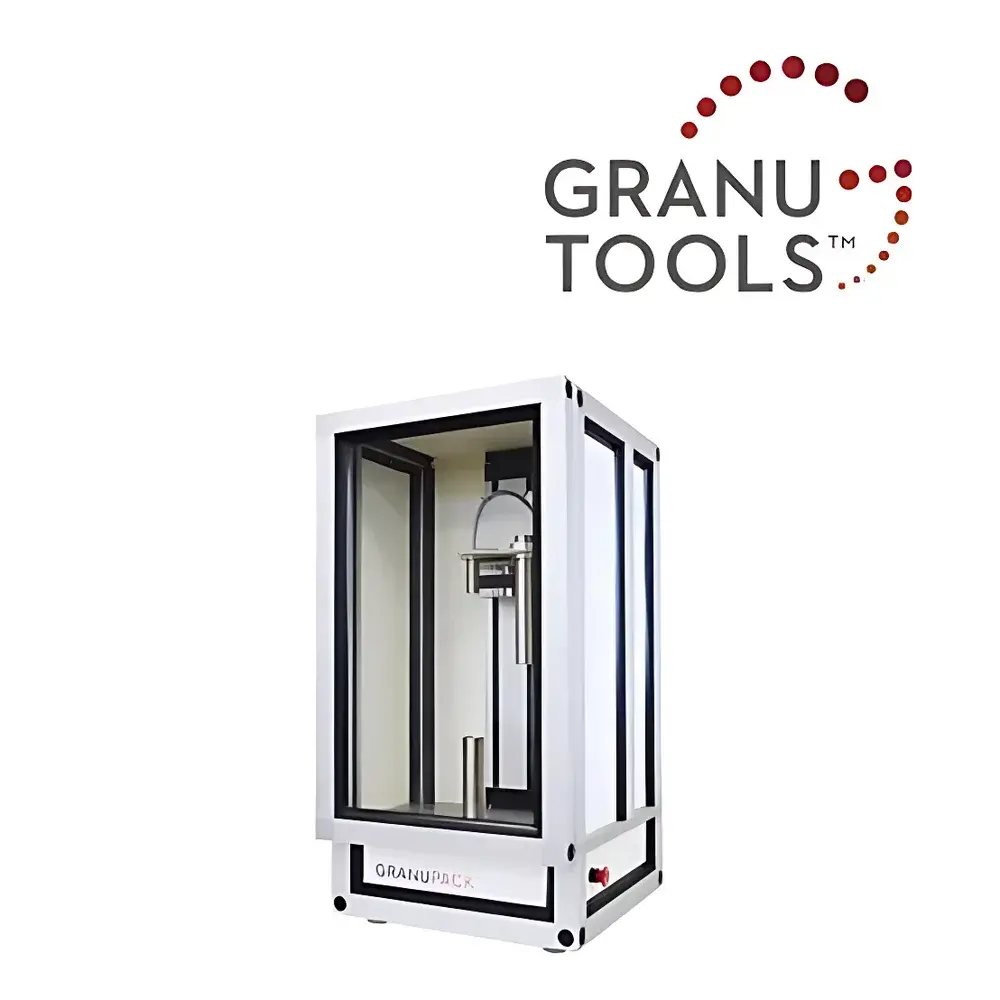
Granutools Granupack Automated Tap Density Analyzer
| Brand | Granutools |
|---|---|
| Origin | Belgium |
| Model | Granupack |
| Sample Capacity | 40 mL (max), 10 mL (min) |
| Measurable Parameters | Bulk Density, Tapped Density, Hausner Ratio, Compaction Curve |
| Measurement Accuracy | ±0.4% for metallic powders, ±0.6% for pharmaceutical excipients |
| Drop Height Options | ΔZ = 1 mm or 3 mm |
| Compliance | European Pharmacopoeia (Ph. Eur. 2.9.34) |
Overview
The Granutools Granupack is an automated, precision-engineered tap density analyzer designed for the quantitative characterization of powder compressibility and flow behavior through standardized mechanical tapping. Unlike manual or semi-automated methods, the Granupack implements a rigorously controlled free-fall compaction protocol grounded in fundamental granular mechanics—specifically, the analysis of powder bed height evolution under repeated, reproducible impacts. Each tap cycle consists of lifting the sample tube to a fixed vertical displacement (ΔZ = 1 mm or 3 mm) followed by a controlled free fall onto a rigid base, simulating industrially relevant consolidation dynamics. Real-time height measurement after every tap enables construction of a high-resolution compaction curve (h vs. tap number), from which bulk density (ρ₀), tapped density (ρₜ), Hausner ratio (Hr = ρₜ/ρ₀), and asymptotic maximum density (ρ∞) are derived with traceable uncertainty. The system’s metrological foundation aligns with Ph. Eur. 2.9.34 “Determination of apparent density and tap density of powders”, ensuring regulatory acceptability in pharmaceutical development and quality control environments.
Key Features
- Fully automated sample initialization and tapping sequence—eliminating operator-induced variability in fill level, tube handling, and visual volume estimation.
- High-precision linear encoder-based height measurement (resolution < 1 µm) ensures density calculation accuracy of ±0.4% for metallic powders and ±0.6% for pharmaceutical excipients.
- Controlled drop-height configuration (1 mm or 3 mm) allows method tailoring for sensitive or highly cohesive materials without mechanical shock artifacts.
- Integrated lightweight hollow cylinder maintains planar powder–air interface during tapping—critical for minimizing surface irregularity and improving inter-laboratory reproducibility.
- Stainless-steel sample tube (40 mL capacity; minimum 10 mL fill volume) with quick-release mechanism for rapid cleaning and cross-contamination prevention.
- Compact footprint and optional enclosure integration support safe operation in ISO Class 5–8 cleanrooms and GMP-compliant laboratories.
Sample Compatibility & Compliance
The Granupack accommodates dry, free-flowing to moderately cohesive powders across pharmaceutical, chemical, metallurgical, and additive manufacturing sectors. It supports routine testing of active pharmaceutical ingredients (APIs), excipients (e.g., microcrystalline cellulose, lactose monohydrate), metal powders (e.g., Ti-6Al-4V, SS316L), and ceramic precursors. All measurements comply with European Pharmacopoeia monograph 2.9.34 and are compatible with USP and ASTM D4781–22 standards for apparent and tapped density determination. The system supports GLP/GMP data integrity requirements via electronic audit trails, user access controls, and 21 CFR Part 11–compliant software modules (available as optional upgrade).
Software & Data Management
The Granupack Control Suite provides real-time visualization of compaction curves, automatic parameter extraction (ρ₀, ρₜ, Hr, n₁/₂, ρ∞), and statistical reporting per ICH Q5A and Q5C guidelines. Raw height-time datasets are stored in vendor-neutral CSV and XML formats, enabling third-party analysis in MATLAB, Python, or JMP. Batch reports include instrument ID, operator credentials, environmental conditions (temperature/humidity logging optional), calibration status, and digital signatures. SOP templates can be embedded and enforced per test sequence, ensuring method consistency across shifts and sites. Data export supports LIMS integration via HL7 or RESTful API interfaces.
Applications
- Differentiation of powder lots based on compressibility profiles—critical for root cause analysis of tablet weight variation or capping in high-speed compression.
- Early-stage formulation screening: correlating Hr and n₁/₂ values with die filling performance and compact tensile strength.
- Process validation support for roller compaction and direct compression unit operations.
- Regulatory submission packages requiring Ph. Eur.-aligned density metrics for drug product registration (e.g., CMC sections of IND/MAA dossiers).
- Research into powder rheology–structure relationships, particularly where interparticle forces dominate densification kinetics.
FAQ
What standards does the Granupack comply with?
The Granupack meets the requirements of Ph. Eur. 2.9.34 and is compatible with USP , ASTM D4781–22, and ISO 3953:2015 for tap density measurement.
Can it measure very small sample quantities?
Yes—the standard 40 mL tube accepts minimum fills of 10 mL; optional low-volume tubes (down to 5 mL) are available for precious or highly potent compounds.
Is calibration traceable to national standards?
Calibration kits include NIST-traceable stainless steel reference cylinders and certified density standards; full calibration documentation follows ISO/IEC 17025 principles.
How is data integrity ensured for regulated environments?
With optional 21 CFR Part 11 software, the system provides electronic signatures, immutable audit trails, role-based permissions, and encrypted database storage.
Does the Granupack provide insight beyond basic density values?
Yes—it delivers kinetic parameters (e.g., n₁/₂, ρ∞) that reflect powder compressibility mechanisms, enabling predictive modeling of powder behavior in downstream processing equipment.



