
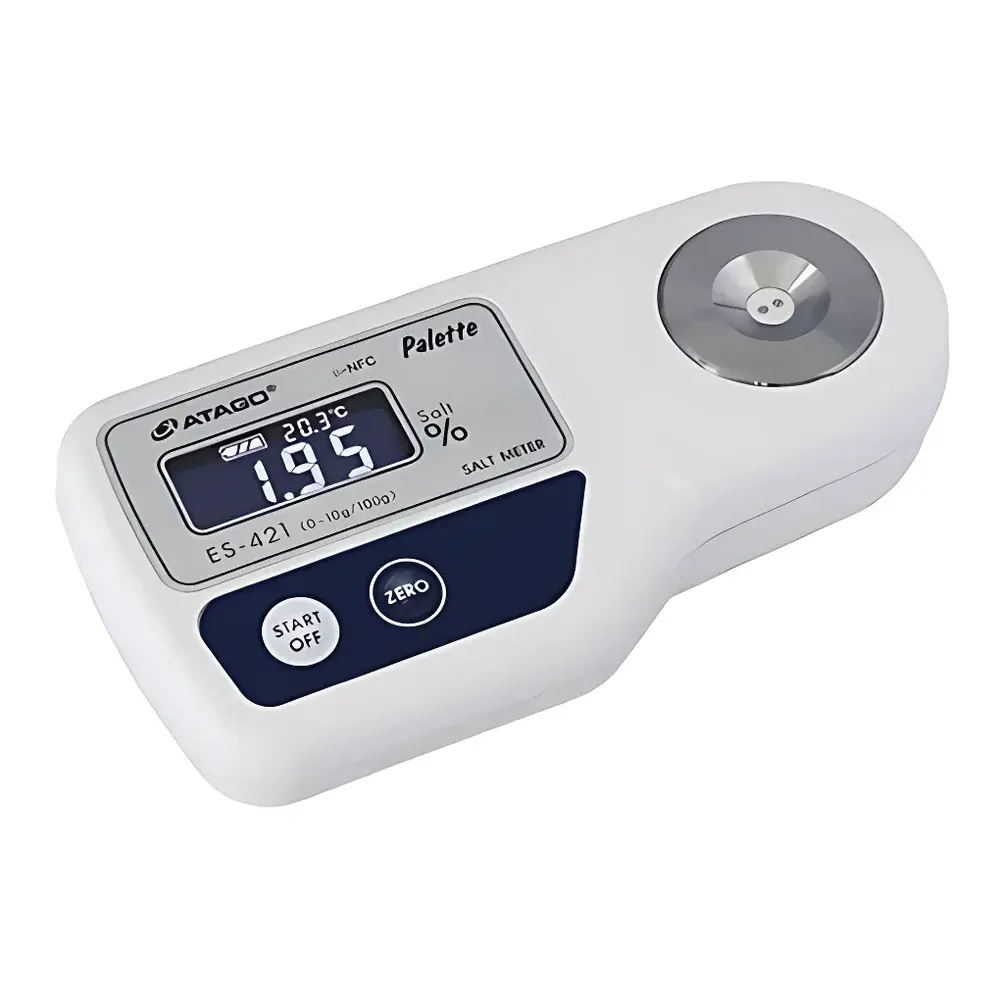
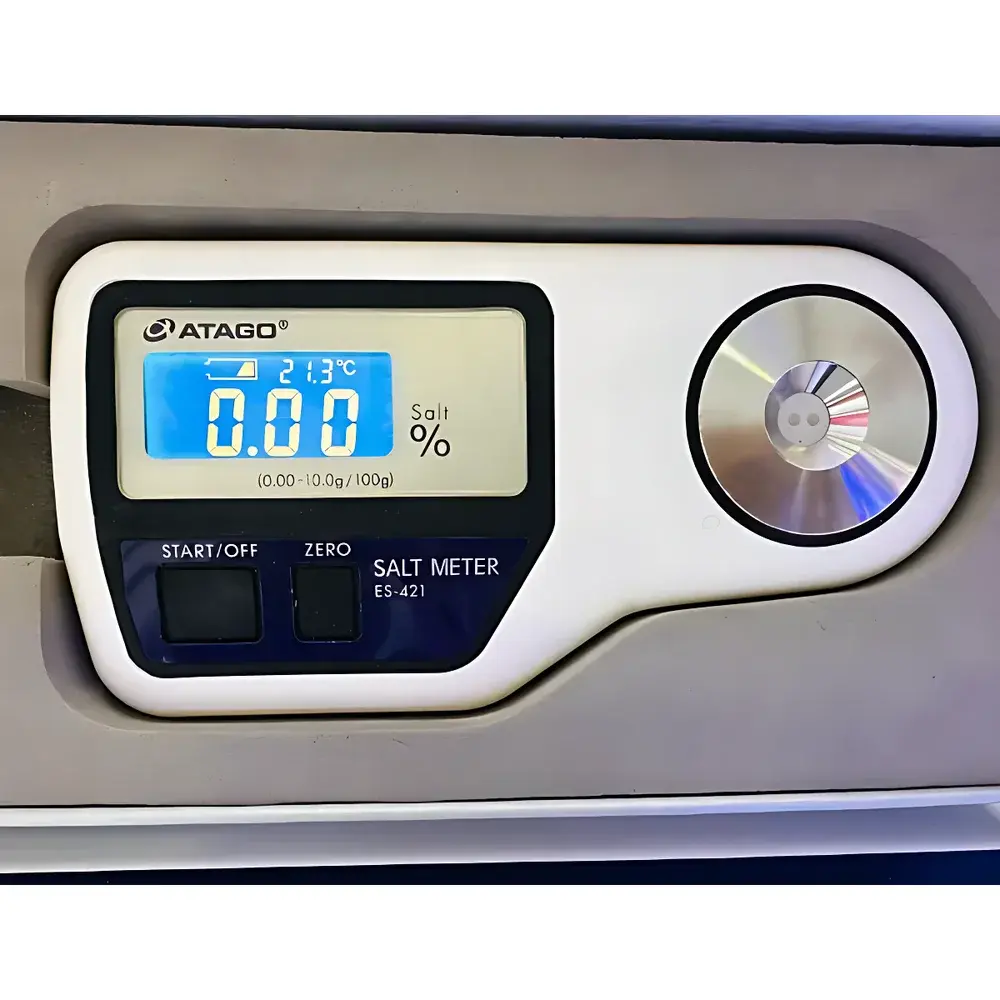
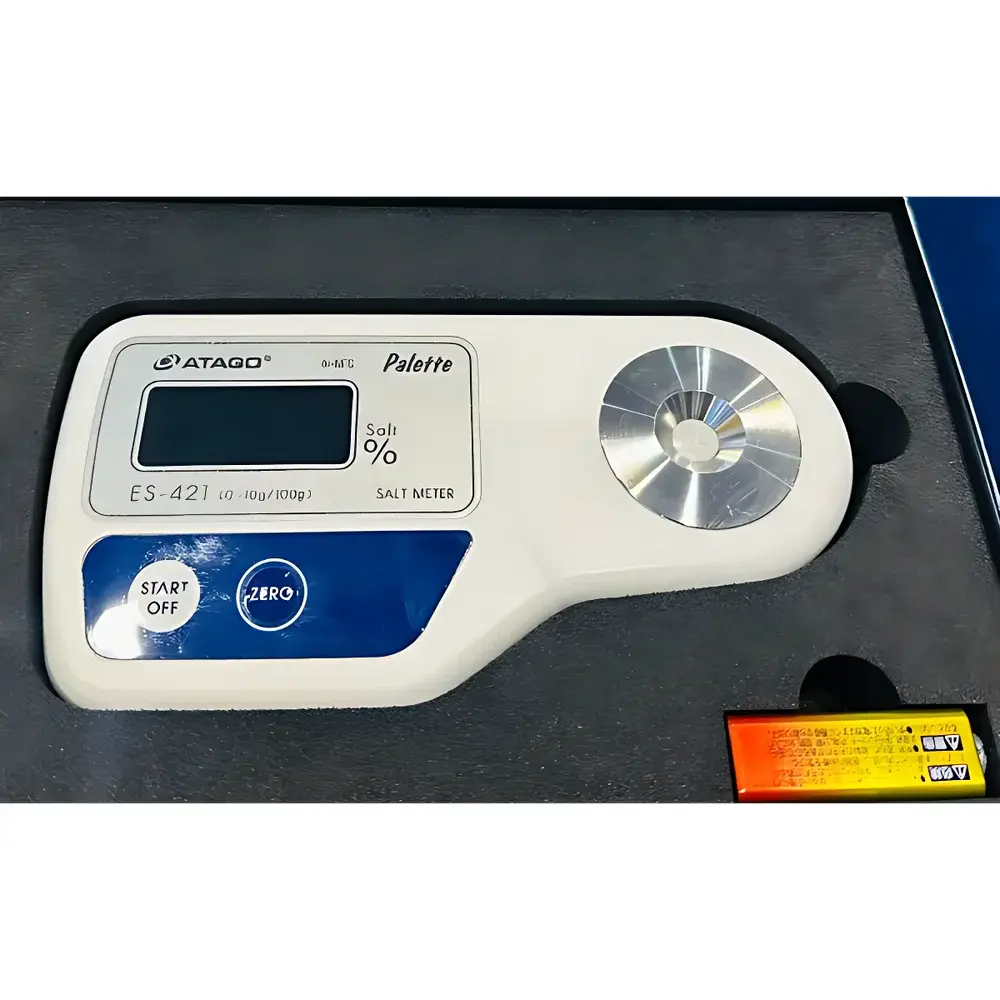
ATAGO ES-421 Digital Salinometer
| Brand | ATAGO |
|---|---|
| Origin | Japan |
| Model | ES-421 |
| Measurement Principle | Conductivity-based Salt Concentration Detection |
| Display | Full-digit LCD |
| Water Resistance | IP65-rated housing |
| Sample Volume | < 0.1 mL |
| Operating Temperature Range | 10–40 °C |
| Calibration | Air-zero function |
| Compliance | CE-marked, conforms to JIS Z 8401 (Accuracy of Measurement) |
Overview
The ATAGO ES-421 Digital Salinometer is a compact, handheld conductivity-based instrument engineered for rapid, field-deployable salt concentration measurement in aqueous solutions. Unlike optical refractometers, the ES-421 employs a two-electrode conductometric principle: it applies an alternating current across platinum-coated electrodes immersed in the sample, measures the resulting conductance, and converts the signal—via factory-calibrated algorithms—to sodium chloride (NaCl) equivalent concentration (wt%). This method ensures reliable quantification across variable temperature conditions when used within its specified operating range (10–40 °C), with automatic temperature compensation (ATC) integrated into the firmware. The device is optimized for routine quality control in environments where portability, robustness, and repeatability are critical—particularly in food processing lines, catering operations, and on-site food safety verification.
Key Features
- Conductivity-driven measurement architecture with dual platinum electrodes for stable, low-drift readings
- Full-digit LCD display with high-contrast backlight for legibility under ambient or low-light conditions
- IP65-rated enclosure ensuring protection against dust ingress and water jets—enabling direct rinsing under running tap water after measurement
- Air-zero calibration function eliminating need for zero-standard solutions; performed via dry electrode contact prior to each use
- Minimal sample requirement (< 0.1 mL) reduces waste and accelerates throughput in high-volume testing scenarios
- Integrated temperature sensor with automatic compensation (ATC) referenced to 25 °C, compliant with ISO 2173:2003 guidelines for salt determination in foodstuffs
- Battery-powered operation (2 × AAA batteries, ~10,000 measurements per set) with auto-power-off after 5 minutes of inactivity
Sample Compatibility & Compliance
The ES-421 is validated for use with homogeneous aqueous solutions containing NaCl as the dominant electrolyte—including brines, marinades, soups, sauces, dairy whey, and processed seafood effluents. It is not suitable for non-aqueous media, highly viscous suspensions, or samples containing significant concentrations of non-NaCl ions (e.g., KCl-rich pickling solutions), which may introduce systematic bias due to differing ionic mobilities. The instrument complies with JIS Z 8401:2019 (Guidelines for Accuracy of Measurement) and meets CE marking requirements for electromagnetic compatibility (EMC Directive 2014/30/EU) and low-voltage safety (LVD Directive 2014/35/EU). While not FDA 21 CFR Part 11–certified as a standalone system, its output supports GLP-compliant documentation when paired with external logging procedures.
Software & Data Management
The ES-421 operates as a standalone, embedded-system instrument without onboard data storage or Bluetooth/Wi-Fi connectivity. All measurements are displayed in real time and must be manually recorded or transcribed. For traceable quality records, users commonly integrate the device into existing LIMS or paper-based QC workflows using standardized test forms aligned with HACCP prerequisite programs. Optional accessories include a protective silicone sleeve (ATAGO Part No. S-ES421) and certified reference standards (0.5%, 5.0%, and 10.0% NaCl w/w) traceable to NIST SRM 999b for periodic verification.
Applications
- Real-time salinity verification during brine preparation in meat curing and fish fermentation facilities
- In-line monitoring of soy sauce, miso, and fish sauce fermentation tanks to ensure consistent ionic strength
- On-site validation of seasoning blends and curry base formulations where NaCl content directly impacts microbial stability and flavor release kinetics
- Food service QA checks for soup stock concentration, pickling solution consistency, and ready-to-eat meal compliance with national sodium labeling thresholds
- Educational laboratory use for teaching fundamental principles of electrolytic conductivity and colligative property relationships
FAQ
Does the ES-421 measure total dissolved solids (TDS) or only NaCl-equivalent salinity?
It reports NaCl-mass-fraction concentration (wt%) derived from conductivity; it does not provide generalized TDS values unless calibrated specifically for a known ionic composition.
Can the device be used for seawater analysis?
No—seawater contains multiple ions (Mg²⁺, Ca²⁺, SO₄²⁻) that deviate significantly from NaCl-specific calibration; use of marine-specific salinometers (e.g., based on UNESCO 1983 algorithm) is required.
How often should air-zero calibration be performed?
Before each measurement session and whenever ambient temperature shifts by >5 °C or electrode contamination is suspected.
Is cleaning solution required after measuring viscous or protein-rich samples?
Rinsing with deionized water followed by gentle blotting suffices; avoid abrasive cloths or organic solvents that may degrade electrode coating.
What is the measurement uncertainty under standard conditions?
±0.1% NaCl (k = 2) at 25 °C for samples within 0.1–12.0% range, per ATAGO’s internal type-test report TR-ES421-2022.




