
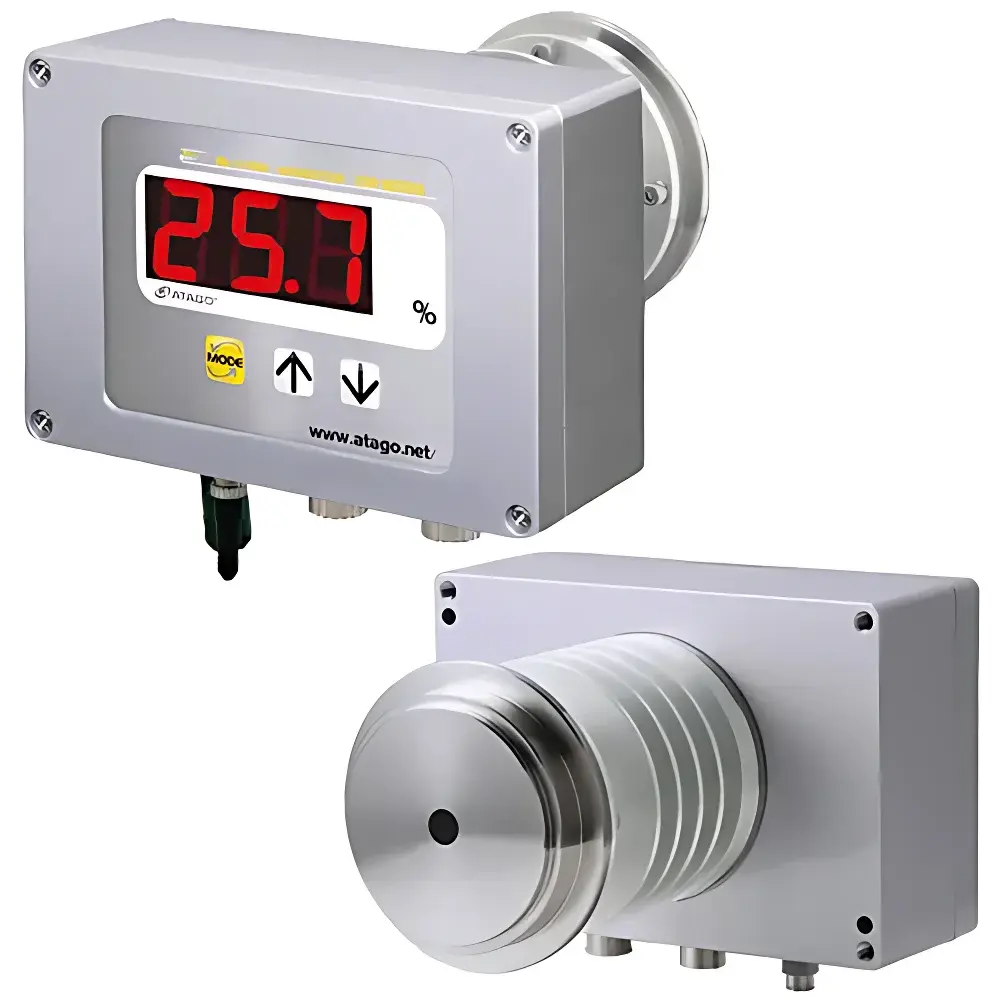
ATAGO CM-800α-H2O2 In-line Refractometer for Hydrogen Peroxide Concentration Monitoring
| Brand | ATAGO |
|---|---|
| Origin | Japan |
| Model | CM-800α-H2O2 |
| Product Type | In-line Refractometer |
| Measurement Range | 0.0–50.0% (w/w) H₂O₂ with Automatic Temperature Compensation (ATC) |
| Accuracy | ±0.6% (w/w) |
| Resolution | 0.2% (w/w), 1°C/°F |
| Temperature Measurement Range | −15 to 160°C |
| ATC Range | 10–35°C |
| Ambient Operating Temperature | 5–40°C |
| Measurement Interval | ~1 second (configurable up to 5 preset intervals) |
| Output | DC 4–20 mA and RS-232C |
| Light Source | LED (approximating sodium D-line, 589 nm) |
| Prism Material | Synthetic Sapphire |
| Body Material | SUS316L Stainless Steel |
| IP Rating | IP67 |
| Dimensions | 160 × 167 × 110 mm |
| Weight | 2.4 kg |
| Power Supply | DC 24 V (AC 100 V optional via AD-32 adapter) |
Overview
The ATAGO CM-800α-H2O2 is a purpose-engineered in-line refractometer designed for continuous, real-time monitoring of hydrogen peroxide (H₂O₂) concentration in aqueous solutions across industrial liquid processing lines. It operates on the principle of critical-angle refractometry: as light passes from a high-refractive-index sapphire prism into the process fluid, the angle at which total internal reflection occurs correlates directly with the solution’s refractive index—and, by calibration, with its mass concentration (w/w %). This optical method enables non-invasive, reagent-free measurement without flow interruption or sample extraction. Unlike offline titration or spectrophotometric methods, the CM-800α-H2O2 delivers stable, drift-resistant readings under dynamic process conditions—ideal for sterilization validation, pharmaceutical clean-in-place (CIP) rinse monitoring, bioreactor feed control, and chemical synthesis where precise H₂O₂ dosing is critical to reaction yield and safety.
Key Features
- High-stability synthetic sapphire prism (Mohs hardness 9) resistant to abrasion, corrosion, and thermal shock—ensuring long-term optical integrity in aggressive oxidizing environments.
- SUS316L wetted parts compatible with ISO 8536-4 and USP material requirements for pharmaceutical-grade fluid contact surfaces.
- Automatic Temperature Compensation (ATC) algorithm calibrated across 10–35°C ambient range, correcting refractive index shifts caused by thermal expansion without requiring external PT100 probes.
- Dual-output interface: isolated 4–20 mA analog signal for PLC/DCS integration and RS-232C digital communication for configuration, diagnostics, and raw refractive index (nD) data export.
- IP67-rated enclosure enabling direct mounting on L-type or straight-pipe configurations in washdown-prone areas (e.g., food & beverage, pharma, semiconductor wet benches).
- Configurable measurement interval (1 s default; five user-selectable settings) supporting both high-speed feedback loops and low-bandwidth archival logging.
Sample Compatibility & Compliance
The CM-800α-H2O2 is validated for use with aqueous H₂O₂ solutions ranging from 0.0 to 50.0% w/w—covering common industrial concentrations used in disinfection (3–6%), etching (27–35%), and polymerization initiators (up to 50%). It is not intended for organic solvent mixtures, viscous suspensions, or opaque emulsions that scatter incident light. The device complies with IEC 61000-6-2 (EMC immunity) and IEC 61000-6-4 (EMC emission) standards. Its construction meets FDA-recommended criteria for equipment used in GMP-regulated environments, including traceable material certifications (EN 10204 3.1) and surface roughness ≤0.8 µm Ra on wetted stainless steel. While not intrinsically safe, it may be deployed in Zone 2 classified areas when installed per IEC 60079-14 guidelines.
Software & Data Management
Configuration and diagnostics are performed via ASCII-command protocol over RS-232C using standard terminal software (e.g., Tera Term, PuTTY). The unit supports factory-default or user-defined calibration curves stored in non-volatile memory. All output data—including concentration, temperature, refractive index, and status flags—are time-stamped and transmitted synchronously with the selected measurement interval. When integrated into SCADA or MES platforms, the 4–20 mA signal can be mapped to alarm thresholds (e.g., low-concentration deviation >±1.5%) triggering automated valve actuation or batch hold protocols. Audit trails are maintained externally via host system logging; while the instrument itself does not embed 21 CFR Part 11-compliant electronic signatures, its deterministic output behavior and hardware write-protection align with ALCOA+ principles for data integrity in GLP/GMP workflows.
Applications
- Real-time verification of H₂O₂ concentration during pharmaceutical CIP cycle rinse phases to ensure residual oxidant removal prior to product contact surfaces.
- Continuous feed control in semiconductor wafer cleaning lines where 30% H₂O₂/H₂SO₄ (Piranha) mixture consistency directly impacts oxide removal rate and particle generation.
- Monitoring of sterilant concentration in vaporized hydrogen peroxide (VHP®) generator supply lines to maintain validated bioburden reduction efficacy (per ISO 14644-3 Annex B).
- Quality gate enforcement in contract manufacturing of disinfectant formulations, reducing reliance on off-line titration and associated sampling variability.
- Process analytical technology (PAT) deployment per ICH Q8(R2), enabling multivariate correlation of refractive index trends with downstream microbial assay results.
FAQ
Does the CM-800α-H2O2 require periodic recalibration?
Yes—ATAGO recommends annual verification against NIST-traceable H₂O₂ reference standards (e.g., certified gravimetric solutions) or in-situ cross-validation with orthogonal methods such as iodometric titration.
Can it measure other chemicals besides hydrogen peroxide?
No—the optical path and factory calibration curve are specifically optimized for H₂O₂/water binary systems. Use of alternate solutes invalidates concentration output without full recharacterization.
Is the sapphire prism susceptible to oxidation or etching by concentrated H₂O₂?
No—synthetic sapphire exhibits negligible reaction with H₂O₂ up to 70% w/w at temperatures below 80°C, as confirmed by ASTM F2519 accelerated aging tests.
How is temperature measured, and where is the sensor located?
An embedded Pt1000 RTD is thermally bonded to the prism housing, measuring bulk fluid temperature at the optical interface—not ambient air—ensuring accurate ATC correction.
What maintenance is required during normal operation?
Routine inspection of the prism face for fouling (e.g., protein film, mineral scale); cleaning with deionized water and lint-free cloth every 72 operational hours in high-fouling applications.



