
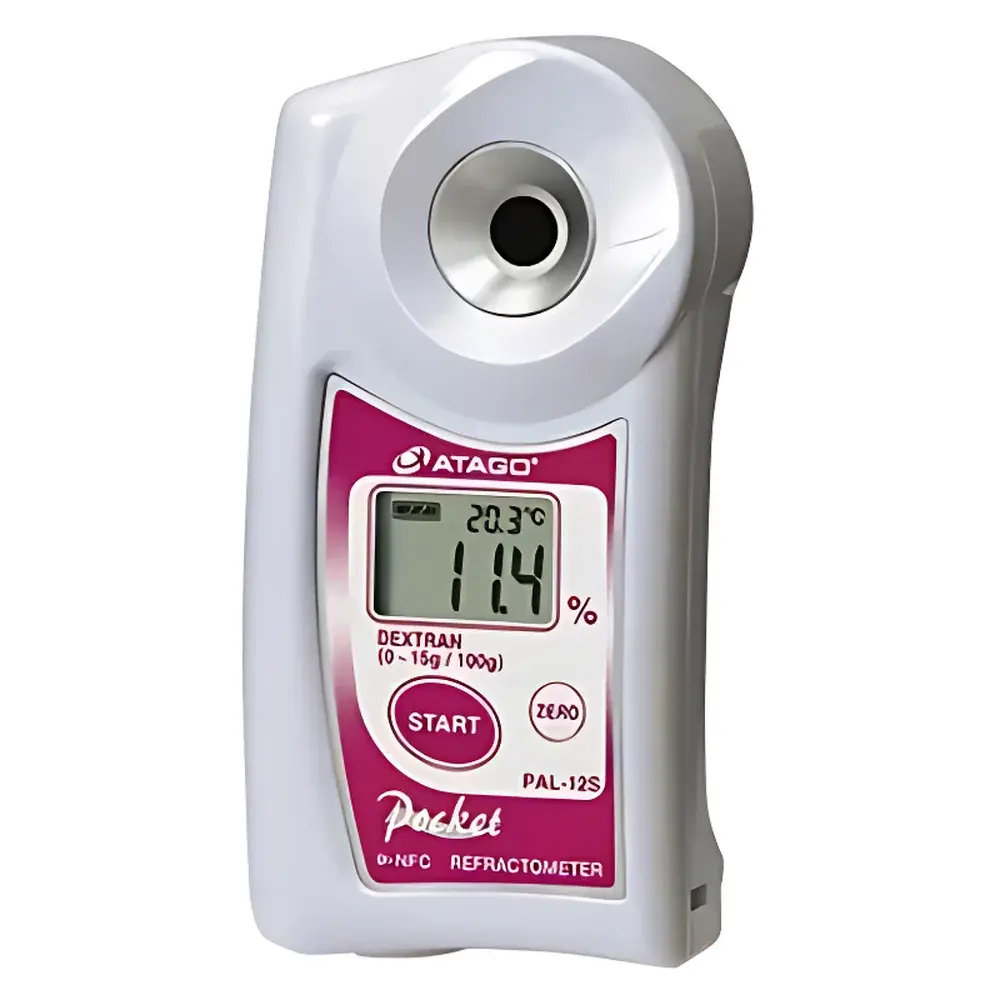
ATAGO PAL-12S Digital Handheld Dextran Refractometer
| Brand | ATAGO |
|---|---|
| Origin | Japan |
| Model | PAL-12S |
| Product Type | Handheld Refractometer |
| Measurement Range | 0.0–15.0% (dextran, w/w) |
| Accuracy | ±0.2% |
| Temperature Compensation | Automatic (ATC, 10–40°C) |
| Resolution | 0.1% |
| Power Supply | 2 × AAA batteries |
| IP Rating | IP65 |
| Dimensions | 5.5 × 3.1 × 10.9 cm |
| Weight | 100 g (instrument only) |
Overview
The ATAGO PAL-12S Digital Handheld Dextran Refractometer is a precision optical instrument engineered for rapid, on-site quantification of dextran concentration in aqueous solutions. Based on the principle of critical-angle refractometry, the PAL-12S measures the refractive index shift induced by dissolved dextran molecules and converts it—via factory-calibrated algorithms—into mass percentage (w/w %), displayed directly in digital format. Unlike general-purpose Brix refractometers, the PAL-12S employs a dextran-specific calibration curve traceable to NIST-traceable reference standards, ensuring metrological validity across the 0.0–15.0% measurement range. Its compact, rugged design integrates temperature-compensated optics with a sapphire prism surface, enabling reliable operation under variable ambient conditions (10–40°C) without external thermostatic control. The device complies with ISO 21748:2017 (guidance on measurement uncertainty in refractometry) and supports routine verification per ASTM D1218 (standard test method for refractive index of transparent liquids).
Key Features
- Dextran-specific optical calibration—optimized for linear response across 0.0–15.0% (w/w), eliminating cross-sensitivity to sucrose, glucose, or other mono-/disaccharides
- Automatic Temperature Compensation (ATC) using integrated thermistor feedback, correcting refractive index drift across 10–40°C operating range
- High-stability sapphire prism with chemical-resistant coating—resistant to abrasion, organic solvents, and repeated cleaning with ethanol or isopropanol
- IP65-rated enclosure—dust-tight and protected against low-pressure water jets, suitable for use in production floors, QC labs, and field environments
- 0.1% resolution digital display with auto-zero function and backlight for low-light operation
- Low-power architecture—operates continuously for >10,000 measurements on two standard AAA alkaline cells
Sample Compatibility & Compliance
The PAL-12S is validated for use with aqueous dextran solutions, including pharmaceutical-grade dextran 40, dextran 70, and microbial fermentation broths containing native dextran polymers. It is incompatible with viscous non-aqueous matrices (e.g., glycerol-based gels), highly turbid suspensions, or samples containing particulates >5 µm without prior centrifugation or filtration. For regulated environments, the instrument supports GLP-compliant documentation through manual entry of operator ID, sample ID, and timestamp; while not FDA 21 CFR Part 11–certified, its deterministic analog-to-digital conversion path and non-volatile display memory ensure audit-ready measurement records. Calibration verification is performed using certified dextran reference solutions (0.0%, 5.0%, and 10.0% w/w), aligned with ISO/IEC 17025 internal calibration requirements.
Software & Data Management
The PAL-12S operates as a standalone instrument with no embedded firmware update capability or USB/Bluetooth connectivity. All measurement data are retained solely in volatile display memory and must be manually transcribed for recordkeeping. For laboratories requiring electronic data capture, ATAGO recommends pairing the PAL-12S with its optional RS-232 interface kit (sold separately), enabling direct output to LIMS or Excel via ASCII protocol (9600 baud, N, 8, 1). Output format includes measurement value, unit (%), date/time stamp, and instrument serial number—supporting traceability in GMP-aligned workflows where raw data integrity is governed by Annex 11 principles.
Applications
- Pharmaceutical manufacturing: In-process monitoring of dextran concentration during sterile filtration and lyophilization buffer preparation
- Biotechnology R&D: Quantification of extracellular dextran yield in Leuconostoc mesenteroides and Streptococcus mutans fermentation batches
- Food ingredient quality control: Verification of dextran content in functional food additives and prebiotic blends
- Petroleum service labs: Field validation of dextran-based fluid-loss additives in drilling mud formulations
- Cosmetic formulation QA: Batch release testing of natural dextran derivatives used as humectants and rheology modifiers in emulsions and serums
FAQ
Is the PAL-12S calibrated for dextran specifically—or is it a repurposed Brix refractometer?
The PAL-12S uses a dextran-specific calibration curve derived from gravimetrically prepared reference standards. It is not a Brix-scaled instrument; its scale reads directly in % (w/w) dextran.
Can the PAL-12S measure dextran molecular weight distributions?
No. Refractometry measures total dissolved solids concentration—not molar mass, polydispersity, or structural conformation. SEC-MALS or viscometry is required for MW characterization.
What is the recommended recalibration interval under continuous use?
ATAGO recommends verification against reference standards before each shift in high-precision applications, and formal recalibration every 6 months when used per ISO/IEC 17025 procedures.
Does the ATC function compensate for sample temperature or ambient temperature?
The ATC sensor measures the prism temperature in real time and applies correction based on the known thermo-optic coefficient of dextran solutions—ensuring accuracy regardless of sample temperature within the 10–40°C range.
Is the sapphire prism replaceable in the field?
No. The sapphire prism is permanently bonded to the optical housing and is not user-serviceable. Prism damage requires return to an authorized ATAGO service center.





