
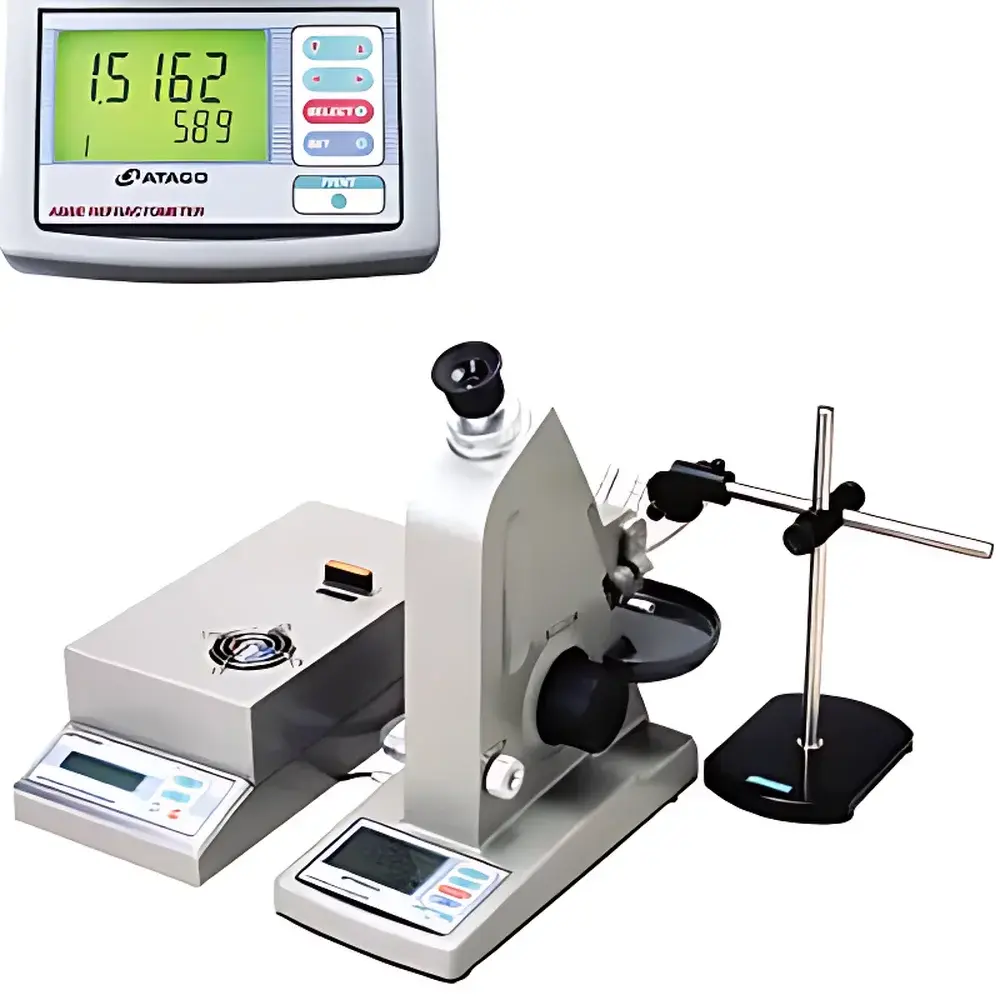
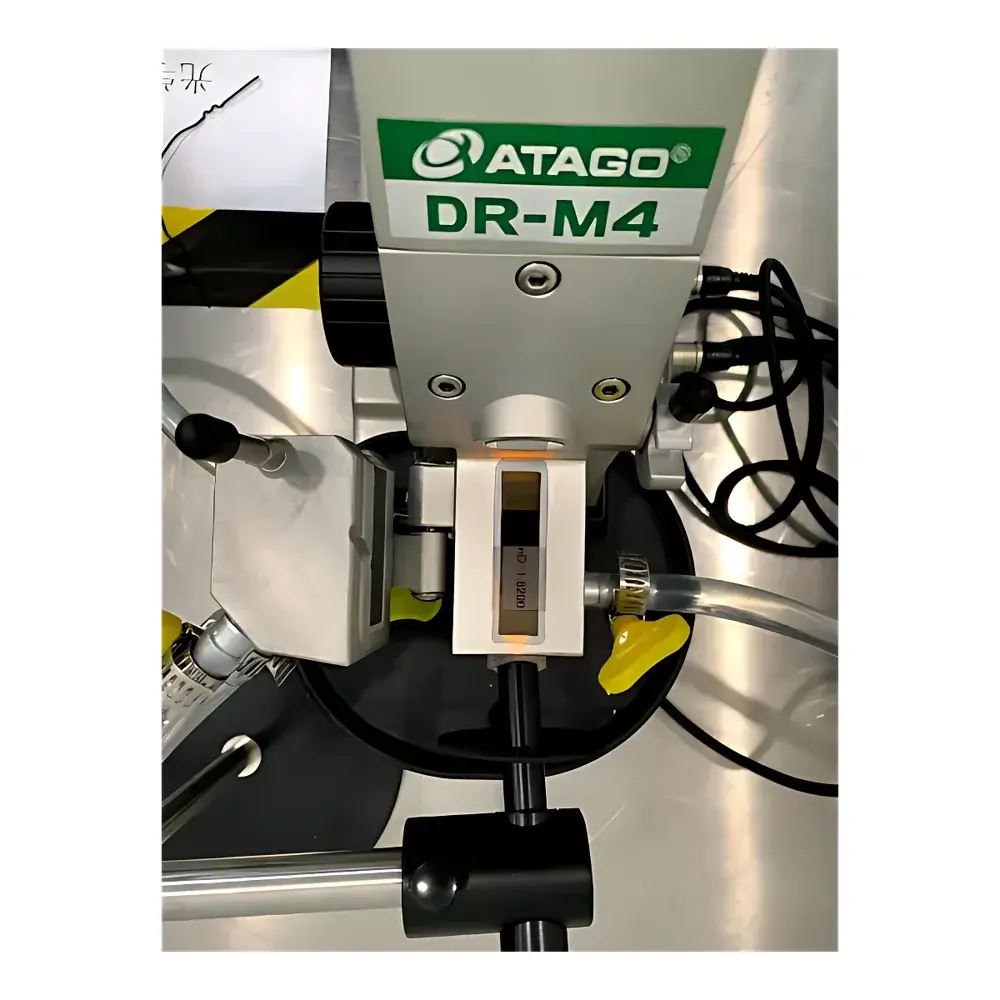
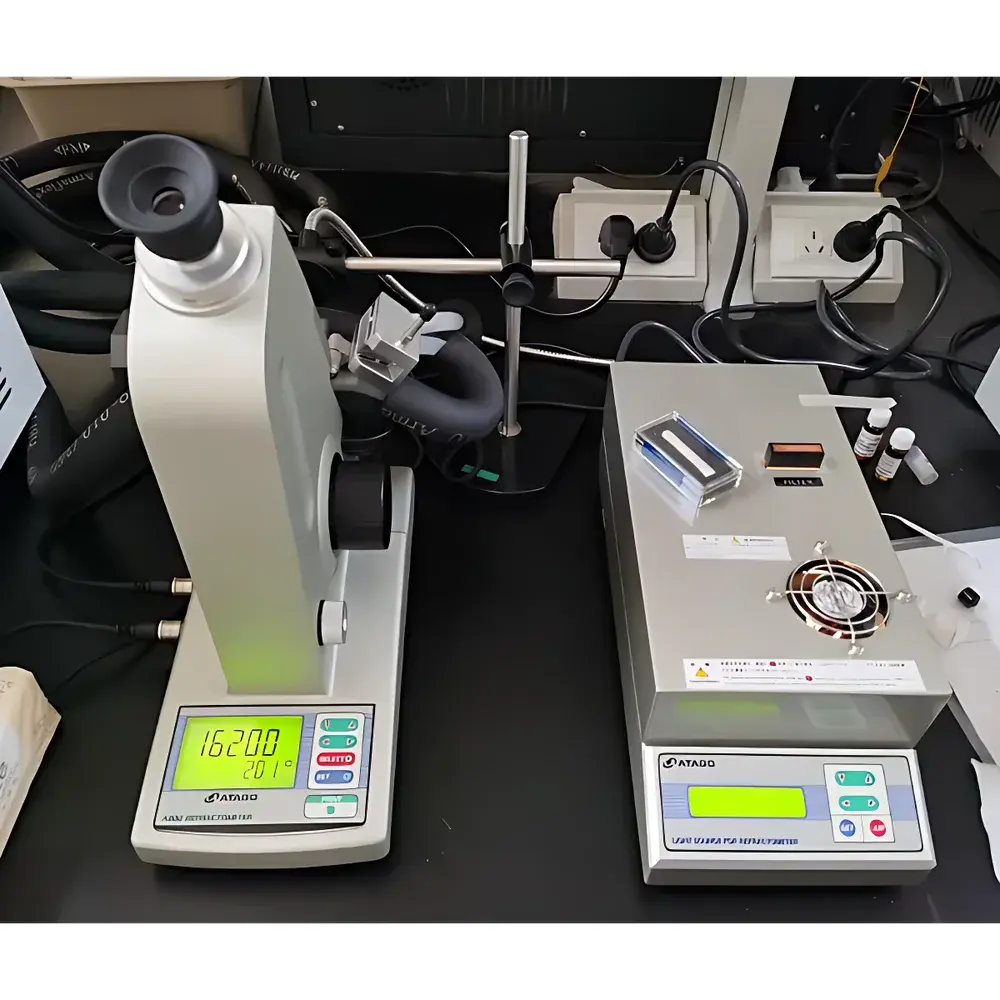
ATAGO DR-M4 Multi-Wavelength Abbe Refractometer (1100 nm)
| Brand | ATAGO |
|---|---|
| Origin | Japan |
| Model | DR-M4 (1100 nm) |
| Product Type | Benchtop Refractometer |
| Digital Display | Yes |
| Temperature Control | None |
| Measurement Range (nD at 1100 nm) | 1.4260–1.8258 |
| Resolution | 0.0001 (nD), 0.1 (Abbe number) |
| Accuracy | ±0.0002 (nD, with 500–650 nm interference filter) |
| Wavelength Range | 450–1100 nm (interference filters required) |
| Light Source | Halogen lamp |
| Power Supply | AC 100–240 V, 50/60 Hz |
| Dimensions (main unit) | 13 × 29 × 31 cm |
| Weight (main unit) | 6.0 kg |
Overview
The ATAGO DR-M4 Multi-Wavelength Abbe Refractometer is a precision benchtop optical instrument engineered for high-accuracy refractive index (nD) and Abbe number (Vd or Ve) measurements across an extended spectral range from 450 nm to 1100 nm. Unlike conventional single-wavelength refractometers, the DR-M4 employs interchangeable interference filters and a stabilized halogen light source to enable wavelength-specific measurements—critical for characterizing dispersion behavior in advanced optical polymers, thin-film coatings, and liquid crystal materials. Its Abbe-type optical design utilizes the critical angle method: incident light undergoes total internal reflection at the prism-sample interface, and the resulting shadow line position on the reticle is translated into nD via calibrated optics and digital signal processing. The instrument’s fixed-angle glass prism (made of high-stability optical crown glass) ensures mechanical and thermal stability during repeated measurements, while its 0.0001 resolution and ±0.0002 accuracy (validated per ISO 17025 traceable protocols using certified reference standards) meet stringent requirements for R&D labs and QC environments in optics manufacturing and materials science.
Key Features
- Extended spectral capability: Measures refractive index at discrete wavelengths from 450 nm (visible blue) to 1100 nm (near-infrared), supporting dispersion analysis and material identification.
- Dual-parameter output: Simultaneously calculates and displays both nD and Abbe number (Vd/Ve) in real time on a high-contrast LCD screen—no manual lookup tables or post-processing required.
- Interference-filter-based wavelength selection: Includes standardized filter sets (e.g., 450 nm, 589 nm, 680 nm, 1100 nm); optional near-infrared observation eyepiece enables safe visual alignment above 681 nm.
- Benchtop robustness: Precision-machined aluminum housing, vibration-damped base, and temperature-stable optical path minimize drift during extended measurement sessions (operating range: 5–50 °C ambient).
- Digital interface readiness: RS-232 port supports connection to external digital printers (e.g., DP-AD(B), optional) or data acquisition systems for GLP-compliant recordkeeping.
- No integrated Peltier or fluidic temperature control—designed for ambient-stable operation; compatible with external recirculating chillers (e.g., ATAGO 60-C5, optional) for temperature-dependent studies.
Sample Compatibility & Compliance
The DR-M4 accommodates solid and liquid samples with flat, optically polished surfaces—including ophthalmic lenses, PET/PVC films, epoxy resins, UV-curable adhesives, and liquid crystal monomers. Sample volume requirements are minimal (< 0.1 mL for liquids; < 10 mm × 10 mm surface area for solids). Its optical configuration complies with ISO 2114 (Plastics — Determination of refractive index) and ASTM D542 (Standard Test Method for Index of Refraction of Transparent Organic Plastics). While not FDA 21 CFR Part 11–certified out-of-the-box, audit trails generated via printer output or third-party data logging software can be validated for GMP/GLP environments. All calibration procedures follow ATAGO’s documented SOPs aligned with JIS Z 8013 and NIST-traceable refractive index standards.
Software & Data Management
The DR-M4 operates as a standalone instrument with embedded firmware—no PC dependency. Measurement data is displayed numerically and may be exported via RS-232 to serial printers (DP-AD(B)) or ASCII-compatible terminals. For laboratories requiring electronic records, the device supports timestamped printouts with user-defined headers (e.g., sample ID, operator, date/time, filter wavelength). Optional integration with LIMS or ELN platforms is achievable through custom serial-to-TCP/IP gateways. Firmware updates (released biannually) address minor calibration refinements and compatibility enhancements—distributed via ATAGO’s global service network.
Applications
- Optical polymer development: Quantifying nD and dispersion (Vd) of polycarbonate, CR-39, and high-index lens resins across visible–NIR bands.
- Thin-film quality control: Verifying refractive uniformity of anti-reflective, ITO, or photoresist layers on silicon wafers and display substrates.
- Liquid crystal formulation: Monitoring batch-to-batch consistency of ne/no ratios in nematic and smectic mixtures under controlled ambient conditions.
- Adhesive and encapsulant validation: Assessing refractive matching between epoxies/silicones and LED packaging substrates (e.g., for reduced Fresnel losses).
- Academic research: Supporting spectroscopic modeling of Sellmeier coefficients and Cauchy equation fitting in novel photonic materials.
FAQ
What wavelength options are standard on the DR-M4?
The instrument ships with a base set of interference filters covering 450 nm, 589 nm (sodium D-line), 680 nm, and 1100 nm. Additional filters (e.g., 546 nm, 850 nm) are available as accessories.
Can the DR-M4 measure samples at elevated temperatures?
No—temperature control is not built-in. However, it may be used with an external recirculating chiller (e.g., ATAGO 60-C5) to maintain sample temperature within the 5–50 °C operating range.
Is calibration traceable to national standards?
Yes—ATAGO provides factory calibration certificates traceable to NIST and JCSS-accredited reference oils and glasses. Users may perform verification using supplied calibration standards (e.g., SF10 glass block, nD = 1.7230 at 589 nm).
Does the DR-M4 support automatic wavelength switching?
No—wavelength selection requires manual filter replacement and re-zeroing per ATAGO’s calibration protocol. This ensures metrological integrity over automated mechanisms.
How is Abbe number calculated?
Vd is computed internally using the formula Vd = (nD − 1)/(nF − nC), where nD, nF, and nC are refractive indices measured at 589.3 nm, 486.1 nm, and 656.3 nm respectively—requiring sequential filter changes and input of measured values.




