
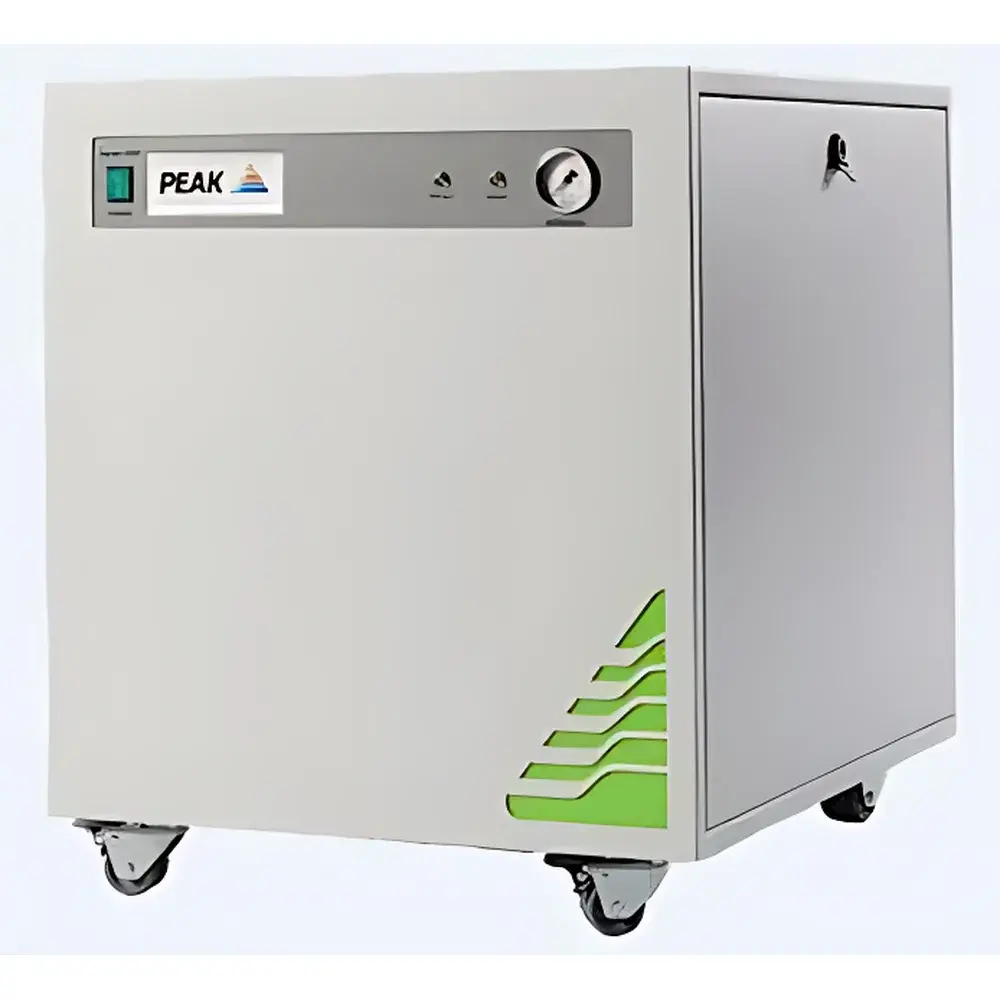
Peak Scientific Genius 1050 Nitrogen Generator
| Brand | PEAK |
|---|---|
| Origin | United Kingdom |
| Manufacturer Type | Original Equipment Manufacturer (OEM) |
| Origin Category | Imported |
| Model | Genius 1050 |
| Nitrogen Generation Principle | Carbon Molecular Sieve (CMS) with Pressure Swing Adsorption (PSA) |
| Output Flow Rate | 32 L/min |
| Output Pressure | 100 psi (6.9 bar) |
| Nitrogen Purity | Up to 99.5% |
| Dew Point | -50 °C |
| Integrated Air Compressor | Yes |
| Power Supply | 230 V ±10% AC, 50/60 Hz, 7 A |
| Dimensions (H×W×D) | 713 × 600 × 750 mm |
| Weight | 115.5 kg |
| Startup Time | ≤30 minutes |
| Warranty | 12-month on-site comprehensive warranty |
Overview
The Peak Scientific Genius 1050 Nitrogen Generator is an engineered solution for laboratories requiring a continuous, reliable, and high-purity nitrogen supply—specifically optimized for demanding analytical instrumentation such as liquid chromatography–mass spectrometry (LC-MS), electrospray ionization (ESI), atmospheric pressure chemical ionization (APCI), and other nitrogen-dependent detection systems. Utilizing proven carbon molecular sieve (CMS) technology combined with pressure swing adsorption (PSA), the Genius 1050 separates nitrogen from compressed ambient air by selectively adsorbing oxygen, carbon dioxide, water vapor, and trace contaminants under elevated pressure, then regenerating the CMS bed during depressurization cycles. This cyclic, non-consumable process ensures stable output without reliance on liquid nitrogen dewars or high-pressure cylinders—reducing logistical complexity, safety risks, and long-term operational cost. Designed and manufactured in the UK, the system complies with IEC 61010-1 safety standards and meets essential requirements for laboratory-grade gas purity in regulated environments.
Key Features
- Integrated oil-free scroll air compressor housed in an acoustically isolated chamber—minimizing operational noise (<55 dB(A)) and mechanical vibration for stable instrument interfacing
- Intelligent maintenance scheduling algorithm that monitors CMS bed saturation, filter life, and compressor runtime—providing advance alerts for preventive service intervals
- On-demand gas delivery logic synchronized with instrument demand signals (via optional 0–10 V or dry-contact interface), reducing energy consumption during idle periods
- Full front-access service architecture: modular CMS columns, coalescing pre-filters, and desiccant post-filters are field-replaceable without tools or system disassembly
- Stainless steel gas path components downstream of the CMS module—including pressure regulators, flow meters, and outlet fittings—to ensure inertness and prevent metallic contamination
- Castor-mounted chassis (locking swivel casters) enabling safe repositioning within laboratory workflows without requiring disconnection or recalibration
Sample Compatibility & Compliance
The Genius 1050 delivers nitrogen meeting ISO 8573-1:2010 Class 2:2:2 specifications for particulate, water, and oil content—ensuring compatibility with high-sensitivity LC-MS systems from Agilent, Thermo Fisher Scientific, Waters, Shimadzu, Bruker, and AB Sciex. Its consistent -50 °C pressure dew point eliminates ice formation in heated capillaries and nebulizers; 99.5% N₂ purity supports robust ionization efficiency across ESI and APCI sources. The generator’s firmware and hardware design support audit-ready operation per FDA 21 CFR Part 11 when integrated with compliant laboratory information management systems (LIMS). All electrical components conform to CE, UKCA, and UL 61010-1 safety directives. No external compressed air source is required—eliminating variability associated with third-party air quality or pressure fluctuations.
Software & Data Management
The onboard control system features a backlit LCD interface with real-time display of outlet pressure, flow rate, CMS cycle status, internal temperature, and cumulative runtime. Optional Ethernet or RS-485 connectivity enables remote monitoring via Peak’s proprietary LabControl™ software (Windows-compatible), supporting data logging at user-defined intervals (1–60 sec resolution), event-triggered alarms (e.g., low flow, high dew point), and export to CSV or XML formats for integration into ELN or LIMS platforms. Audit trails record all parameter changes, service events, and alarm acknowledgments—with timestamp, operator ID, and IP address where networked. Firmware updates are performed securely via signed .bin files with checksum verification.
Applications
- LC-MS mobile phase nebulization and drying gas for quantitative bioanalysis, metabolomics, and proteomics
- Nitrogen blanket gas for solvent evaporation systems (e.g., TurboVap®, CentriVap®) and sample preparation workstations
- Carrier and purge gas for elemental analyzers (ICP-MS, GC-MS/MS) requiring ultra-low moisture and hydrocarbon content
- Inert atmosphere generation for glove boxes, reaction vessels, and stability chambers in pharmaceutical development labs
- Gas supply for nitrogen laser excitation systems and FTIR purge lines where spectral interference must be minimized
FAQ
What is the expected lifetime of the carbon molecular sieve (CMS) column?
Under typical operating conditions (32 L/min, 100 psi, ambient temperature ≤30 °C), the CMS column maintains specified purity and flow performance for ≥20,000 hours—equivalent to approximately 8–10 years of continuous use. Replacement is recommended based on scheduled maintenance alerts rather than fixed calendar intervals.
Can the Genius 1050 be integrated with existing lab infrastructure such as building management systems (BMS)?
Yes—via optional analog (4–20 mA / 0–10 V) or digital (Modbus RTU over RS-485) outputs, the generator can report status, flow, pressure, and fault codes to centralized BMS or SCADA platforms.
Is external cooling or ventilation required?
No dedicated HVAC is needed; the unit operates safely in ambient temperatures of 15–30 °C with ≥30 cm clearance on all sides for natural convection cooling. Exhaust heat is dissipated via rear-mounted thermal vents.
Does the system meet GLP/GMP documentation requirements?
Yes—the integrated event logger, user-accessible calibration history, and configurable electronic signatures (when used with LabControl™ and validated Windows OS) support compliance with GLP, GMP, and ISO/IEC 17025 documentation expectations.
What maintenance is required during the first year of operation?
Routine tasks include quarterly inspection of inlet particulate filter, biannual replacement of coalescing pre-filter (part no. GEN-FIL-01), and annual CMS performance verification using calibrated dew point and oxygen analyzers—fully supported by Peak’s global service network.



