
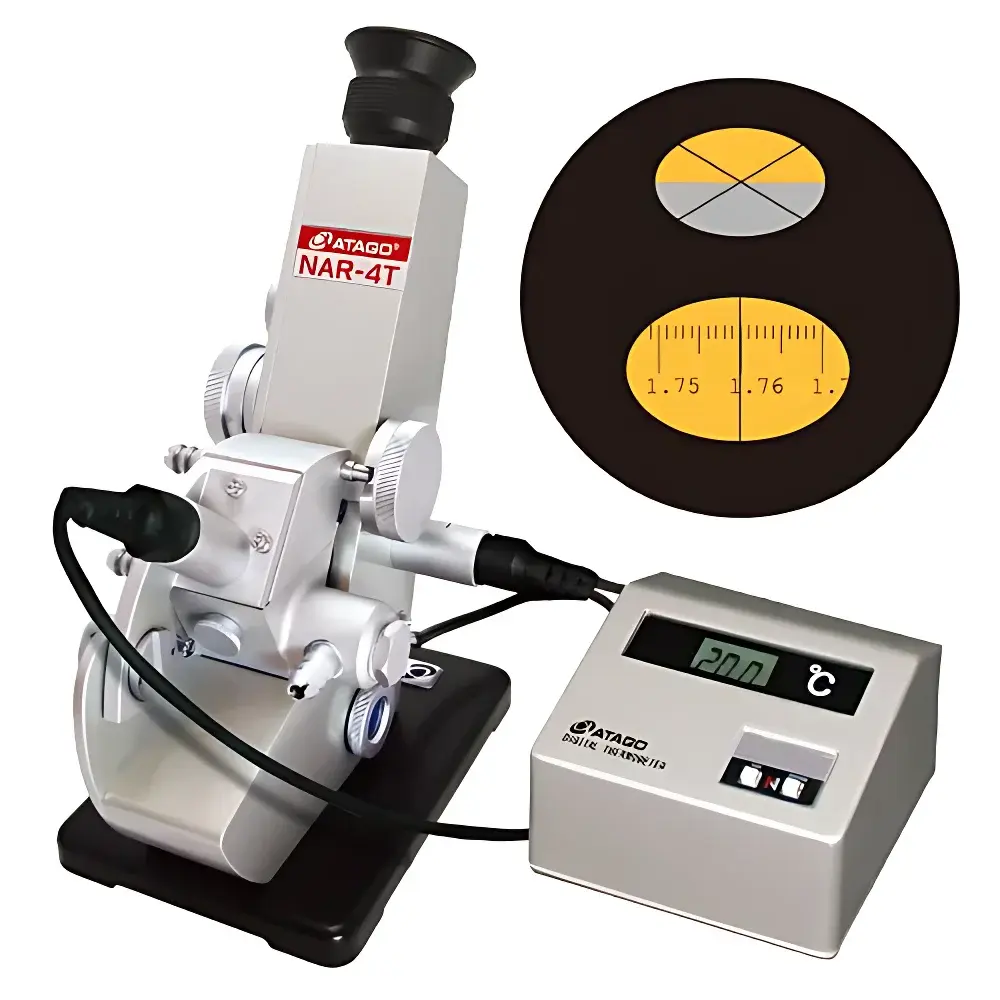
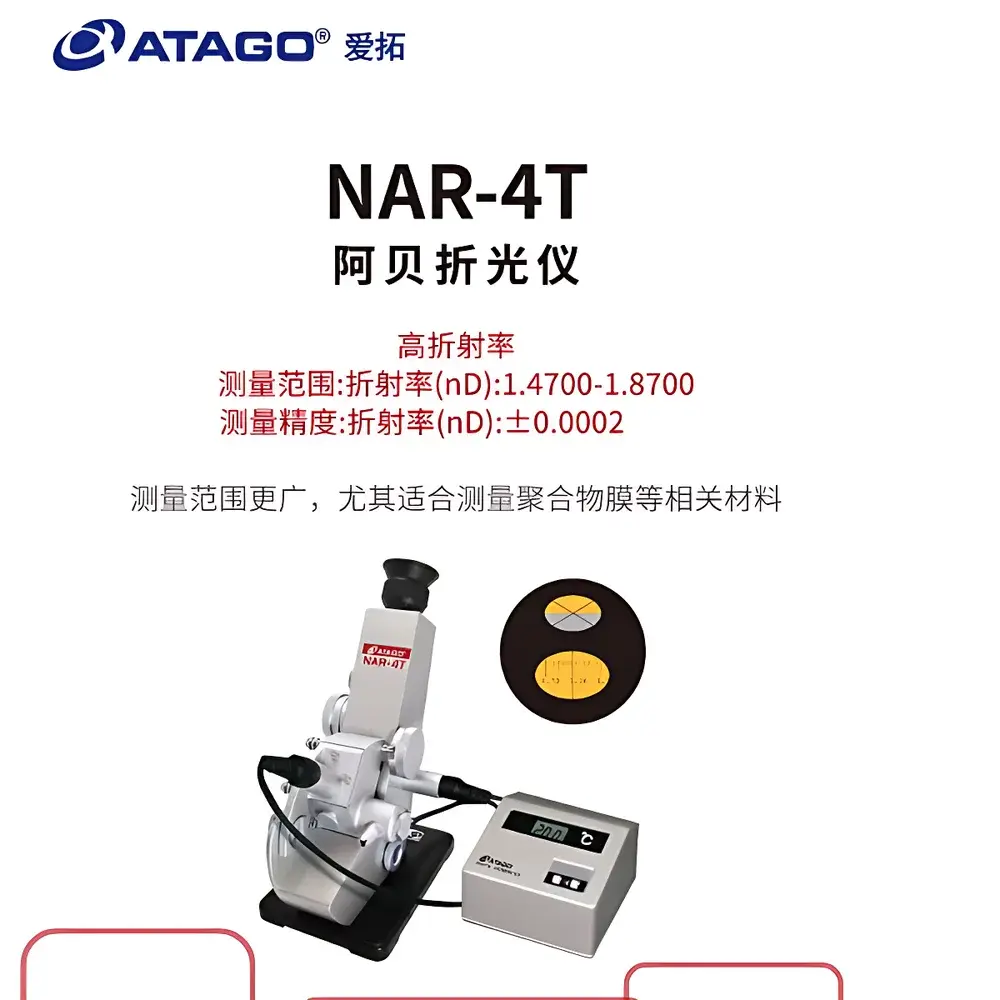
ATAGO NAR-4T High-Index Abbe Refractometer
| Brand | ATAGO |
|---|---|
| Origin | Japan |
| Model | NAR-4T (High-Index) |
| Product Type | Benchtop Abbe Refractometer |
| Measurement Range | nD 1.4700–1.8700 |
| Resolution | 0.001 (nD) |
| Accuracy | ±0.0002 (nD) |
| Temperature Display Range | 0.0–50.0 °C (±0.2 °C accuracy, 0.1 °C resolution) |
| Operating Ambient Temperature | 5–40 °C |
| Power Supply | AC 100–240 V, 50/60 Hz |
| Power Consumption | 5 VA |
| Dimensions (Main Unit) | 13 × 18 × 23 cm |
| Weight (Main Unit) | 1.8 kg |
| Dimensions (Temperature Display Unit) | 10 × 11 × 7 cm |
| Weight (Temperature Display Unit) | 0.5 kg |
Overview
The ATAGO NAR-4T High-Index Abbe Refractometer is a precision optical instrument engineered for the accurate determination of refractive index (nD) and mean dispersion in transparent and semi-transparent materials. Based on the classical Abbe principle—utilizing total internal reflection at the prism-sample interface—the NAR-4T delivers high-fidelity measurements across an extended refractive index range of 1.4700 to 1.8700. This expanded upper limit distinguishes it from standard Abbe refractometers and enables reliable characterization of high-refractive-index media including optical glasses, polymer films, thermosetting resins, lens coatings, and specialty optical adhesives. Designed and manufactured in Japan since 1940, ATAGO’s decades-long specialization in refractometry ensures mechanical stability, optical consistency, and long-term calibration integrity. The instrument operates without integrated temperature control or digital display; instead, it relies on manual focusing and visual interpolation through a calibrated reticle, aligning with ISO 21148:2022 and ASTM D1218 standards for manual Abbe refractometry.
Key Features
- Extended measurement range: nD 1.4700–1.8700 — optimized for high-index optical polymers, borosilicate glasses, and cured epoxy resins
- High-resolution scale with 0.001 nD graduation and ±0.0002 nD measurement accuracy under controlled ambient conditions
- Dual-unit temperature monitoring: separate compact digital temperature display unit (0.0–50.0 °C, ±0.2 °C accuracy, 0.1 °C resolution) for precise thermal correlation during measurement
- Benchtop configuration with rigid aluminum alloy housing (13 × 18 × 23 cm, 1.8 kg), ensuring vibration resistance and optical alignment retention
- Standardized sodium D-line illumination (589.3 nm) with adjustable intensity and collimated beam path for consistent critical angle detection
- No moving parts in optical train—prism assembly fixed and factory-aligned to minimize drift and maximize inter-instrument reproducibility
Sample Compatibility & Compliance
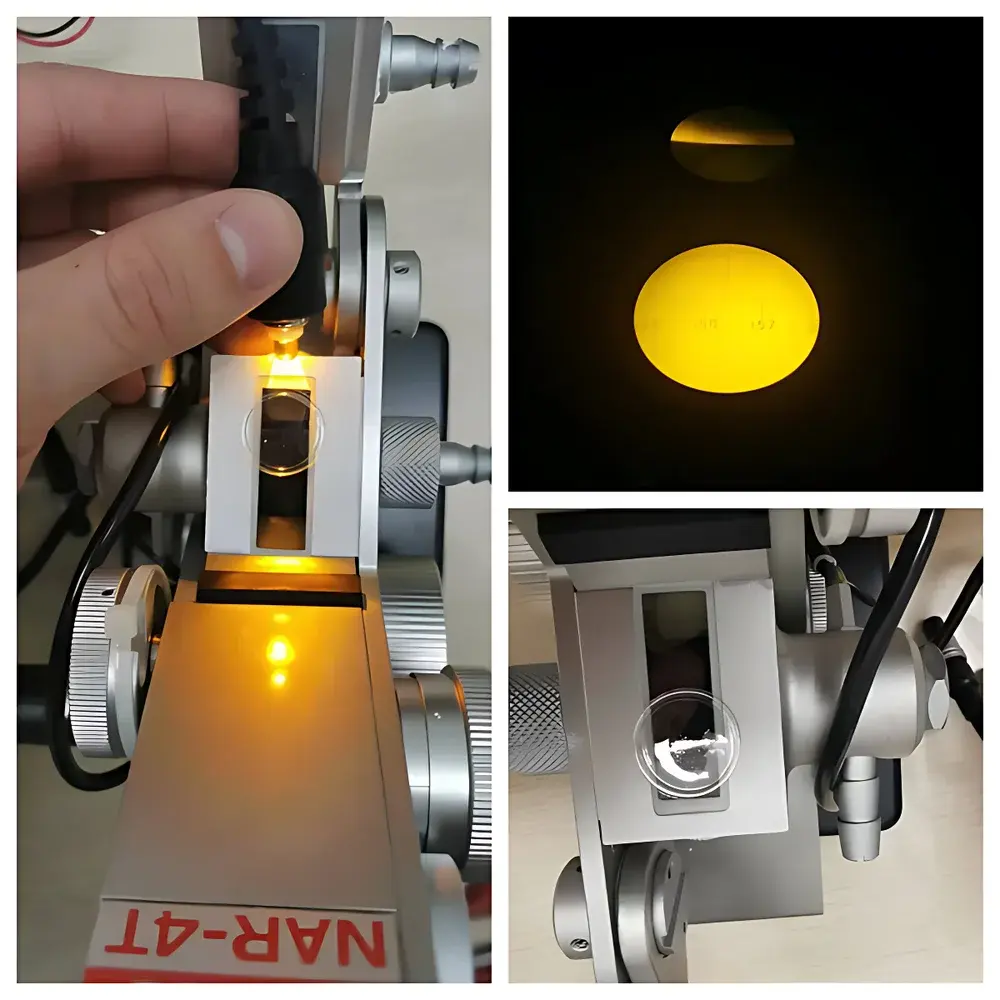
The NAR-4T accommodates both liquid and solid samples. For liquids, standard application includes solvents, monomers, and high-boiling-point resins requiring minimal sample volume (≈0.1–0.3 mL). For solids, flat, polished surfaces ≥10 mm × 10 mm are required; measurement is performed using contact fluid (e.g., bromonaphthalene or α-bromonaphthalene, nD ≈ 1.66) to eliminate air gaps. The instrument complies with fundamental requirements of ISO 21148:2022 (Refractometers — Abbe type — Specification and methods of testing) and supports traceable calibration via certified reference standards (e.g., distilled water, benzene, and SF10 glass blocks). While not equipped with active temperature regulation, its design facilitates use in temperature-stabilized laboratories meeting GLP environmental controls (20–25 °C, ±1 °C).
Software & Data Management
The NAR-4T is a fully analog, non-digital instrument: it features no onboard microprocessor, data logging, or USB/Bluetooth connectivity. All readings are manually recorded from the engraved scale and temperature display. This architecture eliminates firmware dependencies, electromagnetic interference risks, and software validation burdens—making it suitable for regulated environments where simplicity, auditability, and deterministic operation are prioritized over automation. Users maintain measurement records in laboratory notebooks or LIMS-integrated spreadsheets, with full traceability to operator, date, ambient conditions, and calibration certificate numbers. For facilities operating under FDA 21 CFR Part 11 or EU Annex 11, manual entry protocols—including dual-signature verification and controlled document templates—are recommended for compliance alignment.
Applications
- Optical materials R&D: Characterization of lens-grade polycarbonates, PMMA derivatives, and chalcogenide glasses for AR/VR waveguide development
- Thin-film manufacturing: Verification of refractive index uniformity in spin-coated photoresists and anti-reflective coatings
- Pharmaceutical excipient QC: Identity confirmation and batch consistency checks for high-nD solvents (e.g., dimethyl sulfoxide, glycerol formal)
- Polymer synthesis labs: Real-time monitoring of curing degree in epoxy-acrylate hybrid systems via nD shift
- Geological sample analysis: Refractive index matching of mineral inclusions in synthetic quartz and sapphire substrates
- Academic teaching: Demonstration of dispersion theory, Cauchy equation fitting, and Sellmeier modeling in undergraduate optics laboratories
FAQ
Does the NAR-4T include built-in temperature control?
No. It requires external thermal equilibration of samples and prisms. A separate digital temperature display unit is provided for ambient and sample surface temperature monitoring.
Can the NAR-4T measure opaque or turbid samples?
No. It is strictly limited to transparent or semi-transparent homogeneous media. Scattering or absorption above 5% at 589 nm compromises critical angle definition.
What calibration standards are recommended for routine verification?
Certified reference liquids (e.g., distilled water at 20 °C: nD = 1.3330; benzene at 20 °C: nD = 1.5011) and solid standards such as SF10 optical glass (nD = 1.7230) are traceable to NIST or PTB.
Is the NAR-4T compliant with pharmacopeial methods?
Yes—its measurement principle and uncertainty profile satisfy USP , EP 2.2.6, and JP 2.05 for refractive index determination in pharmaceutical raw materials and intermediates.
How often should the instrument be recalibrated?
Annual recalibration by an ISO/IEC 17025-accredited metrology laboratory is recommended; interim verification using primary standards should occur before each analytical campaign.




