
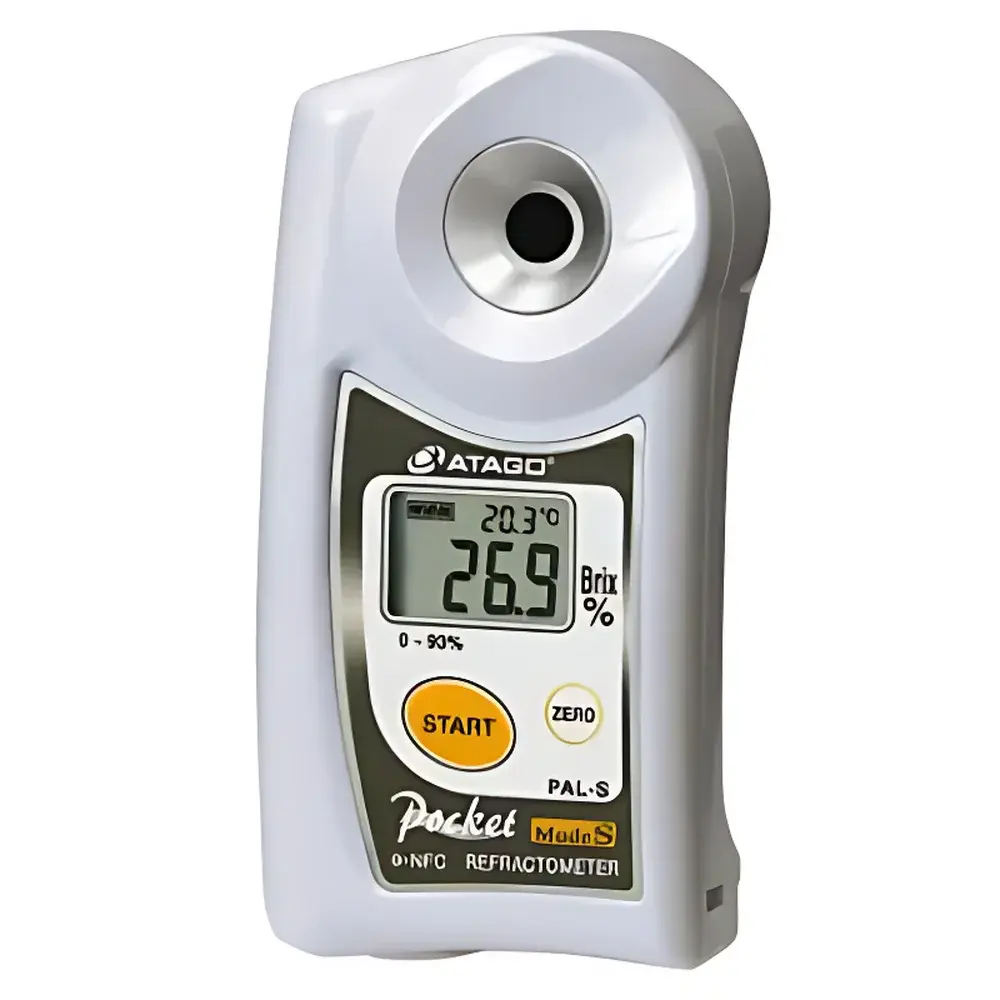
ATAGO PAL-S Portable Digital Refractometer for Dairy and Dark Samples
| Brand | ATAGO |
|---|---|
| Origin | Japan |
| Model | PAL-S |
| Type | Handheld Refractometer |
| Temperature Control | Yes |
| Digital Display | Yes |
| Measurement Range | Brix 0.0–93.0% |
| Accuracy | ±0.2% |
| Resolution | 0.1% |
| Measuring Temperature Range | 10–100°C |
| Ambient Operating Temperature | 10–40°C |
| Power Supply | Two AAA batteries |
| IP Rating | IP65 |
| Dimensions | 5.5 × 3.1 × 10.9 cm |
| Weight | 100 g (instrument only) |
Overview
The ATAGO PAL-S is a purpose-engineered handheld digital refractometer designed specifically for the dairy industry and applications involving optically challenging samples—such as high-fat milks, fermented dairy products, caramelized or dark-colored liquids, and opaque emulsions. Unlike conventional refractometers that rely on standard Abbe optics and assume homogeneous, low-absorption transmission, the PAL-S integrates ATAGO’s proprietary Mode S optical algorithm and temperature-compensated LED-based measurement architecture. This enables robust Brix quantification across an extended range (0.0–93.0%) while maintaining traceable accuracy (±0.2%) under variable thermal and optical conditions. The instrument operates on the principle of critical-angle refractometry: incident light from a stabilized LED source passes through the sample-prism interface; the resulting refraction angle is detected by a linear CCD array and converted to Brix concentration using a pre-calibrated polynomial function validated against NIST-traceable sucrose standards. Its built-in thermistor ensures real-time temperature correction per ISO 2173 and AOAC 932.12 protocols, eliminating manual interpolation and supporting compliance with dairy quality control workflows.
Key Features
- Mode S optical algorithm optimized for scattering- and absorption-prone samples—including whole milk, whey concentrates, condensed milk, chocolate milk, and fermented dairy—enhancing measurement repeatability (RSD < 0.3% at 12% Brix) without dilution or filtration.
- Integrated Peltier-assisted temperature control (10–100°C range) with active stabilization, enabling precise isothermal measurements required for regulatory consistency in raw milk intake and finished product verification.
- IP65-rated enclosure ensures resistance to dust ingress and water jets—critical for use in farm-side collection points, processing line environments, and cold-room settings.
- High-contrast LCD with backlight supports legible readings under low-light conditions common in refrigerated storage areas or outdoor grading stations.
- Auto-power-off and battery-low indicators extend operational uptime; dual AAA cells provide >10,000 measurements per set under typical usage.
- Prism surface engineered from sapphire-coated BK7 glass for abrasion resistance and chemical inertness against dairy acids, cleaning agents, and sanitizers (e.g., peracetic acid, caustic soda).
Sample Compatibility & Compliance
The PAL-S accommodates viscous, particulate-laden, and chromatically dense samples without requiring centrifugation, homogenization, or dilution—reducing preparation time and operator-induced variability. It meets functional requirements outlined in ISO 5725 (accuracy and precision), ASTM D1298 (density and API gravity correlation), and IDF Standard 112 (milk and milk products—determination of total solids). While not certified for GMP or FDA 21 CFR Part 11 out-of-the-box, its audit-ready measurement logs (when paired with optional PC software) support GLP-aligned documentation practices. Calibration verification is performed using certified sucrose reference solutions (0%, 10%, 30%, 60% w/w) traceable to NIST SRM 84d.
Software & Data Management
The PAL-S supports data export via optional RS-232 or USB interface to ATAGO’s LogMaster PC software (v4.2+). This platform enables batch logging, statistical process control (SPC) charting, calibration history tracking, and PDF report generation compliant with internal QA templates. All measurements include embedded timestamps, ambient/temperature values, and user ID fields—facilitating traceability during third-party audits. Exported CSV files are compatible with LIMS integration and Excel-based trending analysis. Firmware updates preserve metrological integrity and are delivered via ATAGO’s secure customer portal.
Applications
- On-farm raw milk Brix screening prior to chilling and transport—correlating with lactose + solids-not-fat (SNF) content for preliminary payment classification.
- In-line verification of ultrafiltered (UF) and reverse osmosis (RO) permeate/concentrate streams during membrane processing.
- Quality release testing of sweetened condensed milk, evaporated milk, and flavored dairy beverages where color interference invalidates traditional photometric methods.
- Process validation for yogurt, kefir, and cultured cream production—monitoring sugar depletion kinetics during fermentation.
- Supplier qualification and incoming inspection of whey protein isolates and milk protein concentrates (MPCs) with high dry matter loadings.
FAQ
Does the PAL-S require recalibration before each use?
No—ATAGO recommends daily verification with a zero-reference solution and full calibration every 24 hours or after exposure to extreme thermal gradients (>15°C change).
Can it measure non-dairy emulsions such as plant-based milks?
Yes, provided the sample exhibits stable refractive index response to dissolved solids; however, Brix values should be interpreted as apparent concentration and correlated empirically to dry matter for soy, oat, or almond matrices.
Is temperature compensation automatic across the full 10–100°C range?
Yes—the integrated thermistor and firmware apply real-time compensation using a five-point polynomial derived from ATAGO’s master calibration database.
What maintenance is required for long-term accuracy?
Daily prism cleaning with lens tissue and distilled water; annual factory verification recommended for ISO 17025-accredited labs.
How does Mode S differ from standard refractometry modes?
Mode S applies adaptive signal averaging and dynamic baseline correction to mitigate noise from suspended fat globules and pigment absorption—improving signal-to-noise ratio without altering optical path length or prism geometry.



