
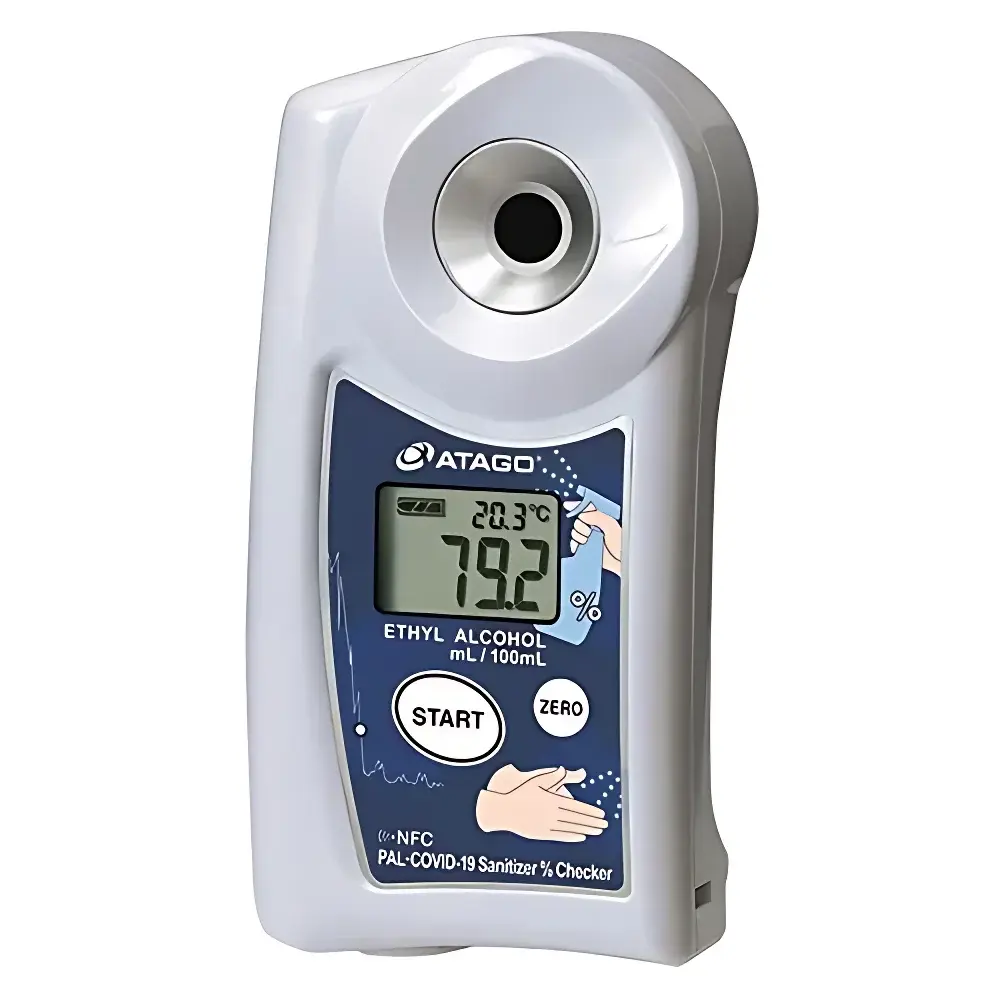
ATAGO PAL-COVID-19 Portable Ethanol-Specific Refractometer
| Brand | ATAGO |
|---|---|
| Origin | Japan |
| Model | PAL-COVID-19 |
| Product Type | Handheld Digital Refractometer |
| Measurement Range | 0–100% (v/v, mL ethanol per 100 mL solution) |
| Accuracy | ±1% (v/v) within specified range |
| Automatic Temperature Compensation (ATC) | 5–30 °C |
| Operating Ambient Temperature | 10–30 °C |
| Display | Digital LCD |
| Built-in Accessories | Dilution cup and calibrated measuring spoon (1× each) |
| Compliance | Designed for routine QC in disinfectant preparation and verification per WHO/US CDC ethanol concentration guidelines |
Overview
The ATAGO PAL-COVID-19 is a purpose-engineered handheld digital refractometer optimized exclusively for rapid, on-site quantification of ethanol (C₂H₅OH) concentration in aqueous disinfectant solutions. It operates on the principle of critical-angle refractometry: as light passes from the prism (sapphire-coated BK7 glass) into the sample, the degree of refraction correlates directly with the solution’s refractive index (RI), which—within the ethanol–water binary system—is highly linear and temperature-dependent between 0–100% (v/v). The instrument employs a high-stability LED light source and a precision photodiode array to capture the shadow line position at the RI boundary, converting it in real time to ethanol volume percentage using a factory-calibrated polynomial algorithm traceable to NIST-traceable ethanol standards. Unlike general-purpose refractometers, the PAL-COVID-19 features a dedicated optical path and firmware algorithm tuned specifically for ethanol–water mixtures, eliminating cross-sensitivity to common excipients (e.g., glycerol, hydrogen peroxide, or surfactants) that would otherwise distort readings in off-the-shelf units. Its design targets frontline use in pharmacies, hospital sterilization units, public health laboratories, and manufacturing QA/QC environments where immediate verification of ethanol concentration is required prior to deployment or batch release.
Key Features
- Dedicated ethanol calibration curve compliant with WHO Technical Report Series No. 999 (2017) Annex 5 and US CDC “Guideline for Disinfection and Sterilization in Healthcare Facilities” (2008) ethanol concentration thresholds.
- Automatic Temperature Compensation (ATC) across 5–30 °C, utilizing dual thermistor sensing to correct RI drift without manual input or external calibration fluids.
- Three-second measurement cycle with single-drop sample requirement (≥0.3 mL), minimizing reagent waste and contamination risk during high-throughput screening.
- Robust ergonomic housing rated IP65 for dust and water resistance, suitable for use in wet or controlled cleanroom environments (ISO Class 7–8).
- No consumables or reagents required—no batteries needed beyond standard CR2032 (included); 10,000+ measurements per battery set under typical usage.
- Non-destructive measurement: sample remains chemically unaltered and can be recovered post-analysis for further testing (e.g., GC validation or microbial challenge assays).
Sample Compatibility & Compliance
The PAL-COVID-19 is validated for use with ethanol–water solutions containing ≤5% (w/w) non-volatile additives such as glycerol, carbomer, or fragrance oils—common in WHO-recommended hand-rub formulations (Formulation I & II). It is not intended for use with isopropanol, quaternary ammonium compounds, sodium hypochlorite, or phenolic solutions. Measurement uncertainty adheres to ISO 5725-2:2019 (accuracy and trueness) and meets internal ATAGO metrological validation protocols aligned with ISO/IEC 17025:2017 clause 7.7 (uncertainty of measurement). Instrument documentation includes full traceability to JCSS (Japan Calibration Service System) certified reference materials, supporting GLP-compliant recordkeeping and audit readiness.
Software & Data Management
While the PAL-COVID-19 operates as a standalone field instrument, its data output supports integration into laboratory information management systems (LIMS) via optional RS-232 serial interface (cable sold separately). Each measurement logs timestamp, ambient temperature, and result automatically—enabling export to CSV for trend analysis, SPC charting, or regulatory submission (e.g., FDA 21 CFR Part 11–compliant audit trails when paired with validated third-party software). Firmware updates are performed via USB adapter (not included), ensuring continued alignment with evolving public health guidance documents.
Applications
- Verification of ethanol concentration in WHO-recommended hand-rub formulations prior to dispensing or bottling.
- Routine quality control of bulk ethanol stock solutions used in hospital central supply departments.
- Field validation of point-of-use disinfectant dilutions in outbreak response settings (e.g., mobile clinics, refugee camps).
- Training and competency assessment for infection prevention staff on rapid concentration verification techniques.
- Supporting ISO 13485:2016 clause 7.5.10 (Control of monitoring and measuring equipment) in medical device manufacturing facilities producing alcohol-based products.
FAQ
Can the PAL-COVID-19 measure isopropyl alcohol (IPA) concentration?
No. This instrument is optically and algorithmically calibrated only for ethanol–water systems. IPA exhibits different refractive index behavior and will yield inaccurate results.
Does it require daily calibration with standard solutions?
No. Factory calibration is stable for 12 months under normal use. Verification with 0% (distilled water) and 75% (v/v) ethanol reference standards is recommended before each shift or after transport-induced shock.
Is the dilution cup and spoon supplied with certified volumetric accuracy?
Yes. The included dilution cup is calibrated to ±1% tolerance at 10 mL nominal volume; the spoon delivers 1.00 ±0.05 g of solid diluent (e.g., NaCl for conductivity-based secondary checks) and is traceable to JCSS-certified mass standards.
How does ATC function without a built-in Peltier element?
The ATC relies on high-resolution thermistor mapping of both prism surface and ambient air temperature, combined with a proprietary thermal lag compensation model derived from 12,000+ empirical RI vs. temperature datasets across the 5–30 °C range.
Is this instrument suitable for regulatory submissions to health authorities?
Yes—when operated per ATAGO’s SOP-REF-01 and documented with instrument ID, calibration verification logs, and operator training records, data generated meets evidentiary requirements for WHO Emergency Use Listing (EUL) and EU MDR Annex XIV conformity assessments.




