
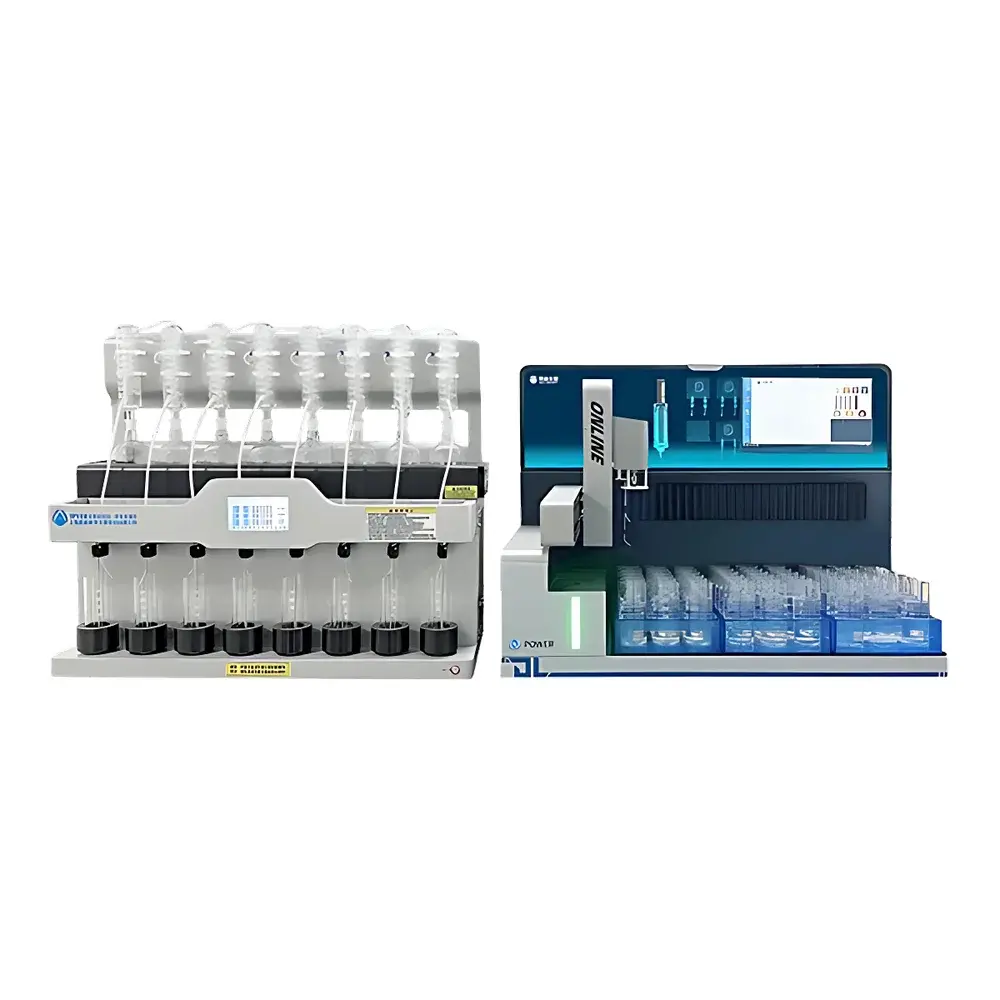
Online Instrument OL2200N Volatile Phenol Analyzer
| Brand | Online Instrument |
|---|---|
| Origin | Shanghai, China |
| Manufacturer Type | Authorized Distributor |
| Country of Origin | China |
| Model | OL2200N |
| Instrument Type | Laboratory-Based Volatile Phenol Analyzer |
| Sample Capacity | 45 positions (expandable upon customization) |
| Distillation Stations | 8 parallel |
| Automation Level | Fully Automated (XYZ robotic sampling, auto-calibration, auto-distillation, reagent addition, phase transfer, liquid-liquid extraction, spectrophotometric quantification) |
| Standard Preparation | Automated multi-point standard curve generation |
| Waste Handling | Closed-loop exhaust and waste liquid collection system |
| Reagent Monitoring | Real-time level sensing with low-reagent alert |
| Remote Access | Web-enabled instrument control and data retrieval via secure HTTPS interface |
| Compliance Framework | Designed to support ISO 6439, HJ 502–2009 (Chinese EPA method), and ASTM D1783–20 for phenolic compounds in water |
Overview
The Online Instrument OL2200N Volatile Phenol Analyzer is a fully automated benchtop system engineered for precise, trace-level quantification of volatile phenols—including phenol, cresols, and xylenols—in aqueous matrices. It implements the internationally recognized 4-aminoantipyrine (4-AAP) colorimetric method following steam distillation, as specified in ISO 6439 and equivalent national standards (e.g., HJ 502–2009). The instrument integrates thermally controlled distillation, programmable liquid handling, solvent-based extraction, and UV-Vis photometric detection at 510 nm—ensuring high reproducibility and minimal operator intervention. Its architecture is optimized for laboratories requiring routine compliance monitoring under environmental regulatory frameworks, including municipal water utilities, industrial effluent testing facilities, third-party environmental labs, and academic research groups conducting water quality assessment.
Key Features
- Fully automated sample processing: XYZ three-axis robotic arm enables precise positioning across 45 sample vials (expandable to 72+ positions via modular rack configuration).
- Parallel 8-channel distillation module with independent temperature and pressure control per station, minimizing cross-contamination and cycle time variability.
- Integrated reagent management system: Pre-programmed delivery of buffer, 4-AAP, potassium ferricyanide, and extraction solvents (e.g., chloroform or methyl isobutyl ketone) with gravimetric verification and low-level alerts.
- Onboard standard preparation: Automatic dilution series generation from stock solutions to construct multi-point calibration curves (typically 0–2.0 mg/L phenol, adjustable range).
- Closed-system vapor containment: All distillation vapors and organic solvent fumes are routed through activated carbon filters and condensate traps before safe venting or recirculation—meeting OSHA PEL and local lab safety requirements.
- Secure remote operation: TLS-encrypted web interface supports real-time status monitoring, method editing, run initiation, and audit-trail-enabled data export (CSV, PDF, XML) from any networked device.
Sample Compatibility & Compliance
The OL2200N accepts raw or filtered liquid samples up to 500 mL volume (standard 250 mL distillation aliquots), including surface water, groundwater, drinking water, municipal wastewater, and industrial process effluents. Turbid or high-suspended-solid samples may require pre-filtration (0.45 µm membrane) per ISO 5667-3. The system conforms to key analytical validation principles outlined in ISO/IEC 17025:2017, supporting documented method verification for parameters such as limit of detection (LOD ≈ 0.5 µg/L), repeatability (RSD < 3.5% at 0.1 mg/L), and linearity (r² ≥ 0.999 over working range). Data integrity safeguards include electronic signatures, user access levels, and full audit trail logging compliant with FDA 21 CFR Part 11 expectations for regulated environments.
Software & Data Management
The embedded Windows-based control software provides intuitive workflow configuration, method library storage, and real-time graphical feedback during distillation and color development. All measurement data—including raw absorbance values, calculated concentrations, calibration diagnostics, and system logs—are timestamped and stored in an encrypted SQLite database. Export options include LIMS-compatible formats (ASTM E1384, HL7) and direct integration with laboratory information management systems via ODBC or REST API. Audit trails record every user action, parameter change, and instrument event—retained for minimum 12 months unless archived externally per institutional retention policy.
Applications
- Regulatory compliance testing for national discharge permits (e.g., China’s GB 8978–1996, EU WFD Annex X).
- Drinking water safety verification in municipal treatment plants and distribution networks.
- Industrial pretreatment monitoring for petrochemical, pharmaceutical, and pulp/paper facilities.
- Environmental impact assessment (EIA) studies and long-term water quality trend analysis.
- Method development and inter-laboratory comparison exercises under GLP conditions.
FAQ
Does the OL2200N comply with U.S. EPA Method 420.1 or equivalent?
It implements the core distillation-colorimetry principle of EPA 420.1 but is validated against ISO 6439 and HJ 502–2009; method adaptation kits and supplementary documentation are available for U.S.-based validation.
Can the system handle saline or high-TDS water samples?
Yes—distillation effectively separates volatile phenols from matrix interferences; however, samples >10,000 mg/L TDS may require dilution to prevent foaming or bumping during distillation.
Is preventive maintenance documentation included?
Yes—the shipment includes a comprehensive PM schedule, consumables list (distillation tubes, filters, reagent kits), and firmware update protocol aligned with ISO 13485 service requirements.
What cybersecurity protocols protect remote data access?
HTTPS with TLS 1.2+, role-based authentication, session timeout enforcement, and optional two-factor login (TOTP) ensure secure remote operation in enterprise IT environments.







