
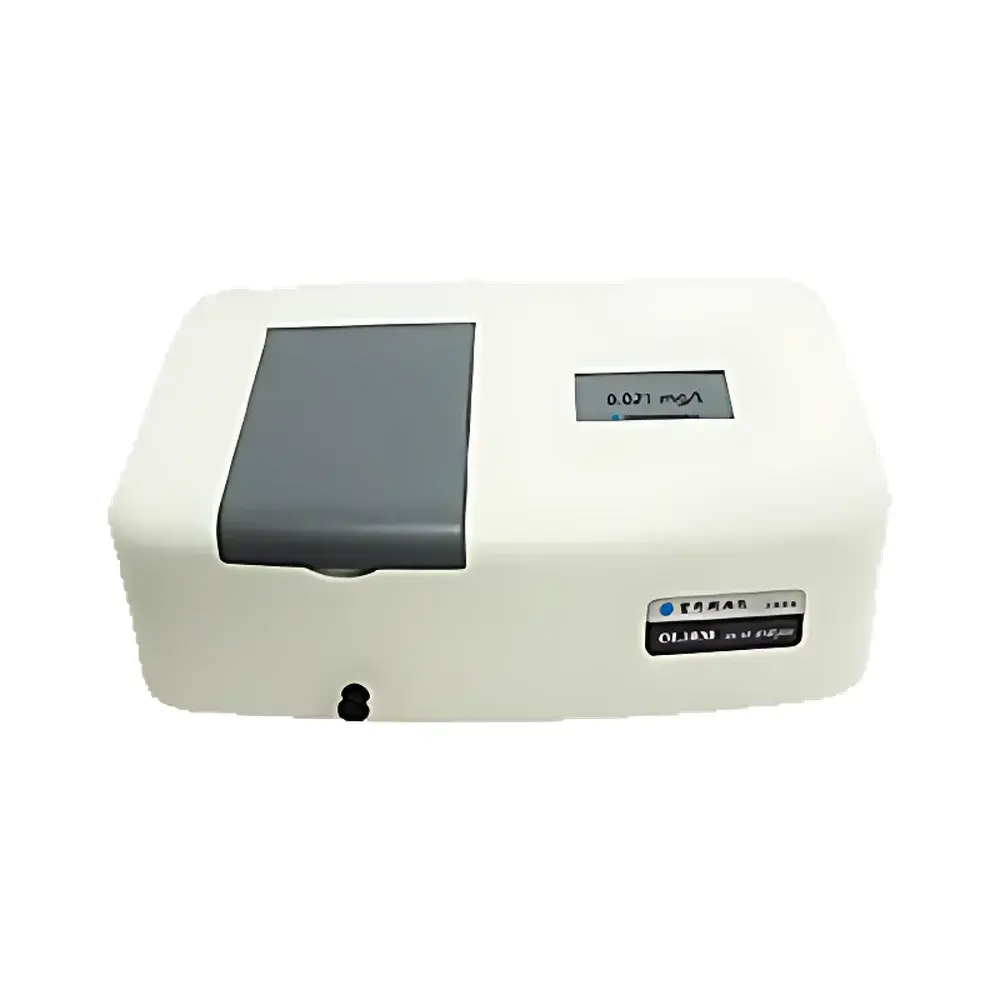
Online Instrument OL1030 UV Spectrophotometric Oil Content Analyzer (Manual Operation)
| Brand | Online Instrument |
|---|---|
| Origin | Shanghai, China |
| Manufacturer Type | Direct Manufacturer |
| Product Category | Domestic |
| Model | OL1030 |
| Instrument Type | Laboratory-Based |
| Measurement Principle | UV Spectrophotometry (225 nm) |
| Detection Limit | 0.005 mg/L |
| Accuracy | ±2% |
| Resolution | 0.001 mg/L |
| Analysis Time | 1 minute per sample |
Overview
The Online Instrument OL1030 UV Spectrophotometric Oil Content Analyzer is a dedicated laboratory instrument engineered for the quantitative determination of petroleum hydrocarbons in aqueous environmental matrices. It implements the standardized UV spectrophotometric method specified in HJ 970–2018, the People’s Republic of China Environmental Protection Standard “Determination of Petroleum Hydrocarbons in Water — UV Spectrophotometric Method.” The analyzer operates on the fundamental principle of Lambert-Beer law, measuring absorbance at 225 nm following solvent extraction and matrix cleanup. In practice, water samples are acidified to pH ≤ 2, extracted with n-hexane, dehydrated using anhydrous sodium sulfate (Na₂SO₄), and further purified by adsorption through magnesium silicate (Florisil®-equivalent) to selectively remove polar interferences—including fatty acids, chlorophylls, and other biogenic lipids—thereby isolating the non-polar petroleum fraction. This rigorous pretreatment ensures high specificity for mineral oil components and minimizes cross-sensitivity to naturally occurring organic matter.
Key Features
- Compliance-driven design aligned with HJ 970–2018 methodology for regulatory reporting in Chinese environmental monitoring programs
- Optimized optical path and low-noise photodetector enabling a detection limit of 0.005 mg/L and resolution of 0.001 mg/L
- Manual, operator-controlled workflow supporting full transparency in extraction volume, solvent volume, and dilution factor inputs
- Integrated concentration calculation engine: automatically computes final oil concentration (mg/L) based on user-defined sample volume (mL), n-hexane volume (mL), and pathlength (cm)
- Flexible calibration architecture supporting single-point standardization, multi-point calibration curves, and verification using three certified reference materials (e.g., mineral oil CRM, diesel CRM, and crude oil CRM)
- Rugged benchtop configuration with corrosion-resistant housing and stable optical bench for reproducible measurements across extended operational cycles
Sample Compatibility & Compliance
The OL1030 is validated for use with surface water, groundwater, seawater, and wastewater effluents. Its sample preparation protocol meets the stringent requirements of HJ 970–2018, including mandatory pH adjustment, n-hexane extraction efficiency validation (>90%), and post-extraction cleanup via magnesium silicate column or cartridge. While primarily deployed in domestic Chinese laboratories, the methodological rigor and documented uncertainty budget (±2% accuracy at mid-range concentrations) support alignment with broader international quality frameworks—including ISO/IEC 17025:2017 for testing laboratory competence—and facilitates data acceptance in cross-border environmental assessments. The instrument does not incorporate automated fluid handling; therefore, all steps—from phase separation to cuvette loading—are performed manually under GLP-compliant documentation protocols.
Software & Data Management
As a manual spectrophotometric system, the OL1030 does not feature embedded firmware or proprietary software. Data acquisition is conducted using external UV-Vis spectrophotometers (e.g., Shimadzu UV-2600, PerkinElmer Lambda 365) configured with 225 nm fixed-wavelength or scanning mode. Quantitative analysis is executed via spreadsheet-based calculation templates or LIMS-integrated spreadsheets that enforce traceable input logging (sample ID, volumes, standard lot numbers, analyst initials, date/time). Audit trails, electronic signatures, and version-controlled calibration records may be maintained externally in accordance with ISO 17025 Clause 7.7 and FDA 21 CFR Part 11 requirements when paired with compliant laboratory informatics systems.
Applications
- Regulatory compliance monitoring for petroleum hydrocarbons in municipal and industrial wastewater discharge permits
- Baseline and trend analysis of oil contamination in riverine, lacustrine, and coastal marine environments
- Leak detection and source identification in groundwater plume investigations near storage tank farms or pipeline corridors
- Method validation and interlaboratory comparison studies supporting national water quality assessment programs
- Educational use in university environmental chemistry and analytical science curricula for teaching solvent extraction, spectral quantification, and matrix interference mitigation
FAQ
Does the OL1030 include an integrated spectrophotometer?
No. The OL1030 is a method-specific workflow system comprising extraction tools, purification consumables, and calculation protocols. Users must supply a compatible UV-Vis spectrophotometer capable of precise 225 nm measurement.
Is n-hexane the only acceptable extraction solvent?
Per HJ 970–2018, n-hexane is the mandated solvent. Substitution with alternatives (e.g., cyclohexane, petroleum ether) is not permitted for regulatory submissions under this standard.
Can the OL1030 be used for total petroleum hydrocarbon (TPH) analysis beyond petroleum hydrocarbons?
No. The method targets only the UV-absorbing fraction of petroleum hydrocarbons (C10–C40 aliphatics and aromatics). It excludes non-UV-active compounds such as long-chain paraffins and certain heterocyclics, and is not equivalent to gravimetric or GC-FID TPH methods.
What documentation is provided for method validation?
A comprehensive application note is supplied, including recovery studies (spike levels: 0.05–5.0 mg/L), precision data (RSD < 4% at n = 6), linearity range (0.01–10 mg/L), and interference testing against common co-contaminants (e.g., humic acid, diesel, lubricating oil).







