
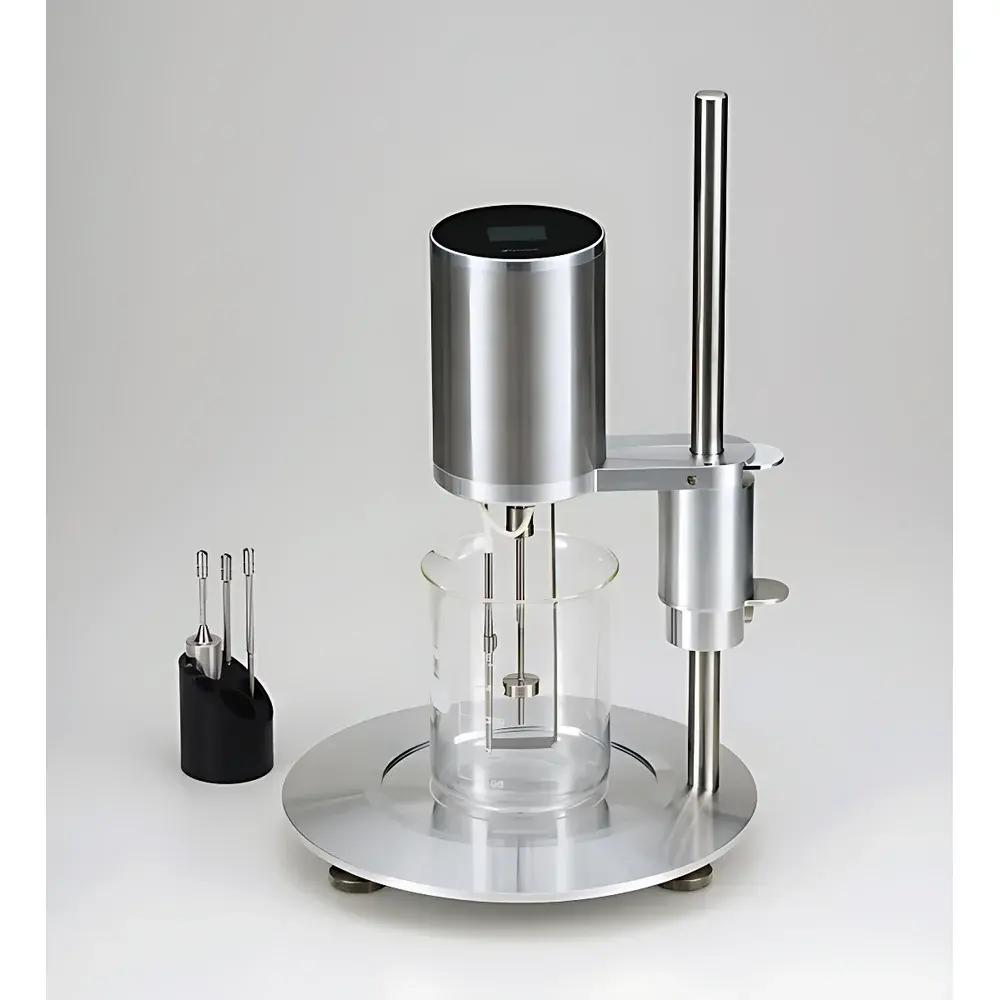
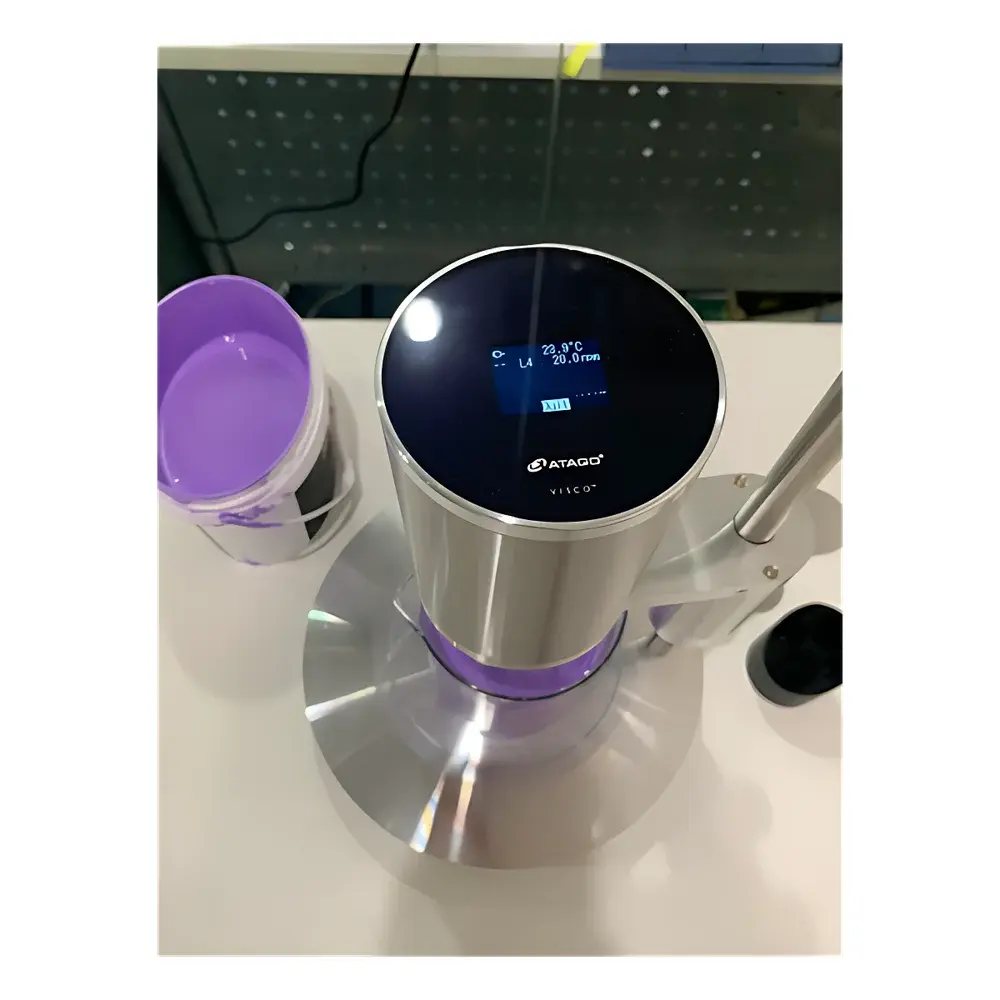
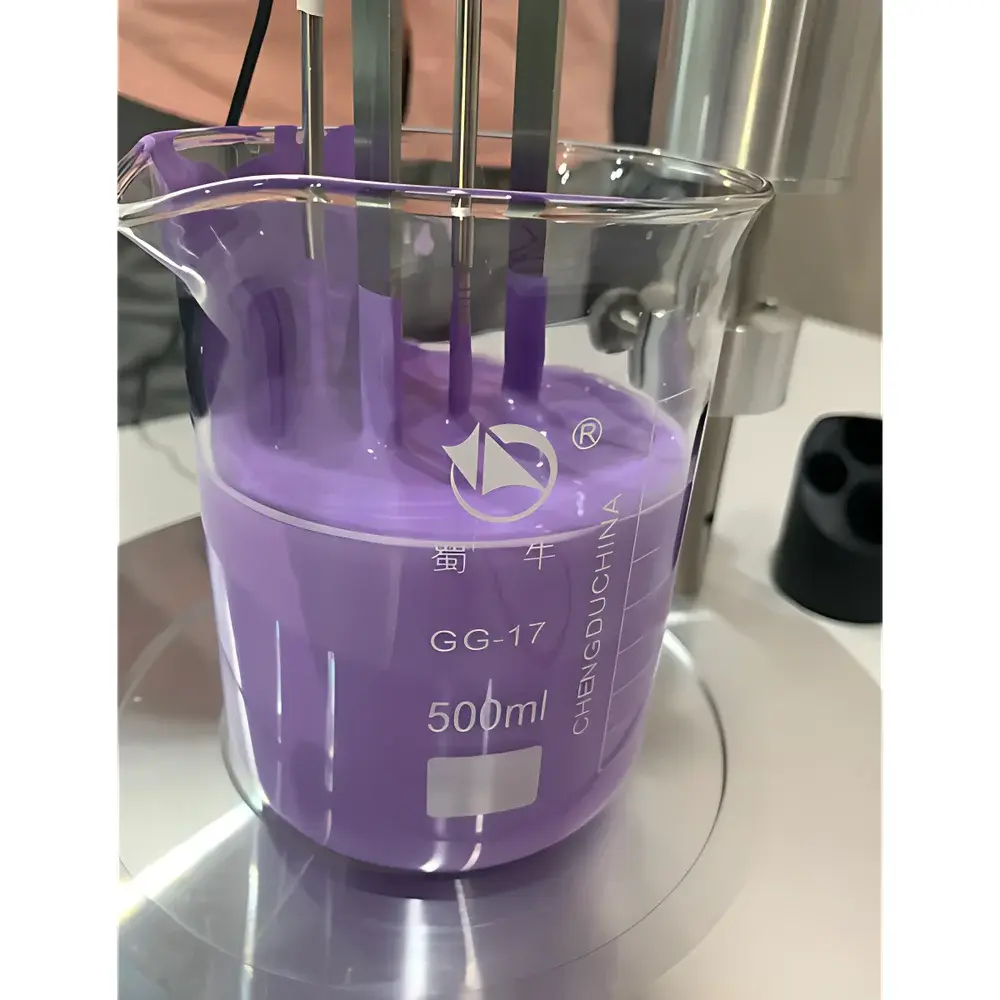
ATAGO VISCO B(L) Benchtop Rotational Viscometer
| Brand | ATAGO |
|---|---|
| Origin | Japan |
| Model | VISCO B(L) |
| Instrument Type | Benchtop Rotational Viscometer |
| Viscosity Range | 50–60,000,000 mPa·s |
| Temperature Control Range | 0.0–100.0 °C |
| Temperature Resolution | 0.1 °C |
| Temperature Accuracy | ±0.2 °C |
| Measurement Principle | Coaxial Cylinder (Couette Flow) Rheology |
| Compliance | Designed for ISO 2555, ASTM D2196, and USP <911> viscosity testing protocols |
Overview
The ATAGO VISCO B(L) Benchtop Rotational Viscometer is a precision-engineered instrument designed for reliable, repeatable measurement of dynamic viscosity across a broad range of Newtonian and non-Newtonian fluids. Operating on the fundamental principle of Couette flow—where torque exerted on a rotating spindle immersed in a sample is proportional to the fluid’s shear stress—the VISCO B(L) delivers high reproducibility under controlled temperature conditions. Its coaxial cylinder geometry ensures minimal wall-slip effects and stable shear rate profiles, making it especially suitable for quality assurance in regulated environments such as pharmaceutical manufacturing, industrial coatings, and food R&D. Unlike capillary or falling-ball viscometers, this rotational system enables direct quantification of dynamic viscosity (in mPa·s or Pa·s), supporting both single-point and multi-speed rheological profiling without requiring fluid density inputs.
Key Features
- Benchtop fixed-mount architecture with integrated Peltier-controlled temperature regulation (0.0–100.0 °C), enabling precise thermal stabilization critical for temperature-sensitive formulations.
- Wide dynamic viscosity range: 50–60,000,000 mPa·s—covering low-viscosity solvents (e.g., ethanol, acetone) through ultra-high-viscosity gels (e.g., carbomer hydrogels, polymer melts, bituminous binders).
- Temperature resolution of 0.1 °C and accuracy of ±0.2 °C—validated per ISO 17025 traceable calibration procedures.
- Dual-mode operation: manual speed selection and programmable ramp sequences for time-dependent viscosity assessment (thixotropy/yield stress estimation).
- Stainless-steel spindles compliant with ISO 3219 geometry standards; interchangeable spindle sets (L-type optimized for high-viscosity, low-shear applications).
- Real-time torque and rotational speed feedback with digital display—no analog dials or parallax errors.
- Robust mechanical design with vibration-dampened base and leveling feet, ensuring stability during extended measurements.
Sample Compatibility & Compliance
The VISCO B(L) accommodates samples from diverse sectors including pharmaceutical intermediates (e.g., protein solutions, sterile suspensions), industrial coatings (water-based acrylics, epoxy resins, UV-curable inks), personal care emulsions (shampoos, hyaluronic acid serums), and food-grade viscous matrices (tomato paste, honey, pectin gels). Its sealed spindle housing prevents cross-contamination and facilitates cleaning between runs. The instrument supports compliance workflows aligned with ISO 2555 (plastics—determination of apparent viscosity), ASTM D2196 (non-Newtonian behavior of paints and related materials), and USP (viscosity of liquid dosage forms). While not inherently 21 CFR Part 11 compliant, its analog output interface allows integration with validated LIMS or ELN systems when paired with audit-trail-enabled data acquisition modules.
Software & Data Management
The VISCO B(L) operates as a standalone unit with front-panel controls and real-time numeric display. For enhanced traceability, optional RS-232/USB connectivity enables export of timestamped viscosity, temperature, spindle ID, and rotational speed data to external PCs. When used with ATAGO’s proprietary data logging software (sold separately), users can generate GLP-compliant reports—including operator ID, environmental conditions, calibration certificate references, and deviation alerts. All stored datasets retain full metadata, supporting internal QA reviews and regulatory inspections under GMP or ISO 17025 frameworks.
Applications
- Pharmaceutical Development: Monitoring viscosity shifts during lyophilization cycle development, assessing injectable suspension stability, and verifying batch-to-batch consistency of ophthalmic gels and nasal sprays.
- Coatings & Inks: Optimizing resin-solvent ratios in architectural paints, evaluating thixotropic recovery after spray application, and validating shelf-life-related viscosity drift in waterborne systems.
- Food Science: Characterizing shear-thinning behavior of ketchup and mayonnaise, detecting gelation onset in pectin-based desserts, and controlling pumpability of concentrated fruit purees.
- Academic Research: Teaching core rheological concepts (Newtonian vs. pseudoplastic flow, yield stress identification) and supporting undergraduate labs in material science and chemical engineering curricula.
- Quality Control Labs: Routine release testing of raw materials (e.g., polyvinyl alcohol solutions, silicone oils) and finished products where viscosity serves as a critical process parameter (CPP).
FAQ
What spindle configurations are supported by the VISCO B(L)?
The VISCO B(L) accepts standard L-series spindles (L1–L4) conforming to ISO 3219 geometry, optimized for high-viscosity, low-shear-rate measurement. Spindle interchange is tool-free and calibrated per spindle-specific constants.
Does the instrument support automatic temperature ramping?
No—it maintains user-set isothermal conditions but does not execute programmed temperature ramps. External circulation baths may be coupled for dynamic thermal profiling.
Can the VISCO B(L) measure yield stress?
Not directly; it provides steady-state viscosity at discrete shear rates. Yield stress estimation requires additional analysis (e.g., Herschel-Bulkley fitting) using multi-speed data collected manually.
Is calibration traceable to national standards?
Yes—ATAGO provides factory calibration certificates traceable to JCSS (Japan Calibration Service System), with optional NIST-traceable verification kits available for in-house validation.
What maintenance is required for long-term accuracy?
Annual recalibration is recommended; spindle surfaces must be cleaned with appropriate solvents after each use to prevent residue buildup affecting torque transmission.



