
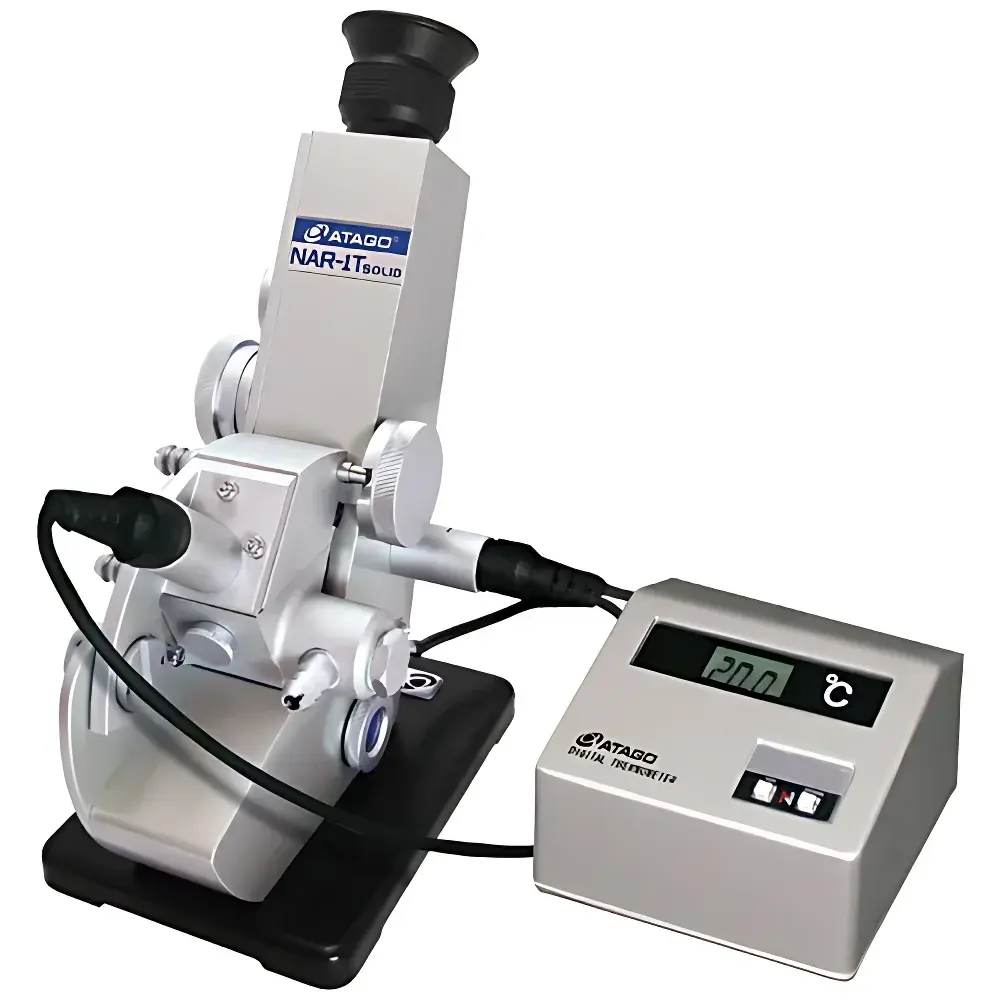
ATAGO NAR-1T SOLID Abbe Refractometer for Solids and Liquids
| Brand | ATAGO |
|---|---|
| Origin | Japan |
| Model | NAR-1T SOLID |
| Type | Benchtop Abbe Refractometer |
| Measurement Range | Refractive Index (nD): 1.3000–1.7000 |
| Brix | 0.0–95.0% |
| Accuracy | ±0.0002 (nD), ±0.1% (Brix) |
| Resolution | 0.001 (nD), 0.5% (Brix) |
| Temperature Range | 5–50°C |
| Temperature Accuracy | ±0.2°C (ambient) |
| Power Supply | AC 100–240 V, 50/60 Hz |
| Power Consumption | 5 VA |
| Dimensions (main unit) | 13 × 18 × 23 cm |
| Weight (main unit) | 1.8 kg |
| Dimensions (temperature display module) | 10 × 11 × 7 cm |
| Weight (temperature display module) | 0.5 kg |
Overview
The ATAGO NAR-1T SOLID Abbe Refractometer is a precision optical instrument engineered for the accurate determination of refractive index (nD) and Brix values in both liquid and solid transparent or semi-transparent samples. Based on the classical Abbe principle—utilizing total internal reflection at the prism-sample interface—the instrument delivers traceable, repeatable measurements without requiring sample dilution or destructive preparation. Its dual-capability design enables direct measurement of flat-surface solids—including optical glass, polymer films, acrylic sheets, resin blocks, and crystalline wafers—alongside conventional liquids such as syrups, solvents, pharmaceutical solutions, and edible oils. The NAR-1T SOLID operates within a calibrated temperature range of 5–50°C, with ambient temperature monitoring integrated via a dedicated digital temperature display module to support manual thermal compensation in accordance with ISO 21147:2021 and ASTM D1218 standards for refractometric analysis.
Key Features
- Optical Abbe configuration with high-stability sodium D-line (589.3 nm) illumination and calibrated quartz prisms ensuring long-term spectral fidelity
- Dual-mode functionality: accommodates both liquid samples (via standard droplet application) and solid specimens (using contact prism coupling with optional immersion oil)
- Mechanically robust benchtop architecture with all-metal housing and anti-vibration base plate for laboratory-grade stability
- Manual focusing eyepiece with fine-adjustment vernier scale for precise critical angle alignment
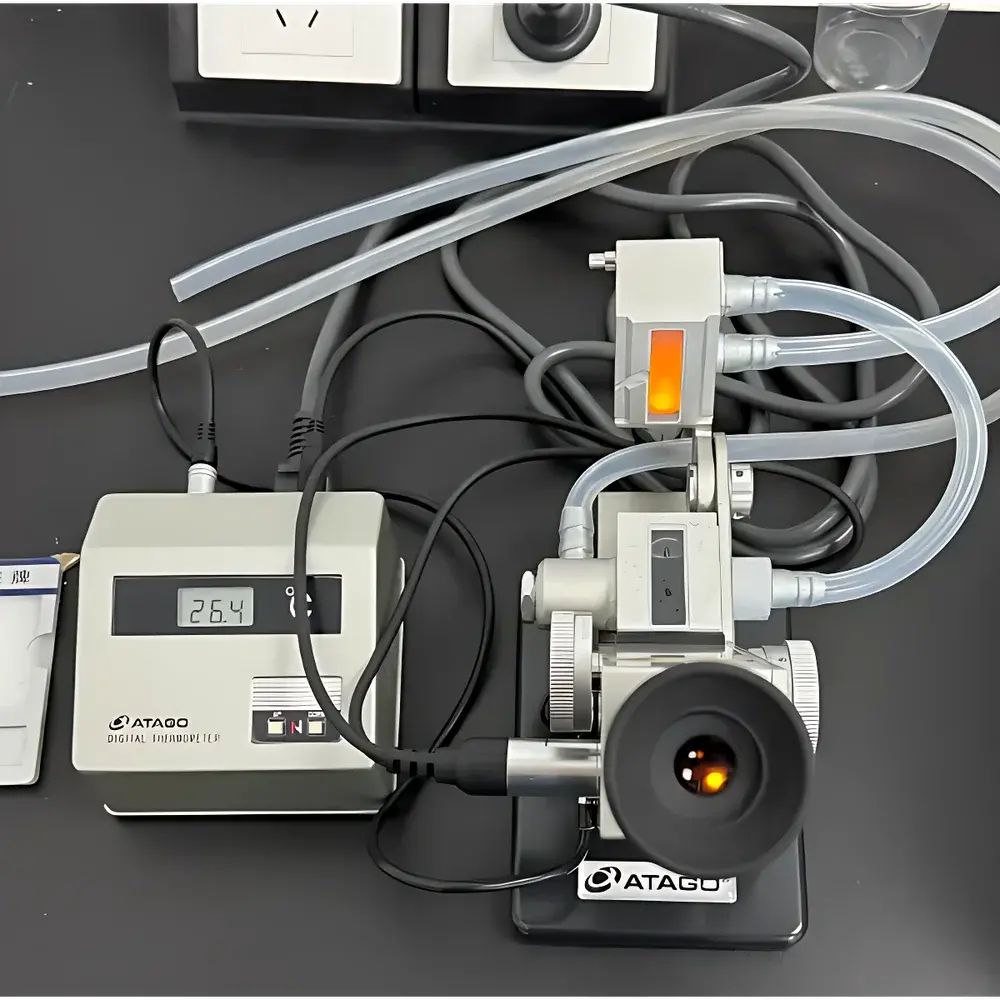
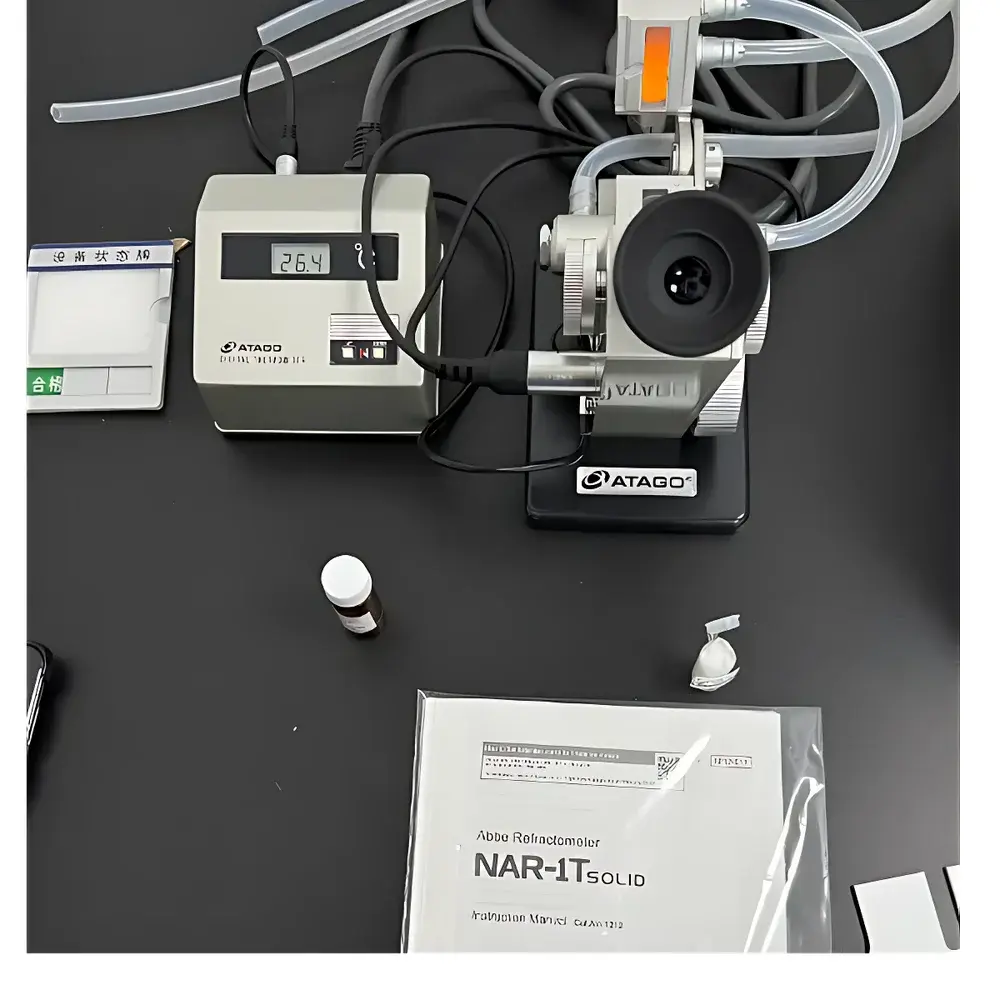
- Integrated temperature monitoring system with independent digital display module (±0.2°C accuracy) supporting real-time environmental condition logging
- No electronic readout or Peltier temperature control—designed for simplicity, reliability, and compliance with GLP environments where minimal firmware intervention is required
Sample Compatibility & Compliance
The NAR-1T SOLID supports a broad spectrum of industrial and academic applications involving homogeneous, optically isotropic materials. Compatible solid samples include float glass, borosilicate lenses, PMMA and PC sheets, silicone elastomer films, and epoxy-coated substrates—provided surface flatness meets ISO 10110-7 specifications (≤0.5 µm RMS roughness). For liquids, viscosity up to 500 mPa·s is accommodated without flow distortion. The instrument conforms to fundamental metrological requirements outlined in JIS K 0061, ISO 21147, and USP , and its mechanical calibration traceability aligns with national standards maintained by NMIJ/AIST (Japan) and NIST SRM reference materials. No software-based audit trail is implemented—consistent with Class I passive optical instrumentation under FDA 21 CFR Part 11 Annex A guidance.
Software & Data Management
The NAR-1T SOLID is a fully analog, non-digital instrument: it features no embedded microprocessor, touchscreen interface, or data export capability. All readings are interpreted visually through the calibrated ocular scale, recorded manually into laboratory notebooks or LIMS-compatible spreadsheets. This design eliminates firmware validation burdens and ensures uninterrupted operation in electromagnetically sensitive environments (e.g., near MRI suites or electron microscopy labs). Temperature data from the external display module may be logged separately using validated electronic thermometers compliant with ISO/IEC 17025 calibration protocols. For regulated QC workflows, users typically pair the NAR-1T SOLID with ATAGO’s optional calibration verification kit (Cat. No. 1212-CAL), which includes certified nD reference glasses traceable to NMIJ.
Applications
- Quality control of optical components in lens manufacturing and display panel fabrication
- Concentration verification of aqueous sugar solutions in confectionery and beverage R&D
- Purity assessment of organic solvents (e.g., ethanol, acetone, chloroform) in pharmaceutical synthesis
- Characterization of polymer film homogeneity during extrusion and coating process development
- Educational use in university physics and analytical chemistry laboratories for teaching optical dispersion principles
- Field-deployable verification of gemstone simulants and synthetic crystals in geological survey units
FAQ
Does the NAR-1T SOLID require electrical power for optical measurement?
No—the core Abbe optical path is entirely passive and requires no power; only the optional temperature display module draws 5 VA from AC mains.
Can I measure powdered or granular solids directly?
No—only flat, polished, transparent or translucent solids with parallel surfaces ≥10 mm × 10 mm are suitable. Powders must be compressed into pellets or embedded in high-nD mounting media prior to analysis.
Is immersion oil included with the instrument?
No—Type F immersion oil (nD ≈ 1.62) is sold separately (ATAGO Cat. No. 1212-OIL) and must be selected based on the expected sample refractive index to avoid total internal reflection failure.
What is the recommended recalibration interval?
Annual verification against certified reference standards is advised per ISO/IEC 17025 Clause 6.6; more frequent checks are required if used in high-throughput production QC environments.
How does temperature variation affect measurement uncertainty?
Refractive index exhibits a typical dn/dT coefficient of −3×10⁻⁴/°C for most organics; therefore, uncontrolled ambient fluctuations >±0.5°C introduce measurable bias—hence the inclusion of the dedicated temperature monitor.



