
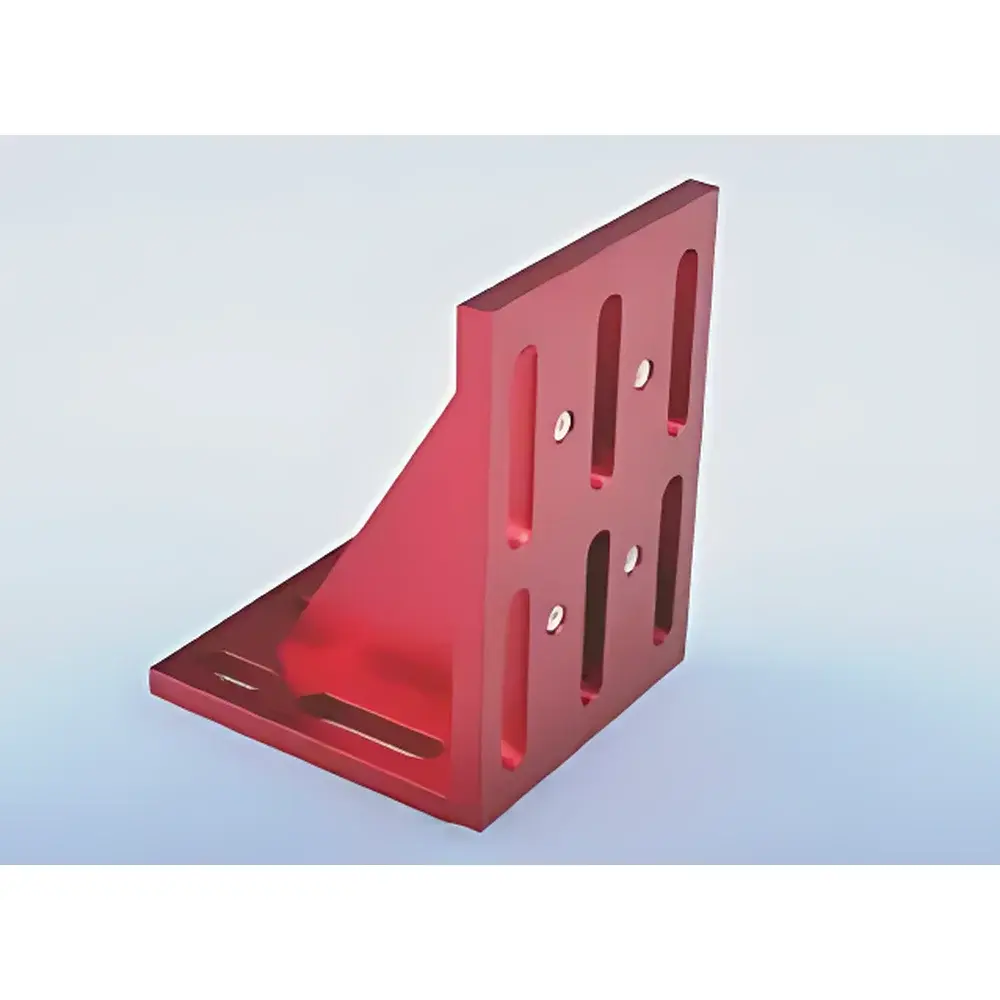
HTLB90 Right-Angle Mounting Block
| Brand | HT (Handing) |
|---|---|
| Origin | Jiangsu, China |
| Manufacturer Type | Authorized Distributor |
| Product Origin | Domestic (China) |
| Model | HTLB90 |
| Pricing | Upon Request |
Overview
The HTLB90 Right-Angle Mounting Block is a precision-machined optical mechanical component engineered for high-stability orthogonal alignment in multi-axis optomechanical systems. Designed according to standard optical breadboard and rail-compatible footprint conventions, it serves as a foundational interface for constructing 2D translation stages, XYZ kinematic platforms, or nested gimbal assemblies. Its core function relies on rigid, kinematically stable right-angle geometry—achieved through dual-face milling with controlled perpendicularity tolerance (typically ≤15 arcsec), ensuring minimal angular deviation during stage coupling. Unlike generic L-brackets, the HTLB90 integrates metrology-grade surface flatness (≤0.5 µm RMS) and stress-relieved aluminum 6061-T6 construction to minimize thermal drift and mechanical hysteresis under repeated loading—critical for interferometric setups, laser beam steering chains, and collimation alignment workflows.
Key Features
- Orthogonal mounting surfaces machined to ≤15 arcsec perpendicularity tolerance, verified via coordinate measuring machine (CMM) traceable to NIST standards
- Multiple standardized mounting patterns: 1/4″-20 UNC and M6 threaded holes on both faces, compatible with Thorlabs, Newport, and OptoSigma stage interfaces
- Black anodized aluminum 6061-T6 body for corrosion resistance, non-magnetic operation, and low thermal expansion coefficient (23.6 × 10⁻⁶ /°C)
- Integrated counterbored holes for flush-mount fastening, reducing profile height and eliminating protruding screw interference in compact optical layouts
- Surface finish: Ra ≤0.8 µm on functional faces; chamfered edges to prevent galling during assembly
Sample Compatibility & Compliance
The HTLB90 is fully compatible with ISO-standard optical tables (e.g., 25 mm grid pitch), metric and imperial translation stages, and modular optomechanical rails (e.g., 30 mm and 40 mm cross-section profiles). It conforms to general laboratory equipment safety guidelines per IEC 61000-6-3 (EMC emissions) and carries CE marking for mechanical components within the EU regulatory framework. While not a measurement instrument itself, its dimensional stability supports applications requiring GLP-compliant alignment repeatability—particularly in setups referenced to ISO 10110 optical surface specifications or ANSI Z80.10 laser safety configurations. No RoHS exemptions apply; lead-free anodizing and fasteners comply with Directive 2011/65/EU.
Software & Data Management
As a passive mechanical component, the HTLB90 does not incorporate embedded electronics, firmware, or software interfaces. However, its dimensional data—including CAD models (STEP, IGES, and SolidWorks formats), GD&T callouts, and material certifications—are available upon request for integration into digital twin workflows, LabVIEW-based system modeling environments, or Ansys Mechanical simulations. All technical documentation adheres to ISO 16792 for mechanical product definition and supports traceable configuration management in regulated R&D settings where audit trails for mechanical infrastructure are required (e.g., FDA-regulated photonics validation protocols).
Applications
- Constructing orthogonal XY or XYZ translation platforms for laser cavity alignment, fiber coupling optimization, and spatial light modulator positioning
- Mounting spectrometer input slits or detector arrays at fixed 90° incidence relative to optical axis in benchtop spectroscopy systems
- Integrating beam-steering mirrors with linear stages in adaptive optics testbeds requiring sub-arcminute angular stability
- Serving as a reference base for calibrating autocollimators, electronic levels, or theodolites in optical metrology labs
- Enabling modular reconfiguration of teaching optics kits (e.g., Meos or PASCO-style educational platforms) without tool-dependent realignment
FAQ
Is the HTLB90 suitable for vacuum environments?
Yes—the anodized aluminum construction and absence of adhesives or elastomers allow use in low-to-medium vacuum (≤10⁻⁴ mbar); however, outgassing testing per ASTM E595 is recommended for ultra-high vacuum integration.
Can it be used with motorized stages?
Absolutely—its mounting hole pattern matches industry-standard motorized translation stages from companies including Zaber, Physik Instrumente (PI), and Aerotech, provided mechanical load limits (max 15 kg static, 5 kg dynamic) are observed.
Does it include mounting hardware?
No—fasteners must be selected based on application requirements (e.g., class 12.9 steel screws for high-vibration environments); recommended torque: 1.2–1.5 N·m for M6 threads.
What surface treatment options are available?
Standard black anodizing (Type II, 15–20 µm thickness) is default; custom hard anodizing (Type III) or nickel plating can be arranged under OEM agreement.
Is dimensional inspection data provided with each unit?
Batch-level CMM reports are supplied with every order; individual unit certification is available upon request with additional lead time and fee.




