
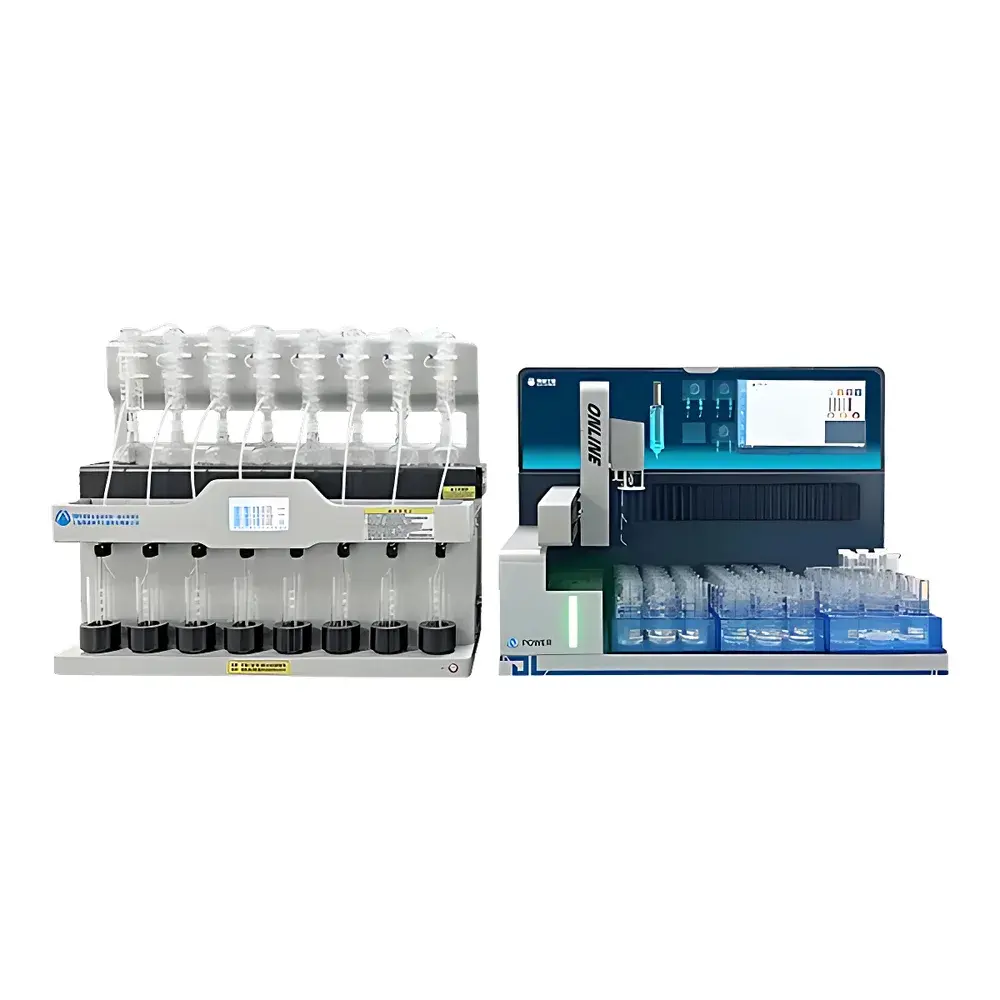
Online Instrument OL2700N Automated Sulfide Analyzer
| Brand | Online Instrument |
|---|---|
| Origin | Shanghai, China |
| Model | OL2700N |
| Instrument Type | Laboratory Benchtop Analyzer |
| Sample Capacity | 45 positions |
| Distillation Stations | 8 |
| Automation Level | Fully Automated (sample transfer, reagent addition, calibration curve generation, mixing, colorimetric reaction timing, final volume adjustment, photometric measurement, post-run cleaning and waste disposal) |
| Data Management | Cloud-synced reporting with remote mobile access |
| Compliance Context | Designed for compliance with ISO 16392:2017 (Water quality — Determination of sulfide — Colorimetric method using methylene blue), EPA Method 376.1, and HJ 1226-2021 (Chinese Environmental Protection Standard for Sulfide in Water) |
Overview
The Online Instrument OL2700N Automated Sulfide Analyzer is a benchtop laboratory system engineered for precise, high-throughput quantification of dissolved and acid-volatile sulfide (AVS) in aqueous environmental matrices. It employs the standardized methylene blue colorimetric method—based on the reaction of sulfide ions with N,N-dimethyl-p-phenylenediamine under acidic conditions to form a stable chromophore measured at 670 nm. The instrument integrates sequential batch distillation, automated reagent handling, and spectrophotometric detection within a single platform, eliminating manual intervention from sample loading through data export. Its architecture supports unattended operation for up to 45 samples per run, with eight parallel distillation units enabling time-efficient processing while maintaining analytical integrity across variable matrix complexity.
Key Features
- Fully automated workflow: Integrated robotic arm handles sample vial positioning, acidification, nitrogen purging, distillate collection, reagent dispensing (FeCl3, DPD reagent), mixing, reaction incubation (programmable timer, 10–30 min), and final photometric readout.
- Dual-range calibration capability: Stores and recalls multiple pre-validated calibration curves (e.g., 0–0.5 mg/L and 0.5–5.0 mg/L S2−) with automatic range-switching logic based on preliminary absorbance screening.
- Distillation module with temperature-controlled condensation: Eight independent borosilicate glass distillation paths featuring PID-regulated heating mantles (up to 200 °C) and chilled condensers (4–10 °C) to ensure quantitative recovery of volatile sulfide species without carryover or loss.
- Optical detection system: Dual-beam visible spectrophotometer (670 nm ± 2 nm bandwidth) with quartz flow cell, auto-zero referencing, and linear dynamic range spanning 0.005–5.000 mg/L (as S2−), traceable to NIST-certified standards.
- Remote operational interface: Web-based control panel accessible via desktop or mobile browser; real-time status monitoring, run queue management, alarm notification (e.g., low reagent, clogged line), and encrypted data download (CSV, PDF, XML).
Sample Compatibility & Compliance
The OL2700N accommodates standard 40–50 mL glass sample vials and accepts untreated or preservative-stabilized (e.g., ZnAc2) water samples—including turbid surface waters, saline groundwater, aerobically treated effluents, and high-TDS industrial discharges. Matrix tolerance is enhanced by programmable acid addition volume (1–10 mL) and adjustable distillation duration (5–25 min). The system meets functional requirements of ISO 16392:2017 and U.S. EPA Method 376.1 for sulfide determination in regulatory reporting. Audit trails, electronic signatures, and user-access logs comply with GLP principles and support alignment with FDA 21 CFR Part 11 readiness when deployed in validated laboratory environments.
Software & Data Management
The embedded Linux-based control software (v3.2+) provides intuitive method editor, QC flagging (e.g., curve R2 < 0.995 triggers alert), and automated report generation including sample ID, timestamp, operator ID, calibration parameters, raw absorbance values, concentration results, and pass/fail status against method-defined limits. All data are stored locally on an industrial-grade SSD with optional cloud backup via TLS 1.2–encrypted API to customer-owned servers. Export formats include LIMS-compatible ASTM E1384-compliant files and customizable templates for regional environmental agency submissions (e.g., China’s MEP Form 2021).
Applications
The OL2700N serves routine and compliance-driven analysis across municipal and industrial sectors: monitoring influent/effluent sulfide in wastewater treatment plants to prevent biocorrosion and odor complaints; assessing AVS speciation in sediment porewater for ecological risk assessment; verifying sulfur compound removal efficiency in petroleum refinery desulfurization units; supporting corrosion inhibitor testing in cooling water systems; and validating pretreatment performance prior to membrane filtration or advanced oxidation processes. Its robustness enables deployment in field laboratories, mobile environmental units, and centralized reference labs requiring reproducible, auditable sulfide data.
FAQ
What sample preservation protocols are recommended prior to analysis?
Samples should be preserved with zinc acetate (final concentration ≥1% w/v) and stored at 4 °C; analysis is recommended within 24 h for dissolved sulfide or 7 days for acid-volatile sulfide if frozen at −20 °C.
Can the OL2700N analyze suspended solids or sludge samples?
Yes—when configured with optional ultrasonic homogenization module (sold separately), it supports semi-quantitative AVS extraction from digested sludge and sediment slurries per ISO 16700.
Is method validation documentation provided?
Yes—the instrument ships with IQ/OQ documentation templates, a factory-verified performance qualification report (including LOD/LOQ, precision, spike recovery across 5–100% of range), and SOP drafts aligned with ISO/IEC 17025 requirements.
How often does the system require maintenance?
Preventive maintenance is scheduled every 6 months: tubing replacement, optical path cleaning, distillation head inspection, and calibration verification using certified sulfide reference standards.
Does the software support multi-user role-based access control?
Yes—administrator, analyst, and reviewer roles are configurable with password policies, session timeouts, and granular permissions for method editing, result approval, and audit log viewing.
Related Products







