
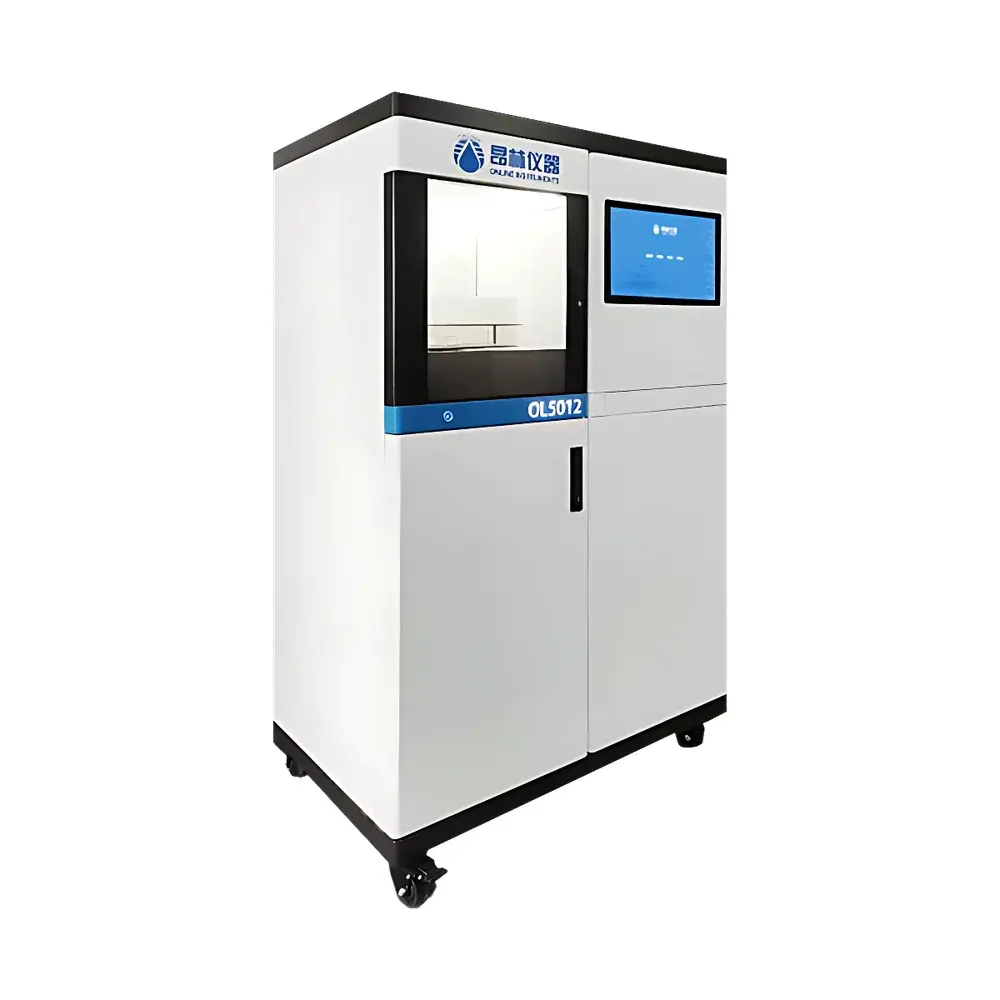
Online Instrument OL 5012 Total Phosphorus and Total Nitrogen Analyzer
| Brand | Online Instrument |
|---|---|
| Origin | Shanghai, China |
| Manufacturer Type | Direct Manufacturer |
| Product Category | Domestic |
| Model | OL 5012 |
| Measurement Parameters | Total Phosphorus (TP) & Total Nitrogen (TN) |
| Instrument Type | Laboratory-Based Analyzer |
| Measurement Principle | Spectrophotometry (UV-Vis) |
| TP Range | 0.04–1.2 mg/L |
| TN Range | 0.2–7 mg/L |
| Accuracy | <2% for both TP and TN |
| Detection Limit | TP: 0.01 mg/L |
| TN | 0.05 mg/L |
| Resolution | 0.001 mg/L |
Overview
The Online Instrument OL 5012 Total Phosphorus and Total Nitrogen Analyzer is a fully automated, benchtop laboratory system engineered for precise, trace-level quantification of total phosphorus (TP) and total nitrogen (TN) in aqueous environmental samples. It implements standardized spectrophotometric detection following digestion-based oxidation protocols aligned with ISO 11908 (for TP) and ISO 11909 (for TN), as well as EPA Method 365.4 and HJ 670–2013. The instrument integrates high-pressure thermal digestion (up to 160 °C, 0.6 MPa), automated reagent dispensing, in-situ calibration curve generation via multi-point standardization, and post-analysis fluidic pathway regeneration—all within a single, closed-loop architecture. Designed for regulatory compliance and method fidelity, the OL 5012 replicates manual wet-chemistry workflows—including identical sample volume (e.g., 10 mL), reagent volumes, digestion duration (60 minutes per parameter), and optical detection wavelengths—ensuring direct comparability with reference laboratory results.
Key Features
- Fully automated sequence: integrated high-pressure digestion, reagent addition (persulfate for TN; ammonium molybdate/ascorbic acid for TP), color development, photometric measurement at 880 nm (TP) and 220/275 nm (TN), and quantitative calculation.
- Self-cleaning fluidic architecture: programmable rinse cycles (1–5 passes) using deionized water and optional acid wash, minimizing carryover between samples with differing concentration levels.
- Touchscreen HMI with embedded Windows OS: intuitive graphical interface for method selection, run scheduling, real-time status monitoring, and local data review.
- Remote operation and supervision: secure cloud-enabled connectivity supporting mobile (iOS/Android) access for instrument control, live process tracking, and result retrieval via encrypted HTTPS API.
- Integrated hazardous reagent handling: sealed reagent cartridges with pressure-relief venting, on-board activated carbon adsorption module for NOx and acidic vapors, and automatic waste liquid collection into certified containment vessels compliant with IEC 61000-6-3 EMC standards.
- LIMS interoperability: native support for ASTM E1384-compliant data export (CSV, XML) and bidirectional HL7/FHIR-compatible integration for seamless synchronization with laboratory information management systems.
Sample Compatibility & Compliance
The OL 5012 accepts raw, filtered (0.45 µm), or centrifuged liquid samples from surface water, groundwater, municipal wastewater, and industrial effluents. It meets performance criteria specified in ISO/IEC 17025:2017 for analytical competence and supports GLP/GMP audit readiness through full electronic record retention—including timestamps, operator ID, calibration logs, maintenance history, and raw absorbance values. All digestion and detection steps comply with US EPA 40 CFR Part 136 validation requirements for wastewater analysis and are suitable for reporting under national discharge permits (e.g., China’s GB 3838–2002 and GB 18918–2002).
Software & Data Management
The embedded analytical software provides automated calibration curve construction using up to 8 standard points, dynamic range adaptation, outlier rejection (Dixon’s Q-test), and uncertainty estimation per ISO/IEC Guide 98-3. Audit trails conform to FDA 21 CFR Part 11 requirements, including electronic signatures, immutable event logging, and role-based user permissions (administrator, analyst, viewer). Data exports include metadata tags (sample ID, digestion temperature, reagent lot numbers) and are compatible with third-party statistical platforms (e.g., JMP, Minitab) for trend analysis and QA/QC reporting.
Applications
- Regulatory monitoring of TP/TN in receiving waters under national water quality standards.
- Wastewater treatment plant (WWTP) influent/effluent compliance testing against discharge limits.
- Environmental impact assessment (EIA) baseline and post-construction monitoring programs.
- Research applications in eutrophication studies, nutrient budget modeling, and biogeochemical cycling investigations.
- Method verification and interlaboratory comparison exercises under CNAS-accredited frameworks.
FAQ
What digestion method does the OL 5012 use for total nitrogen determination?
It employs alkaline potassium persulfate digestion at elevated temperature and pressure, oxidizing organic and inorganic nitrogen species to nitrate prior to UV spectrophotometric quantification.
Can the instrument analyze TP and TN simultaneously in one sample batch?
No—TP and TN require separate digestion and detection protocols due to incompatible reagent chemistries and wavelength requirements; however, the system supports sequential automated runs without manual intervention.
Is the OL 5012 compliant with ISO 17025 documentation requirements?
Yes—the system maintains complete electronic records of all analytical events, calibration verifications, and preventive maintenance actions, satisfying Clause 7.5 and Annex A3 of ISO/IEC 17025:2017.
How is reagent consumption tracked and managed?
Each reagent cartridge contains an RFID tag storing lot number, expiration date, and initial volume; the software monitors usage in real time and triggers low-volume alerts.
What safety certifications does the instrument hold?
It complies with IEC 61010-1 (Safety Requirements for Electrical Equipment for Measurement) and CE marking directives for electromagnetic compatibility (EMC) and low voltage (LVD).
Related Products







