
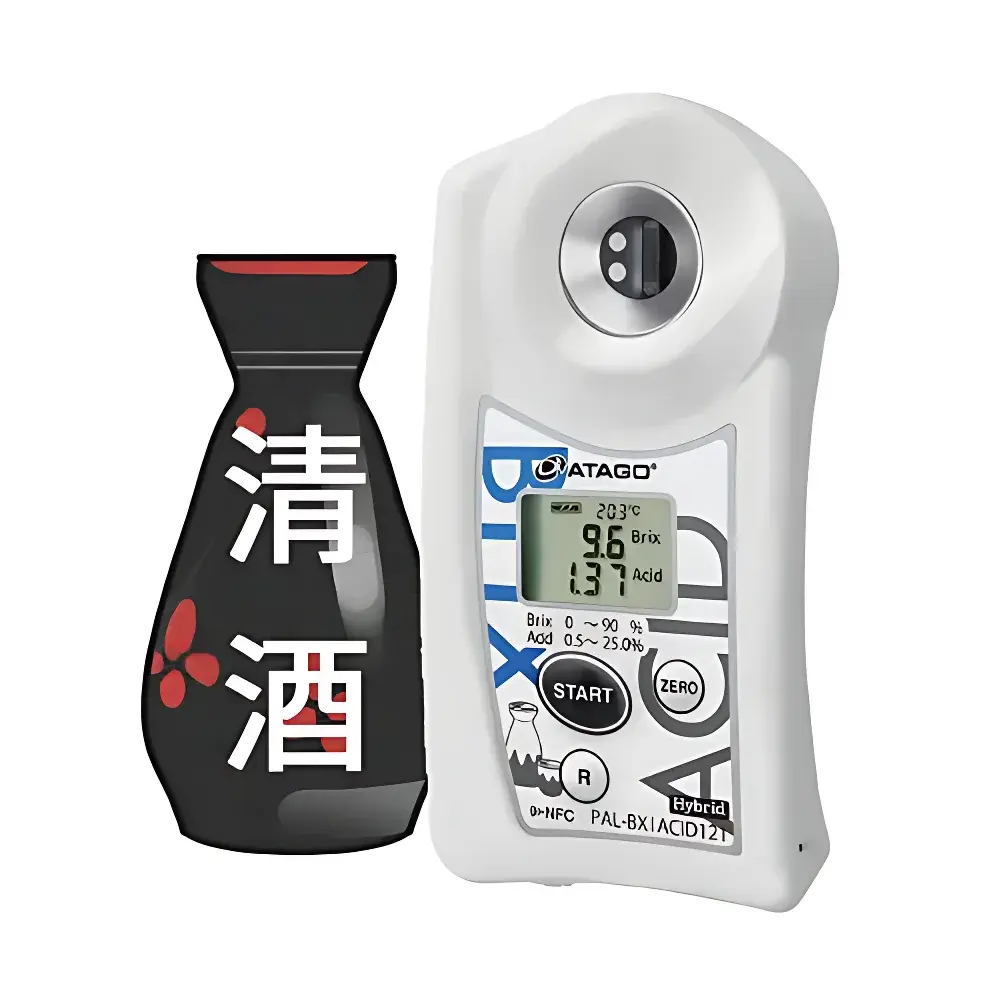
ATAGO PAL-BX/ACID 121 Portable Dual-Parameter Refractometer for Sake Brix and Titratable Acidity Measurement
| Brand | ATAGO |
|---|---|
| Origin | Japan |
| Model | PAL-BX/ACID 121 |
| Product Type | Handheld Digital Refractometer |
| Temperature Compensation Range | 10–40 °C |
| Brix Range | 0.0–90.0 % |
| Acid Range | 0.50–25.00 % (as citric acid equivalent) |
| Brix Accuracy | ±0.2 % |
| Acid Accuracy | ±0.10 % (0.10–1.00 %), ±10 % relative (1.01–8.80 %) |
| Brix Resolution | 0.1 % |
| Acid Resolution | 0.01 % (0.00–9.99 %), 0.1 % (≥10.0 %) |
| Sugar-Acid Ratio Display | Yes (R-key activated) |
| IP Rating | IP65 |
| Power | 2 × AAA alkaline batteries |
| Dimensions | 5.5 × 3.1 × 10.9 cm |
| Weight | 100 g (instrument only) |
Overview
The ATAGO PAL-BX/ACID 121 is a precision-engineered handheld refractometer designed specifically for rapid, on-site quantification of soluble solids (Brix) and titratable acidity in sake, rice wine, fruit juices, and other fermented or acidic beverages. It operates on the principle of critical-angle refractometry—measuring the refractive index of a liquid sample to infer Brix concentration—and integrates an empirically calibrated optical-acid algorithm that correlates refractive index shift after controlled dilution (1:50 w/w with distilled water) to total acid content, expressed as citric acid equivalents. Unlike conventional titration-based methods requiring standardized reagents, burettes, pH meters, and trained personnel, the PAL-BX/ACID 121 delivers repeatable, field-deployable measurements in under 3 seconds per parameter. Its dual-parameter architecture eliminates instrument switching and data reconciliation between separate Brix and acidity devices—critical for QC labs, sake breweries, and beverage R&D facilities where throughput, traceability, and method consistency are governed by internal SOPs aligned with ISO 2173 (fruit juice Brix determination) and AOAC Official Method 973.06 (titratable acidity in beverages).
Key Features
- Simultaneous Brix and acidity measurement capability with dedicated R-key activation for instantaneous sugar-acid ratio calculation—eliminating manual division errors and spreadsheet dependency.
- High-stability Abbe-type prism optics with temperature-compensated LED light source, ensuring stable refractive index readings across 10–40 °C ambient conditions without external thermostatic control.
- Dual-range acid algorithm optimized for low-concentration matrices (0.50–25.00 % as citric acid), validated against reference potentiometric titration per AOAC guidelines for fermented alcoholic beverages.
- IP65-rated enclosure—dust-tight and protected against low-pressure water jets—enabling reliable operation in humid brewery environments, production floors, and outdoor sampling stations.
- Auto-zero function and one-button calibration using distilled water, supporting daily verification without proprietary calibration fluids.
- Compact ergonomic design (100 g, 5.5 × 3.1 × 10.9 cm) with large backlit LCD display—optimized for gloved-hand operation and readability under variable lighting conditions.
Sample Compatibility & Compliance
The PAL-BX/ACID 121 is validated for use with clarified, non-viscous aqueous solutions typical of filtered sake, shochu, fruit nectars, soft drinks, and vinegar-based condiments. Sample viscosity must remain below 100 mPa·s to ensure uniform film formation on the prism surface; highly turbid or particulate-laden samples require centrifugation or filtration prior to analysis. The device complies with JIS K 0067 (Japanese Industrial Standard for refractometers) and meets CE marking requirements for portable optical instrumentation. While not inherently 21 CFR Part 11 compliant, its measurement logs (when exported via optional PC interface software) support GLP/GMP-aligned documentation when paired with lab-controlled calibration records, operator ID protocols, and audit-trail-enabled data management systems.
Software & Data Management
The PAL-BX/ACID 121 operates as a standalone instrument with no embedded memory or Bluetooth/Wi-Fi connectivity. However, it supports optional serial communication (RS-232) via ATAGO’s proprietary PAL-Link software (Windows-compatible), enabling batch export of timestamped Brix, acidity, and sugar-acid ratio values into CSV or Excel formats. This facilitates integration into LIMS environments, statistical process control (SPC) dashboards, and trending analysis for HACCP critical control point monitoring. Calibration history, operator annotations, and environmental temperature metadata can be manually appended during data import—supporting traceability requirements under ISO/IEC 17025 accredited testing laboratories.
Applications
- Real-time quality verification of sake mash fermentation endpoints—tracking Brix decline and acid accumulation to determine optimal pressing time.
- Batch-to-batch consistency assessment in premium rice wine production, particularly for namazake (unpasteurized sake) where microbial stability correlates strongly with sugar-acid balance.
- R&D formulation of flavored alcoholic beverages, where precise acid modulation affects flavor release kinetics, mouthfeel perception, and preservative efficacy.
- Raw material screening of rice koji and steamed rice substrates for enzymatic hydrolysis potential, inferred from initial Brix solubilization rates.
- Regulatory compliance checks for labeling accuracy of “dry”, “medium-dry”, and “sweet” sake categories defined by Japan’s National Tax Agency (NTA) based on calculated sugar-acid ratios.
FAQ
How is acidity measured without titration?
The PAL-BX/ACID 121 uses a validated dilution-refractometric correlation: a 1:50 (w/w) dilution of sample in distilled water induces a predictable refractive index shift proportional to total titratable acid concentration, calibrated against citric acid standards.
Does the device require recalibration before each use?
No—daily verification with distilled water is sufficient; full calibration is recommended weekly or after exposure to extreme temperatures or mechanical shock.
Can it measure undiluted sake directly for acidity?
No—undiluted sake yields non-linear refractive responses due to ethanol interference; the 1:50 dilution protocol is mandatory for acid mode accuracy.
Is temperature compensation automatic?
Yes—integrated thermistor continuously monitors sample temperature and applies NIST-traceable correction coefficients across 10–40 °C.
What maintenance is required?
Wipe prism surface with lens tissue and distilled water after each use; avoid organic solvents. Store in supplied protective case with desiccant to prevent condensation-related drift.




