
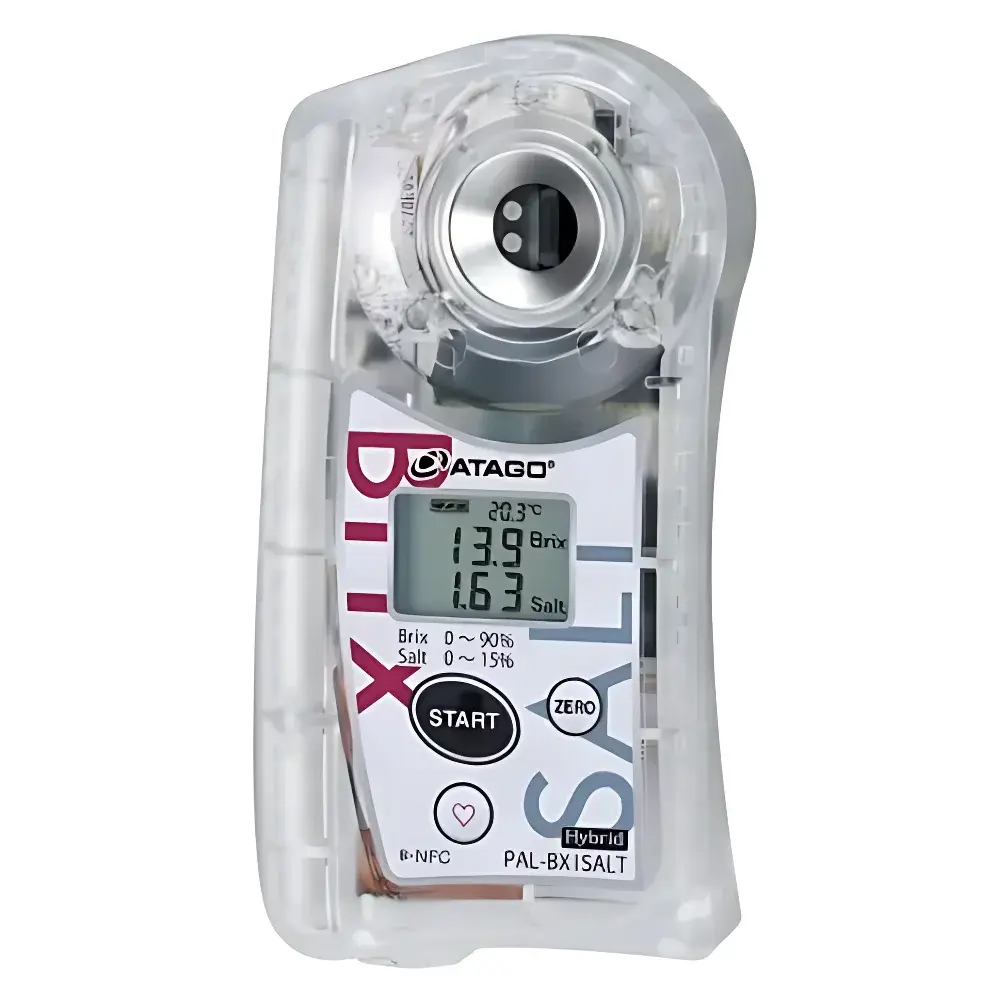
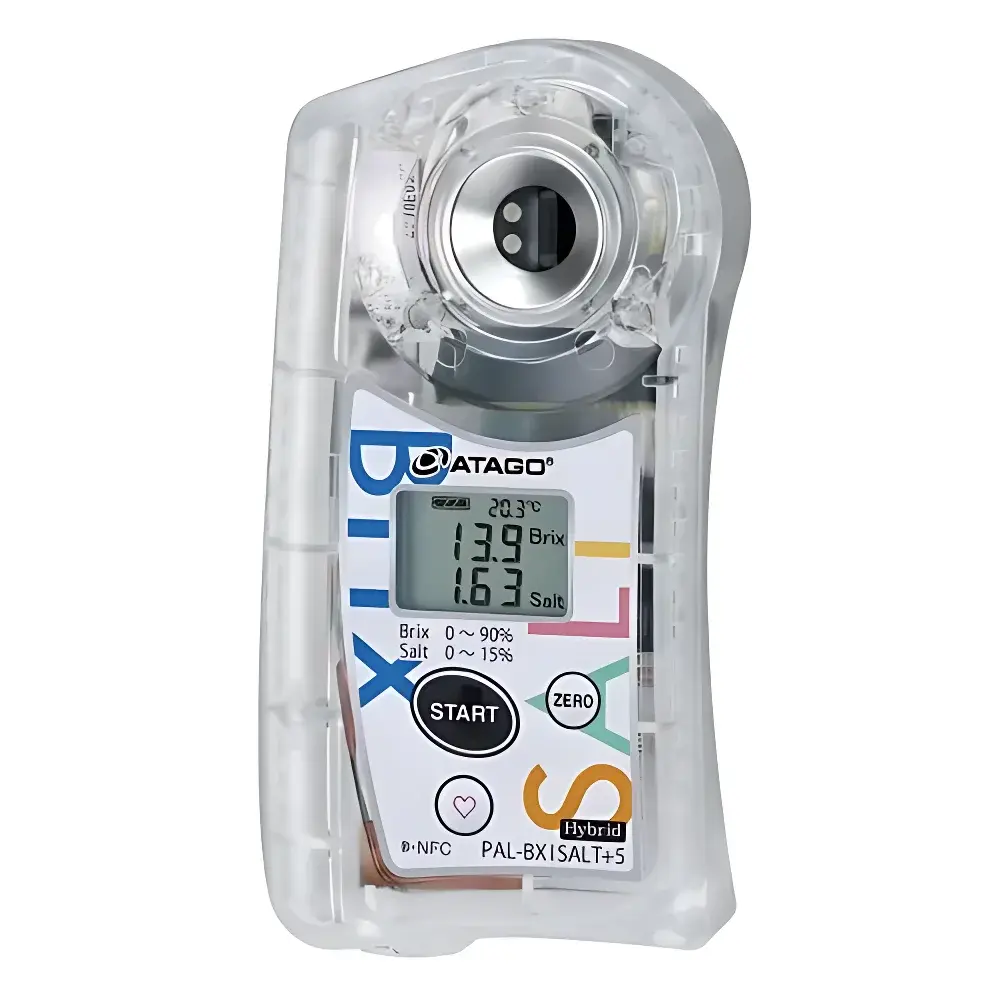
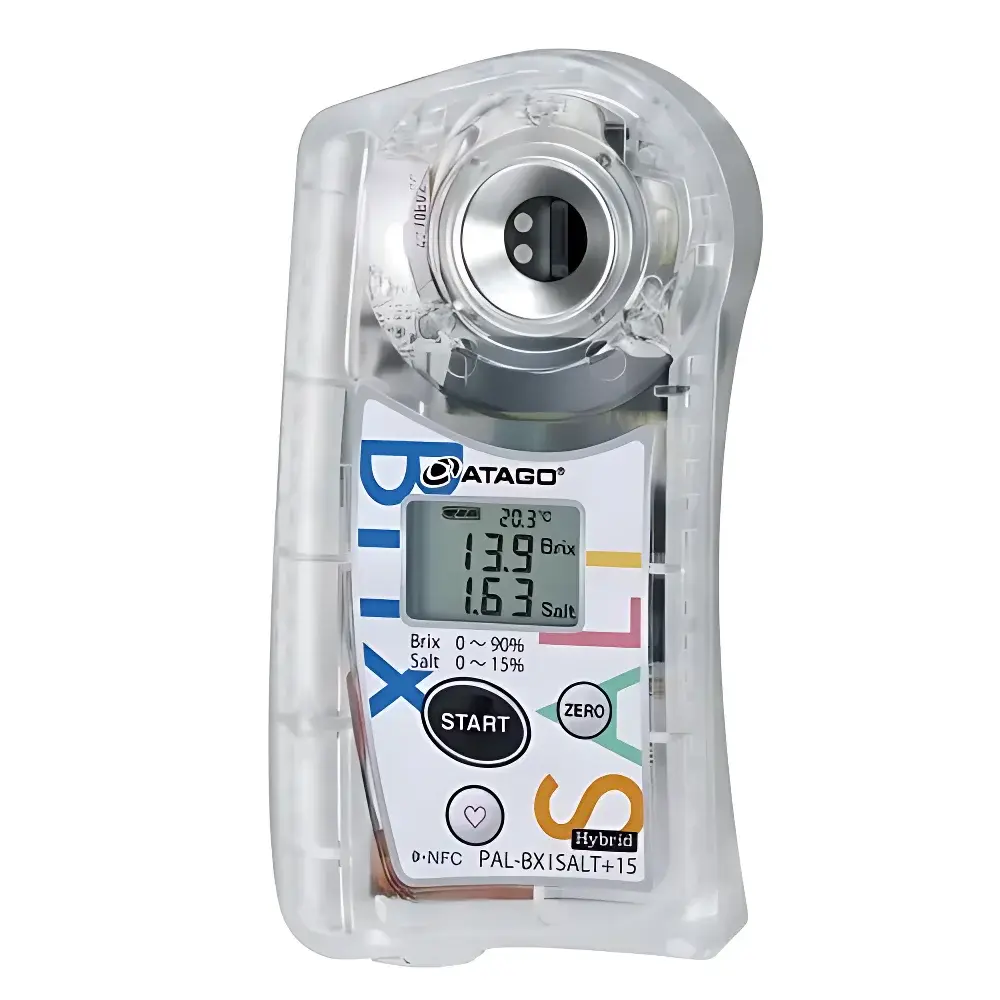
ATAGO PAL-BX-SALT Digital Refractometer for Simultaneous Brix and Salt Concentration Measurement
| Brand | ATAGO |
|---|---|
| Origin | Japan |
| Model | PAL-BX-SALT (Brix & Salt Dual-Parameter Portable Refractometer) |
| Measurement Principle | Total Internal Reflection via Abbe Refractometry |
| Display | LCD Digital |
| Sample Volume | ≤0.3 mL |
| Measurement Time | <3 seconds |
| Calibration | Automatic Temperature Compensation (ATC) 10–40 °C |
| Compliance | ISO 2173, AOAC 955.03, JIS K 0064 |
Overview
The ATAGO PAL-BX-SALT is a high-precision, handheld digital refractometer engineered for the simultaneous quantitative determination of sucrose concentration (expressed as % Brix) and sodium chloride concentration (expressed as % salt, w/w) in aqueous solutions. Leveraging Abbe-type total internal reflection optics and temperature-compensated refractive index measurement, the instrument correlates refractive index shifts—induced by solute concentration changes—to calibrated Brix and salt scales with traceable metrological foundations. Unlike single-parameter refractometers, the PAL-BX-SALT integrates dual-algorithm firmware that discriminates between sugar- and salt-dominated refractive responses based on empirical dispersion models validated across food-grade matrices. Its optical architecture features a sapphire prism surface (Vickers hardness >2000 HV), ensuring long-term stability against abrasion and chemical exposure typical in production-line environments. Designed for routine quality assurance in regulated settings, the device operates without reagents or consumables and requires no external power source beyond its built-in rechargeable lithium-ion battery (rated for ≥5,000 measurements per charge).
Key Features
- Dual-parameter output: Simultaneous real-time display of % Brix and % salt (NaCl, w/w) on a single LCD screen—eliminating manual cross-referencing or secondary calculations.
- Micro-volume sampling: Requires only 0.2–0.3 mL of sample; compatible with viscous, particulate-laden, or temperature-sensitive liquids (e.g., soy sauce, brined vegetables, fruit juices).
- Automatic Temperature Compensation (ATC): Built-in thermistor corrects refractive index readings across 10–40 °C, conforming to ISO 2173’s thermal correction protocol for saccharide solutions.
- User-configurable scale expansion: PAL-BX-SALT+5 supports up to five custom calibration curves; PAL-BX-SALT+15 extends this to fifteen—enabling traceable adaptation to proprietary formulations (e.g., blended marinades, functional beverages).
- GLP-compliant operation: Timestamped measurement logging (via optional PC interface), password-protected calibration mode, and non-volatile memory retention for ≥1000 data points.
- Rugged industrial design: IP65-rated enclosure, shock-absorbing elastomer housing, and prism guard shutter—certified for continuous use in wet processing zones per IEC 60529.
Sample Compatibility & Compliance
The PAL-BX-SALT demonstrates validated accuracy for homogeneous aqueous solutions containing sucrose, glucose, fructose, NaCl, and binary mixtures thereof—within concentration ranges typical of food manufacturing (0–40% Brix; 0–26% salt). It is routinely employed in facilities operating under FDA 21 CFR Part 11, ISO 22000, and BRCGS Food Safety Standard v9 requirements. Measurement uncertainty (k=2) is ±0.2% Brix and ±0.3% salt when used per ATAGO’s documented calibration procedure (using NIST-traceable sucrose and NaCl reference standards). The instrument complies with AOAC Official Method 955.03 for soluble solids in beverages and JIS K 0064 for refractometric salt analysis in processed foods. Prism cleaning protocols align with USP Analytical Instrument Qualification guidelines.
Software & Data Management
Data export is supported via USB-C connection to ATAGO’s proprietary PAL-Link software (Windows/macOS compatible), enabling CSV-formatted reports with embedded metadata: operator ID, ambient temperature, measurement timestamp, and calibration status. Audit trails record all calibration events—including date, standard lot number, and deviation from nominal value—satisfying ALCOA+ data integrity principles. Firmware updates preserve historical calibration coefficients and user-defined scales. Optional Bluetooth 5.0 module (PAL-BX-SALT-BT variant) enables wireless synchronization with LIMS platforms compliant with ASTM E1578-22 Laboratory Information Management Systems Standard Guide.
Applications
- Food & beverage QC: Rapid verification of brine concentration in canned seafood, pickling solutions, and fermented products; Brix/salt ratio validation in sauces, dressings, and ready-to-eat meals.
- Contract manufacturing: In-process checks during blending, cooking, and cooling stages to prevent batch rejection due to off-spec solute ratios.
- Research & development: High-throughput screening of formulation variants where osmotic balance (governed by combined Brix/salt contribution) affects texture, shelf life, or microbial stability.
- Regulatory testing labs: Supporting ISO/IEC 17025 accredited methods for salt content labeling compliance (EU Regulation 1169/2011, FDA Nutrition Facts Panel).
- HACCP critical control point monitoring: Real-time detection of deviations in salting or sugaring steps—integrated into CCP logbooks per Codex Alimentarius CAC/RCP 1-1969.
FAQ
How does the PAL-BX-SALT differentiate between Brix and salt contributions in mixed solutions?
It applies empirically derived dispersion coefficients specific to sucrose and NaCl at 589 nm wavelength, solving a two-variable refractive index equation using factory-loaded calibration matrices traceable to NIST SRM 84d (sucrose) and SRM 919a (NaCl).
Is periodic recalibration required, and what standards are recommended?
Yes—ATAGO recommends daily verification with distilled water (nD = 1.3330 @ 20 °C) and quarterly full calibration using certified sucrose (0–40% w/w) and NaCl (0–26% w/w) reference solutions.
Can the device measure non-aqueous or alcoholic solutions?
No—the optical model assumes aqueous matrix dominance; ethanol concentrations >5% v/v introduce systematic bias exceeding ±0.5% Brix due to refractive index nonlinearity.
Does PAL-BX-SALT support Good Manufacturing Practice (GMP) documentation requirements?
Yes—when used with PAL-Link software, it generates 21 CFR Part 11–compliant electronic records including operator authentication, calibration history, and immutable measurement logs.
What is the service life expectancy of the sapphire prism under routine cleaning?
With proper maintenance (using lint-free wipes and deionized water only), the prism maintains optical fidelity for ≥10 years or 100,000+ measurements, per ATAGO’s accelerated wear testing per JIS Z 8401.





