
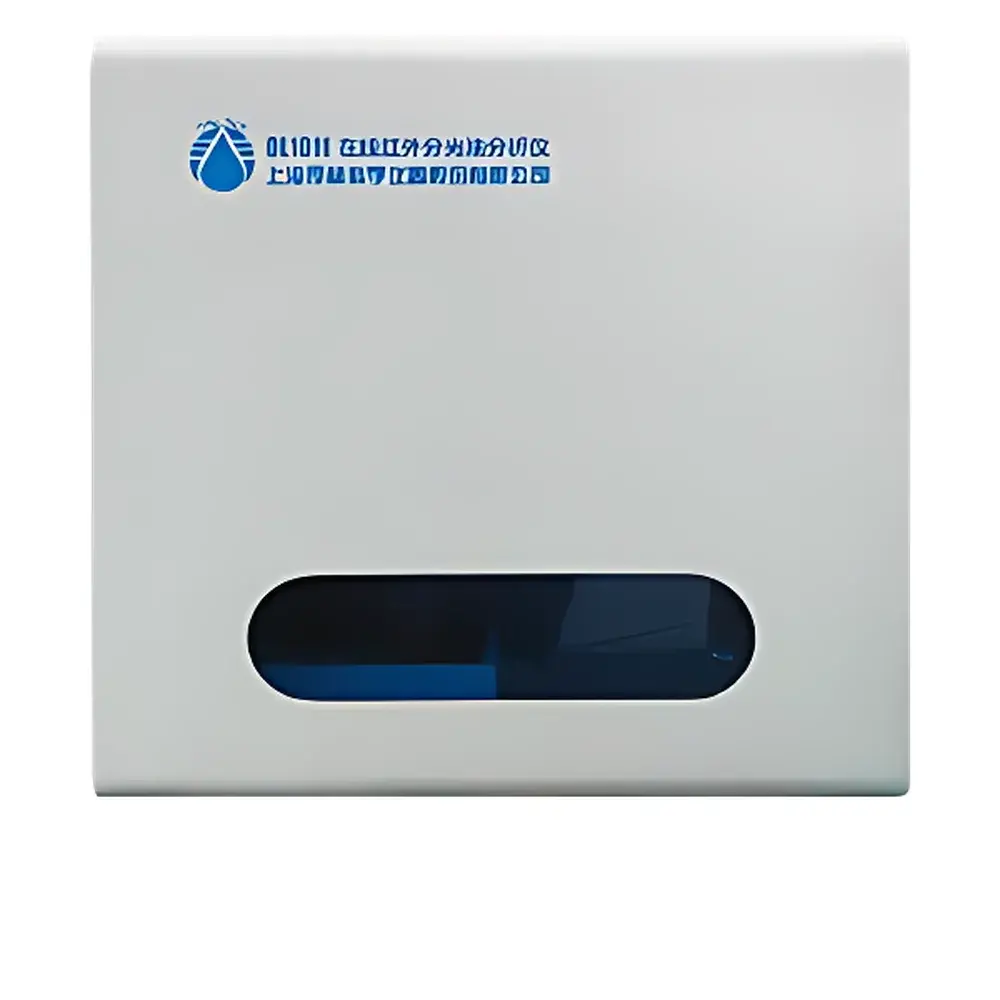
Online Instrument OL1011 Online Infrared Spectrophotometric Oil Analyzer
| Brand | Online Instrument |
|---|---|
| Origin | Shanghai, China |
| Manufacturer Type | Manufacturer |
| Product Category | Domestic |
| Model | OL1011 |
| Instrument Type | Online |
| Measurement Principle | Infrared Spectrophotometry |
| Measurement Range | 0–50,000 mg/L |
| Detection Limit | 0.06 mg/L |
| Accuracy | ±2% |
| Resolution | 0.001 mg/L |
| Measurement Frequency | User-Configurable |
Overview
The Online Instrument OL1011 Online Infrared Spectrophotometric Oil Analyzer is an industrial-grade, fully automated analyzer engineered for continuous, real-time quantification of total petroleum hydrocarbons (TPH), animal and vegetable oils (AVO), and total oil content in aqueous effluents. It operates on the fundamental principle of mid-infrared absorption spectroscopy—specifically targeting the characteristic C–H stretching vibrations near 2930 cm⁻¹, 2960 cm⁻¹, and 2870 cm⁻¹—enabling selective and simultaneous differentiation of aliphatic hydrocarbons (petroleum) and ester-linked triglycerides (AVO) in a single analytical cycle. Designed for unattended operation in harsh wastewater environments, the OL1011 integrates sample homogenization, solvent extraction, phase separation, adsorption-based fractionation, and infrared detection into a single compact platform compliant with ISO 9377-2:2000 (water quality — determination of hydrocarbon oil — part 2: infrared spectrometric method) and aligned with ASTM D7066-04 (standard test method for determination of oil and grease in water by infrared spectrophotometry).
Key Features
- Fully automated three-parameter output: simultaneous reporting of petroleum hydrocarbons, animal/vegetable oils, and total oil concentration (mg/L), all traceable to NIST-traceable calibration standards.
- Integrated magnesium silicate adsorption column with real-time reagent depletion monitoring via embedded capacitive sensors and predictive algorithm-driven alerts—ensuring consistent AVO selectivity and minimizing manual intervention.
- Dynamic phase separation system utilizing reverse-pressure backflush with tetrachloroethylene (C₂Cl₄), eliminating membrane fouling and carryover between samples; includes dual-stage dehydration via anhydrous Na₂SO₄ and hydrophobic PTFE membrane filtration.
- Molecular-level homogenization module employing high-shear turbulent mixing prior to extraction—critical for heterogeneous influents containing suspended solids or emulsified oil droplets (e.g., refinery blowdown, rolling mill coolant, or coking wastewater).
- Hermetically sealed fluidic architecture with activated carbon–packed off-gas treatment and segregated waste solvent collection—fully compliant with OSHA 29 CFR 1910.1200 (Hazard Communication) and EPA 40 CFR Part 262 (hazardous waste accumulation requirements).
- IP65-rated wall-mount enclosure with operational stability across 0–90 °C ambient and process water temperatures; supports both local HMI touch interface and remote SCADA integration via Modbus TCP or OPC UA.
Sample Compatibility & Compliance
The OL1011 is validated for direct analysis of raw, untreated, or partially clarified wastewater streams—including municipal sewage, petrochemical process water, steel mill cooling effluent, coal washing runoff, and port bilge water. It accommodates turbidities up to 500 NTU and total suspended solids (TSS) ≤ 200 mg/L without pre-filtration. All wetted components are constructed from chemically resistant materials (e.g., PTFE-lined tubing, Hastelloy C-276 valves, borosilicate flow cells) to withstand prolonged exposure to chlorinated solvents and acidic/alkaline matrices. The system meets GLP data integrity requirements through built-in audit trails, electronic signatures (per FDA 21 CFR Part 11), and time-stamped event logging for all calibration, maintenance, and measurement actions.
Software & Data Management
Embedded Linux-based firmware supports configurable measurement intervals (1 min to 24 h), programmable auto-calibration schedules (including single-point standard addition and multi-point curve verification), and adaptive dilution logic for out-of-range samples. Raw spectral data (absorbance vs. wavenumber) and processed chromatograms are stored locally on encrypted SD card and synchronized to centralized servers via TLS 1.2–secured HTTP(S) push. Remote access is enabled through role-based web dashboard (view-only, operator, admin tiers) and mobile-responsive interface compatible with iOS and Android. All reports comply with ISO/IEC 17025 documentation requirements—including uncertainty budgeting per GUM (Guide to the Expression of Uncertainty in Measurement).
Applications
- Continuous compliance monitoring of NPDES (National Pollutant Discharge Elimination System) permits for petroleum hydrocarbons in industrial outfalls.
- Real-time optimization of dissolved air flotation (DAF) and API separator performance in upstream oil & gas facilities.
- Leak detection and source tracking in integrated steel plant cooling circuits where lubricating oil ingress compromises heat transfer efficiency.
- Process control feedback for bioremediation units treating AVO-laden food processing wastewater.
- Early warning system for accidental diesel or fuel oil releases in harbor stormwater drainage networks.
FAQ
What extraction solvent does the OL1011 use, and is it compliant with current environmental regulations?
Tetrachloroethylene (C₂Cl₄) is used as the primary extraction solvent, selected for its high extraction efficiency, low water solubility, and spectral clarity in the IR fingerprint region. Its handling and recovery fully comply with EU Directive 2008/105/EC (priority substances in water policy) and U.S. EPA Method 1664B.
Can the instrument differentiate between mineral oil and synthetic ester-based lubricants?
Yes—the OL1011 leverages differential absorption ratios (A2930/A2960) and second-derivative spectral deconvolution to distinguish saturated aliphatic chains (mineral oil) from unsaturated and branched ester moieties (synthetic lubricants), though compound-specific identification requires GC-MS confirmation.
How often does the magnesium silicate column require replacement under typical industrial conditions?
Based on field data from 12-month deployments in refinery wastewater (mean oil load: 85 mg/L), column service life averages 16–18 weeks; the system triggers maintenance alerts at 90% estimated capacity depletion.
Is remote firmware update supported, and what cybersecurity protocols are implemented?
Yes—OTA (over-the-air) updates are delivered via signed package verification using RSA-2048 keys; all network interfaces enforce TLS 1.2+ encryption, disabled Telnet/FTP, and configurable firewall rules per IEC 62443-3-3.
Related Products







