
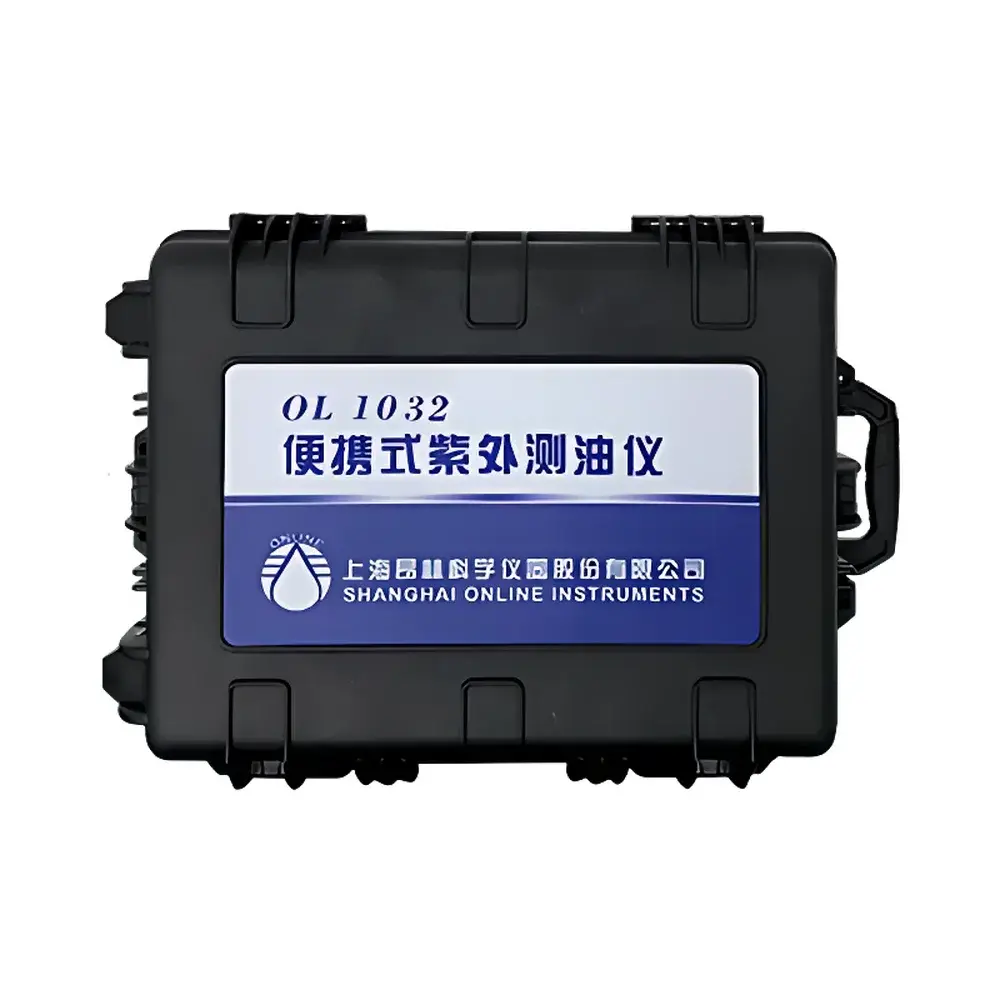
Online Instrument OL1032 Portable UV Oil Content Analyzer
| Brand | Online Instrument |
|---|---|
| Origin | Shanghai, China |
| Manufacturer Type | Direct Manufacturer |
| Product Category | Domestic |
| Model | OL1032 |
| Instrument Type | Portable |
| Measurement Principle | Ultraviolet (UV) Spectrophotometry |
| Measurement Range | 0–50 mg/L |
| Detection Limit | 0.005 mg/L |
| Accuracy | ±2% |
| Resolution | 0.001 mg/L |
| Measurement Frequency | Not Applicable |
Overview
The Online Instrument OL1032 Portable UV Oil Content Analyzer is a field-deployable spectrophotometric instrument engineered for rapid, on-site quantification of petroleum hydrocarbons in aqueous matrices. It operates on the principle of ultraviolet absorption spectroscopy at 225 nm, where aromatic and olefinic compounds in oil—extracted using n-hexane—exhibit characteristic absorbance proportional to concentration. Designed for environmental compliance and emergency response applications, the OL1032 integrates a monolithic optical path architecture that eliminates alignment drift and ensures measurement stability under dynamic conditions—including vehicle transport, vessel motion, or field deployment on unstable terrain. Its compact form factor, integrated tablet interface, and battery-powered operation enable uninterrupted operation for >8 hours per charge, supporting real-time decision-making during spill investigations, regulatory inspections, and routine water quality surveillance.
Key Features
- Monolithic optical system with fixed-path UV optics: Eliminates mechanical alignment sensitivity, delivers high reproducibility (<1.5% RSD over 24 h) and shock resistance compliant with IEC 60068-2-64 for portable instrumentation.
- Motorized precision wavelength positioning: Sub-micron stepper motor control ensures consistent 225 nm spectral acquisition without manual calibration drift.
- Integrated Android-based tablet interface: Preloaded with dedicated analysis firmware; enables one-touch measurement initiation, real-time absorbance curve visualization, and automatic calculation via preloaded calibration curves.
- Multi-modal connectivity: Supports RS-232 serial, Bluetooth 5.0, and IEEE 802.11n Wi-Fi for local data export (CSV/PDF), remote instrument control, and integration into centralized environmental monitoring platforms.
- Field-compatible extraction workflow: Optimized for EPA Method 1664A-compliant n-hexane liquid-liquid extraction; compatible with the optional Online Instrument Portable Extractor (PE-100) for fully integrated sample preparation in non-lab environments.
- Regulatory-ready data handling: Audit trail logging, user authentication, and timestamped measurement records support GLP/GMP-aligned workflows and US EPA Region-specific reporting requirements.
Sample Compatibility & Compliance
The OL1032 is validated for petroleum hydrocarbon determination in freshwater, seawater, groundwater, and estuarine samples per ASTM D7066-22 (Standard Test Method for Determination of Oil and Grease in Water by Infrared Spectrophotometry — adapted for UV methodology where IR interference is prohibitive) and aligned with the technical basis of China’s HJ 970-2018 standard for petroleum hydrocarbons in water. It accommodates sample volumes of 10–100 mL post-extraction and tolerates turbidity up to 50 NTU without filtration when using matched n-hexane blanks. All firmware and calibration protocols are traceable to NIST-traceable UV photometric standards. Device firmware supports dual-language (English/Chinese) UI and complies with IEC 61326-1 for electromagnetic compatibility in industrial field environments.
Software & Data Management
The embedded analytical software provides full spectral acquisition (190–400 nm scan mode), baseline correction, peak integration, and multi-point standard curve generation (linear and quadratic). Data files include raw absorbance spectra, calibration metadata, operator ID, GPS coordinates (when enabled), and environmental parameters (temperature, humidity). Export formats include CSV (for LIMS ingestion), PDF reports (with digital signature support), and XML (compatible with ISO/IEC 17025-accredited lab information systems). Remote access via secure HTTPS API enables centralized fleet management, over-the-air firmware updates, and automated data synchronization with cloud-based environmental dashboards—fully compliant with FDA 21 CFR Part 11 requirements for electronic records and signatures when configured with role-based access controls.
Applications
- Emergency response: Real-time oil-in-water assessment during offshore spills, pipeline ruptures, or industrial runoff events.
- Regulatory monitoring: Field verification of discharge permits (e.g., NPDES, EU WFD Annex V) and compliance with national surface water quality criteria.
- Research & education: Teaching tool for environmental chemistry labs requiring portable UV-Vis instrumentation with full spectral capability.
- Maritime operations: Onboard oil content monitoring for ballast water treatment verification and MARPOL Annex I enforcement support.
- Drinking water source protection: Rapid screening of petroleum contamination in aquifer recharge zones and reservoir intakes.
FAQ
What extraction solvent is required for the OL1032?
n-Hexane (≥95% purity, UV-transparent grade) is the specified solvent, consistent with EPA Method 1664A and HJ 970-2018.
Does the instrument require external PC connection for operation?
No—full functionality is available via the built-in tablet; PC connection is optional for bulk data export or advanced spectral processing.
Can the OL1032 be used for diesel or lubricating oil detection?
Yes, provided the target hydrocarbon fraction exhibits measurable UV absorbance at 225 nm; method validation per analyte matrix is recommended prior to regulatory use.
Is the device certified for intrinsically safe operation in hazardous areas?
Not inherently; it is rated IP54 for dust and water resistance but requires external explosion-proof enclosures for Zone 1/2 deployment.
How is calibration traceability maintained?
Calibration standards are prepared from NIST SRM 2781 (petroleum hydrocarbon standard) or equivalent; certificate of analysis and instrument calibration log are stored internally and exportable.
Related Products







