
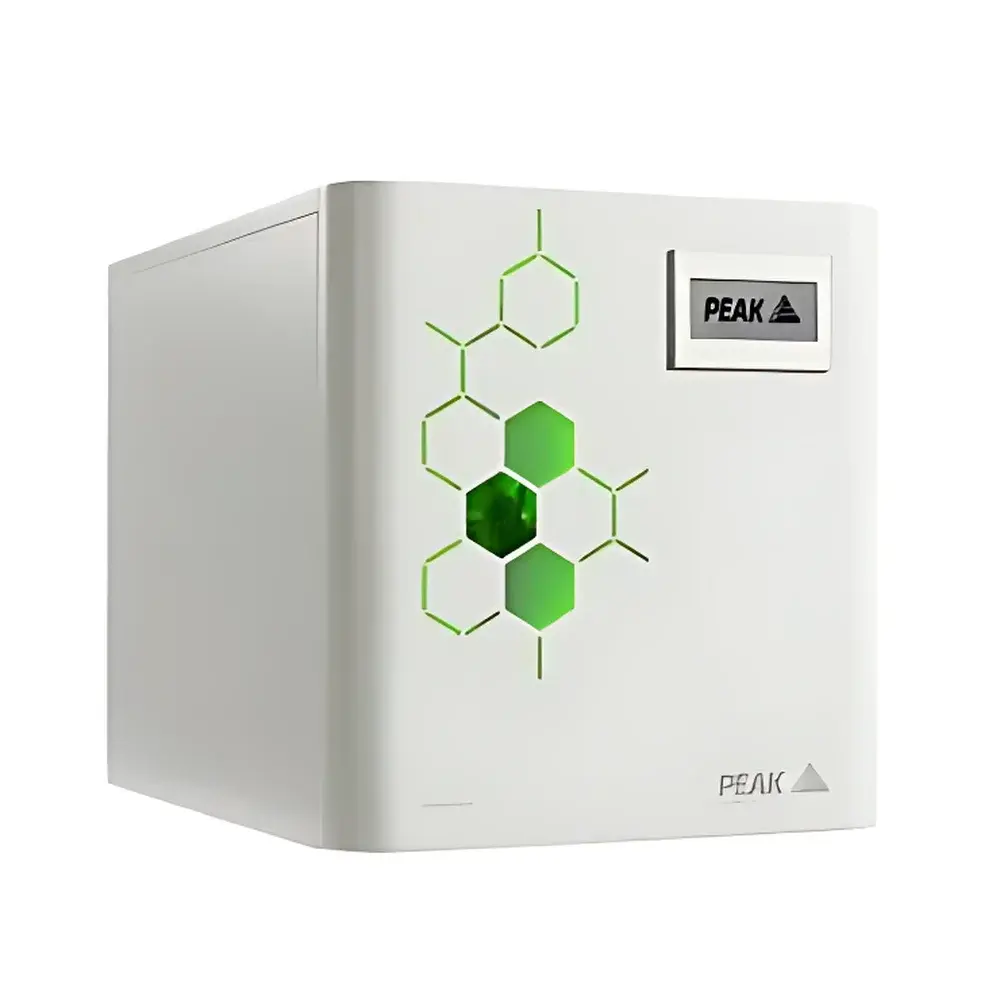
Peak Scientific Precision Hydrogen 300 Hydrogen Generator
| Brand | PEAK |
|---|---|
| Origin | United Kingdom |
| Manufacturer Type | Original Equipment Manufacturer (OEM) |
| Import Status | Imported |
| Model | Peak Precision Hydrogen 300 |
| Hydrogen Generation Principle | Pure Water Electrolysis via Proton Exchange Membrane (PEM) |
| Output Flow Rate | 300 cm³/min |
| Output Pressure | 100 psi (6.9 bar) |
| Hydrogen Purity | 99.9995% |
| Power Consumption | 405–422 W |
Overview
The Peak Scientific Precision Hydrogen 300 is a laboratory-grade, PEM-based hydrogen generator engineered for continuous, on-demand supply of ultra-high-purity hydrogen gas to gas chromatography (GC) detectors—primarily Flame Ionization Detectors (FID) and Flame Photometric Detectors (FPD). Unlike conventional cylinder-based gas delivery, this system employs catalytic electrolysis of deionized water across a solid polymer electrolyte membrane, producing hydrogen with trace-level impurity control and zero hydrocarbon carryover. The integrated design eliminates reliance on high-pressure storage, limiting internal hydrogen inventory to <10 mL at any time—a critical safety advantage in regulated laboratory environments. Its compact footprint and modular architecture support benchtop integration within GC instrument clusters or centralized gas supply cabinets, delivering stable flow and pressure across variable detector demand without manual intervention.
Key Features
- Proton Exchange Membrane (PEM) electrolysis core ensures consistent hydrogen generation from purified water—no caustic electrolytes or metal catalysts required.
- Real-time pressure regulation maintains constant 100 psi output across flow ranges from 0 to 300 cm³/min, with closed-loop feedback control for ±1% flow stability.
- Multi-stage gas conditioning includes desiccant drying and dual-stage particulate/chemical filtration, achieving residual moisture <1 ppmv and total hydrocarbons <0.1 ppbv.
- Embedded safety architecture includes automatic shutdown on overpressure, low-water detection, membrane temperature monitoring, and hydrogen leak sensing per IEC 61000-6-4 EMC compliance.
- Front-panel LCD interface with status indicators for water level, filter life, system pressure, and fault diagnostics; supports remote monitoring via RS-232 or optional Ethernet module.
- Modular consumables—replaceable DI cartridge and silica gel desiccant column—enable field maintenance in under 5 minutes without tools or service technician involvement.
Sample Compatibility & Compliance
The Precision Hydrogen 300 is compatible with all major GC platforms requiring H₂ as fuel gas, including systems from Agilent, Thermo Fisher Scientific, Shimadzu, Waters, Bruker, and Sciex. It meets ISO 8573-1:2010 Class 1 compressed air purity equivalency for hydrogen (excluding oil content), and its output purity satisfies ASTM D7504-22 requirements for GC carrier/fuel gas applications. The unit is CE-marked per Machinery Directive 2006/42/EC and Electromagnetic Compatibility Directive 2014/30/EU. For regulated environments, it supports audit-ready operation when paired with Peak’s optional GLP-compliant software package, enabling full electronic record retention of run logs, calibration events, and maintenance history per FDA 21 CFR Part 11 data integrity guidelines.
Software & Data Management
While the Precision Hydrogen 300 operates autonomously via embedded firmware, optional Peak Connect software enables centralized fleet management for multi-unit installations. This Windows-based application provides real-time telemetry (flow, pressure, temperature, consumable status), configurable alarm thresholds, scheduled maintenance reminders, and exportable CSV logs for QA/QC documentation. All system events—including power cycles, auto-shutdown triggers, and filter replacement timestamps—are timestamped and stored locally with tamper-resistant write-once memory. When deployed in GxP environments, the software supports user role-based access control and electronic signature workflows compliant with ALCOA+ principles.
Applications
This generator serves as a primary hydrogen source in analytical laboratories performing routine and high-throughput GC-FID analysis of volatile organic compounds (VOCs), residual solvents, petrochemical fractions, environmental pollutants (e.g., BTEX, PAHs), and flavor/aroma compounds in food and beverage matrices. Its reliability and purity performance make it suitable for method validation under USP , EP 2.2.46, and ICH Q2(R2) guidelines. In pharmaceutical QC labs, it supports compendial testing for residual solvents in APIs and finished dosage forms. Academic and government research facilities utilize it for method development requiring long-duration unattended runs—particularly where cylinder logistics, purity variability, or safety audits constrain traditional gas supply models.
FAQ
What inlet water quality is required?
Deionized water with resistivity ≥1 MΩ·cm and total organic carbon (TOC) <50 ppb is mandatory. Use of reverse-osmosis pretreatment followed by point-of-use polishing is strongly recommended.
Can the generator supply multiple GC instruments simultaneously?
Yes—when connected via appropriately sized stainless steel tubing and pressure-rated manifolds, the Precision Hydrogen 300 can serve up to three FID-equipped GC systems operating at combined flows ≤300 cm³/min.
How often must consumables be replaced?
Under typical usage (8 h/day, 5 days/week), the DI cartridge requires replacement every 6–9 months and the desiccant column every 12–18 months—both intervals are tracked automatically and displayed on the front panel.
Is external cooling required?
No—the unit is air-cooled and designed for ambient lab temperatures between 15–30°C and relative humidity ≤80% non-condensing.
Does the system comply with local fire codes for indoor hydrogen generation?
Yes—its <10 mL internal hydrogen inventory, automatic leak detection, and fail-safe shutdown mechanisms meet NFPA 55 (2023) and EN 13445-3 Annex C requirements for low-capacity on-site gas generation equipment.



