
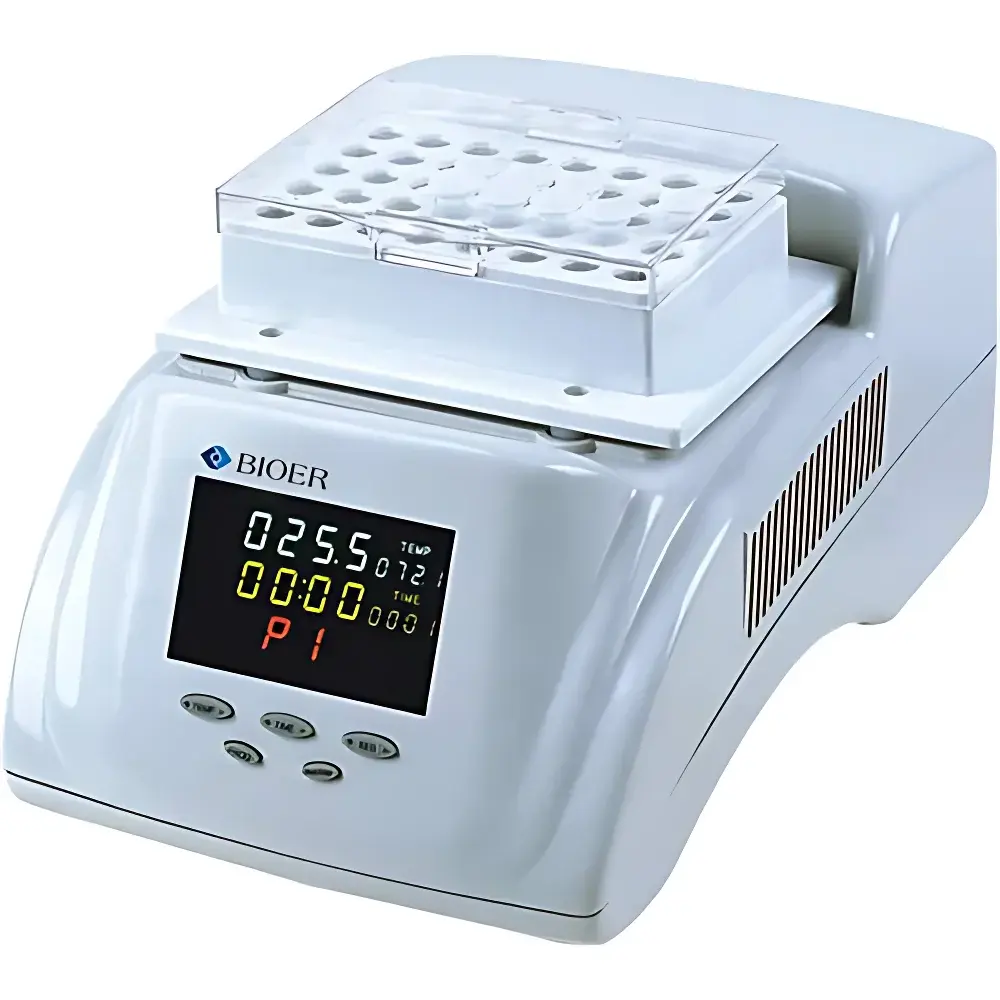
Bioer HB-202 ThermoCell Oscillating Metal Block Heater
| Brand | Bioer |
|---|---|
| Model | HB-202 |
| Temperature Range | (Ambient + 5°C) to 105°C |
| Temperature Accuracy | ≤ ±0.5°C |
| Heating Time | ≤ 12 min (20°C to 100°C) |
| Dimensions (L×W×H) | 300 × 200 × 160 mm |
| Net Weight | 2.8–3.2 kg |
| Power Supply | 220 V~, 50 Hz, 120 W |
| Control System | 32-bit microprocessor |
| Drive Mechanism | Brushless DC motor |
| Heating Element | PTC heater |
| Optional Modules | A (40 × 1.5 mL), B (54 × 0.5 mL), C (96 × 0.2 mL), D (24 × φ15 mm), G (26 × 0.5 mL + 24 × 1.5 mL), H (40 × 2.0 mL), J (96-well microplate), E (115 × 73 × 38 mm water bath insert) |
Overview
The Bioer HB-202 ThermoCell Oscillating Metal Block Heater is an integrated thermal and mechanical incubation platform engineered for precise temperature control and consistent orbital shaking in life science and analytical chemistry workflows. Unlike conventional water baths or static dry blocks, this instrument employs a solid aluminum heating block with embedded PTC (Positive Temperature Coefficient) heating elements and a brushless DC motor-driven oscillation mechanism—enabling simultaneous thermal stabilization and homogeneous sample mixing without liquid medium dependency. Its operating principle relies on direct conductive heat transfer through machined metal wells and uniform 2D orbital motion (typically 200–1,200 rpm, user-adjustable), minimizing thermal gradients and ensuring reproducible kinetic conditions across all tube positions. Designed for routine applications such as enzyme reaction incubation, PCR pre-heating, cell culture sample equilibration, and reagent thawing/mixing, the HB-202 complies with fundamental laboratory safety and performance expectations outlined in ISO/IEC 17025:2017 for equipment used in accredited testing laboratories.
Key Features
- High-precision 32-bit microprocessor control with real-time digital PID feedback for stable thermal regulation
- Temperature accuracy of ≤ ±0.5°C across the full operating range (ambient + 5°C to 105°C), verified per ASTM E220–22 calibration methodology
- Rapid thermal response: ≤12 minutes to reach 100°C from 20°C, minimizing experimental downtime
- Orbital oscillation with adjustable speed (typically 200–1,200 rpm) and amplitude (2 mm nominal), optimized for low-shear mixing of viscous or sensitive biological samples
- Modular interchangeable block system supporting eight standard configurations—including 96-well plate, 0.2 mL PCR strip, 1.5 mL microcentrifuge tubes, and custom inserts—for flexible assay scalability
- Robust aluminum construction with anodized surface finish ensures long-term thermal stability, corrosion resistance, and mechanical durability under daily lab use
- Front-panel LED display with intuitive keypad interface; no external software required for basic operation
Sample Compatibility & Compliance
The HB-202 accommodates common laboratory consumables including polypropylene and polyethylene tubes (0.2–2.0 mL), PCR strips, 96-well microplates, and cylindrical vials up to φ15 mm. All module interfaces are CNC-machined to ISO 8573-1 tolerances, guaranteeing repeatable insertion depth and thermal contact integrity. The device meets IEC 61010-1:2010 requirements for electrical safety in laboratory equipment and incorporates over-temperature cut-off protection (hardware-limited at 110°C). While not inherently GLP/GMP-certified, its deterministic time/temperature logging capability—when paired with external data acquisition systems—supports audit-ready documentation per FDA 21 CFR Part 11 when validated in-house.
Software & Data Management
The HB-202 operates as a standalone instrument with no proprietary software dependency. Temperature setpoint, oscillation speed, and timer duration (1 minute to 99 hours 59 minutes) are configured directly via front-panel controls. For integration into automated workflows, optional RS-232 or USB-to-serial adapters enable communication with LabVIEW, Python-based control scripts, or LIMS platforms using ASCII command protocols. All parameter changes are stored in non-volatile memory and retained after power cycling. Audit trail generation requires external timestamped logging; internal event history is limited to last-set parameters only.
Applications
- Enzyme kinetics studies requiring simultaneous thermal incubation and gentle agitation
- Pre-analytical sample preparation for HPLC, GC, or mass spectrometry workflows
- Cell lysis optimization using detergent-based or mechanical disruption protocols
- Antibody labeling reactions where temperature-sensitive conjugates demand uniform thermal exposure
- Standard curve preparation in ELISA and qPCR assays involving serial dilution and mixing steps
- Controlled crystallization trials in pharmaceutical formulation development
- Quality control testing of thermal stability for diagnostic reagents and biologics
FAQ
Does the HB-202 support refrigerated operation?
No. The HB-202 is a heating-only unit. It does not incorporate thermoelectric (TE) cooling or compressor-based refrigeration. Its minimum operational temperature is ambient + 5°C.
Can multiple modules be used interchangeably during a single experiment?
Yes—modules are mechanically keyed and thermally isolated. Swapping is tool-free and takes less than 30 seconds; however, thermal equilibration time must be re-established after each change.
Is calibration traceable to NIST standards?
The unit ships with a factory calibration certificate referencing internal reference sensors. End-user NIST-traceable calibration requires external platinum RTD probes and documented SOPs per ISO/IEC 17025.
What maintenance is required for long-term reliability?
Annual inspection of thermal interface surfaces for debris accumulation and verification of oscillation belt tension (if applicable) is recommended. No lubrication or consumable replacement is specified by the manufacturer.
How is temperature uniformity validated across the block?
Bioer specifies ≤ ±0.5°C well-to-well variation at steady state, measured using nine-point probe mapping per ASTM E220–22 Annex A3 guidelines. Users may replicate this with calibrated multi-channel thermocouple loggers.



