
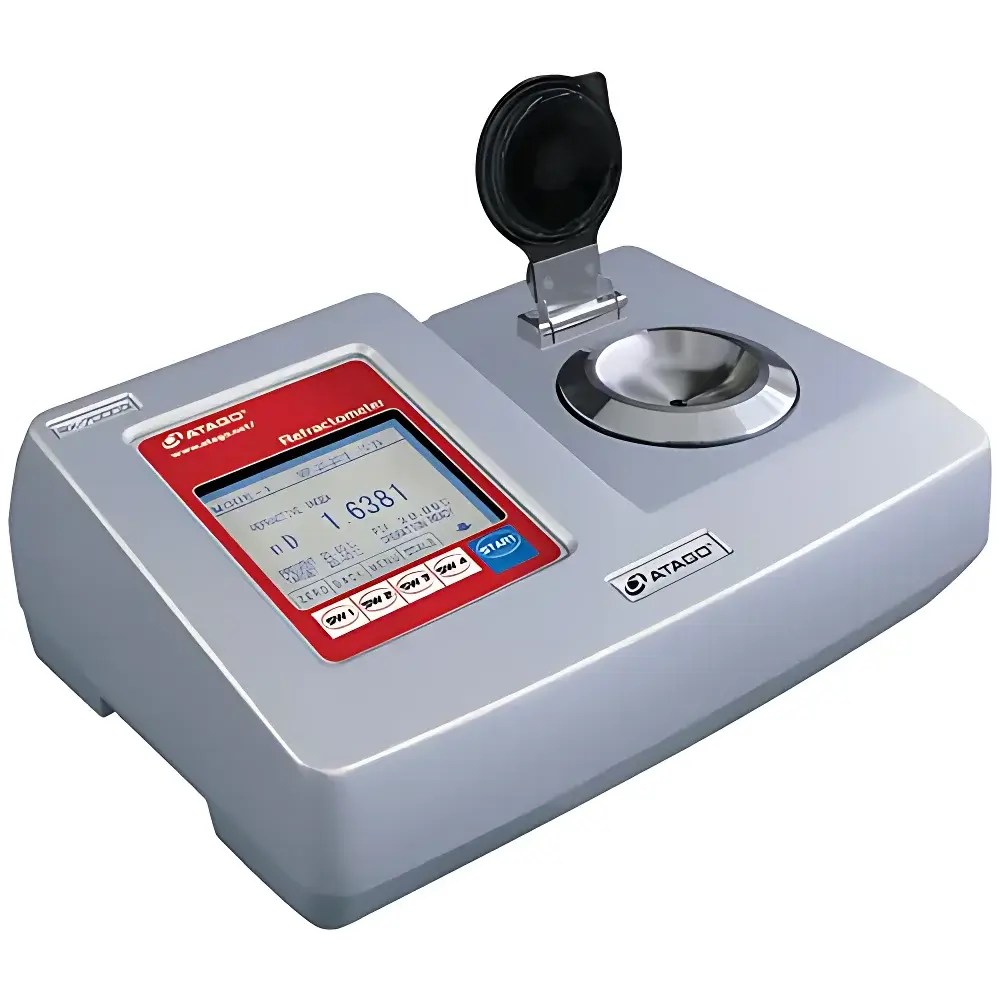
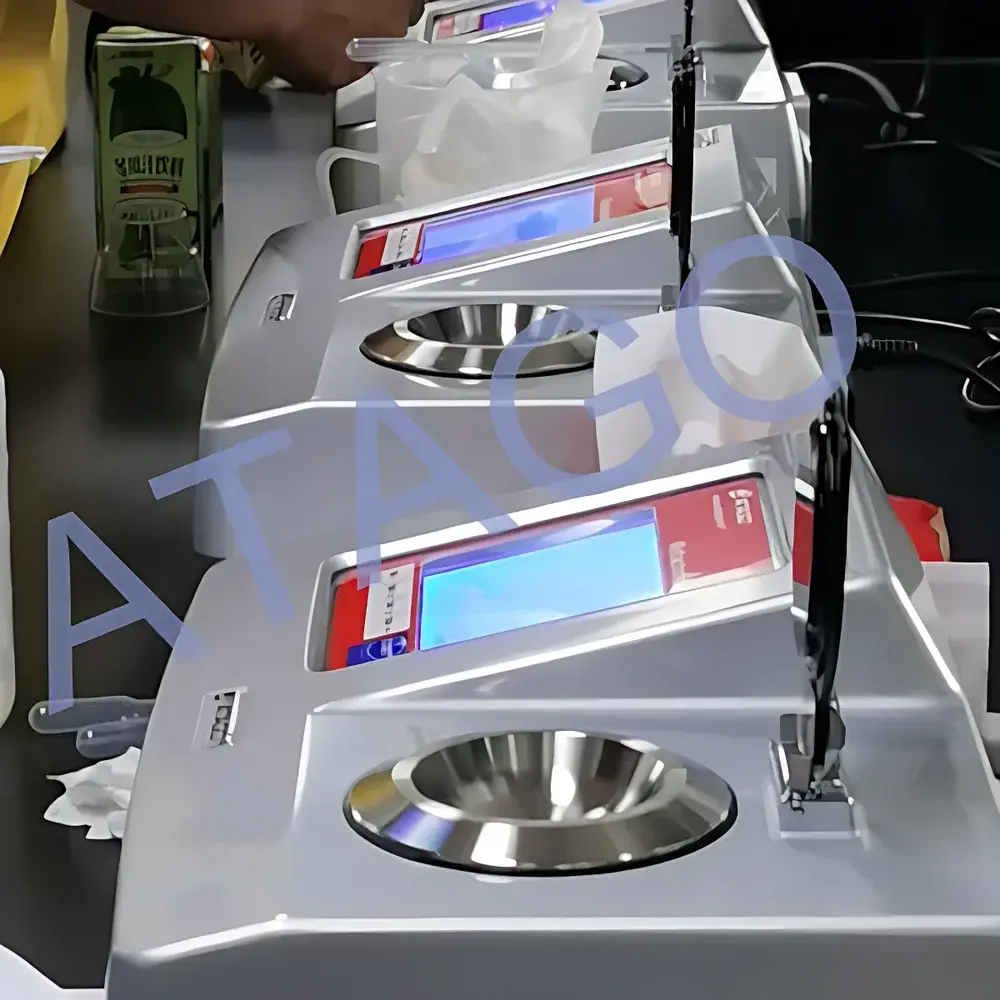
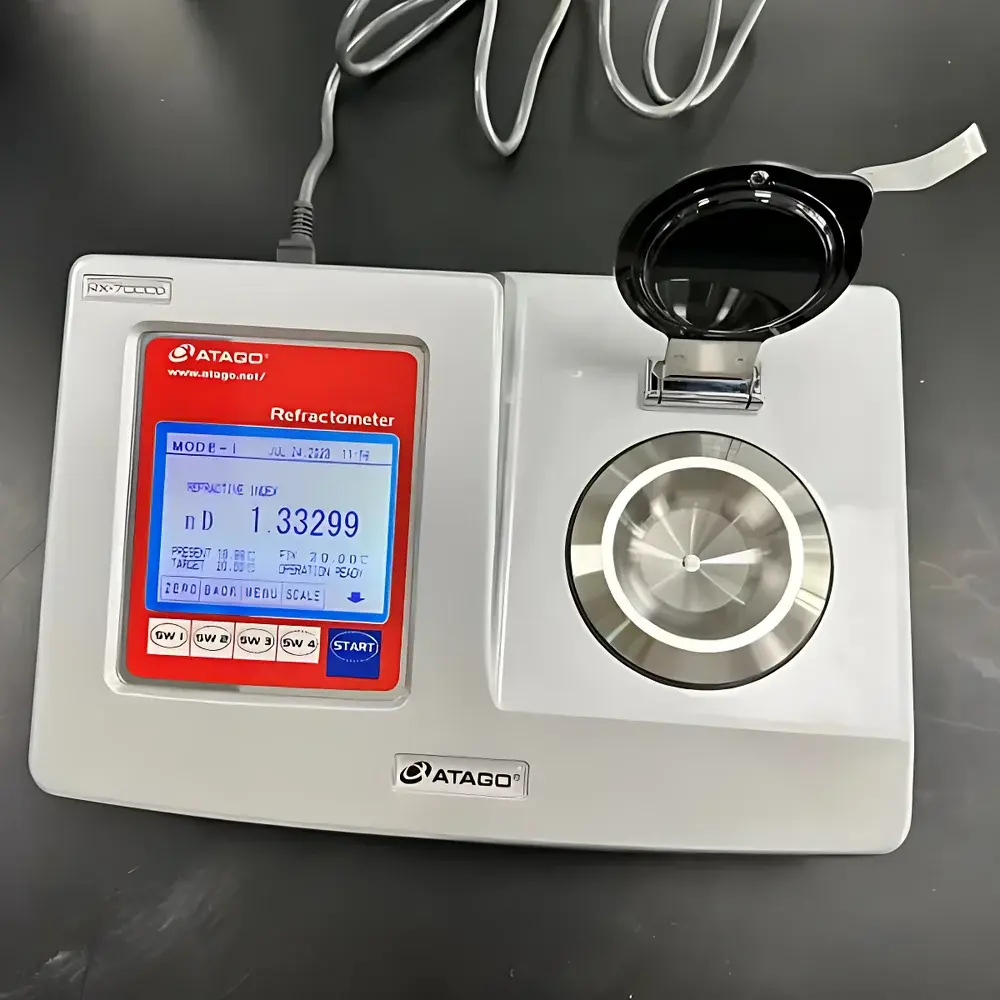
ATAGO RX-7000α High-Melting-Point Oil Refractometer
| Brand | ATAGO |
|---|---|
| Origin | Japan |
| Model | RX-7000α |
| Type | Benchtop Refractometer |
| Temperature Control | Peltier-based, 5.00–70.00 °C (±0.05 °C) |
| Digital Display | Yes |
| Refractive Index Range | 1.29980–1.71500 nD |
| Refractive Index Accuracy | ±0.0001 nD (repeatability ±0.00005 nD) |
| Resolution | 0.00001 nD |
| Brix Range | 0.00–100.00% |
| Brix Accuracy | ±0.1% (repeatability ±0.02%) |
| Brix Resolution | 0.01% |
| Prism Material | Synthetic Sapphire |
| Sample Stage Material | SUS316 Stainless Steel |
| Interface | RS-232C |
| Data Output | Optional thermal printer & PC connectivity |
| Custom Scales | Up to 30 user-defined scales |
| Power | AC 100–240 V, 50–60 Hz, 65 VA |
| Dimensions | 37 × 26 × 14 cm |
| Weight | 6.8 kg |
Overview
The ATAGO RX-7000α High-Melting-Point Oil Refractometer is a precision benchtop instrument engineered for accurate refractive index (nD) measurement of thermally stable, high-refractive-index liquid and semi-solid samples—including hardened fats, waxes, synthetic lubricants, aromatic solvents, polymer precursors, and specialty optical resins. Unlike conventional Abbe-type refractometers limited by low upper-range nD thresholds and passive thermal equilibration, the RX-7000α employs an active Peltier-controlled sample stage with programmable temperature regulation from 5.00 °C to 70.00 °C—enabling reproducible measurements under strictly defined thermal conditions essential for process-critical applications in materials science and advanced manufacturing. Its extended refractive index range (1.29980–1.71500 nD) accommodates substances such as brominated organic compounds, high-molecular-weight silicone oils, and fluorinated solvents that exceed the operational limits of standard optical instruments. The measurement principle follows Snell’s law via critical angle detection on a synthetic sapphire prism, ensuring long-term stability, chemical resistance, and minimal drift across repeated thermal cycles.
Key Features
- Extended refractive index range: 1.29980–1.71500 nD, optimized for high-nD industrial fluids and solid-melt phase samples
- Peltier-based temperature control with ±0.05 °C accuracy and 0.01 °C resolution—critical for viscosity- and density-sensitive refractive measurements
- Synthetic sapphire prism and SUS316 stainless steel sample stage—resistant to aggressive organic solvents, halogenated compounds, and high-temperature melts
- High-resolution digital display: 0.00001 nD (displayed to 0.0001 nD) and 0.01% Brix, supporting trace-level formulation adjustments
- RS-232C interface for GLP-compliant data export to LIMS or laboratory informatics systems; optional thermal printer for audit-ready hardcopy records
- Up to 30 user-definable calibration scales—enabling direct readout of concentration, purity, or compositional indices per internal SOPs
- Compliance-ready architecture: supports 21 CFR Part 11–aligned electronic record workflows when paired with validated software environments
Sample Compatibility & Compliance
The RX-7000α is routinely deployed for quality control and R&D in sectors requiring strict adherence to material specification standards—including ISO 17025-accredited testing labs, semiconductor wafer cleaning chemistry suppliers (per SEMI C10), and polymer synthesis facilities governed by ASTM D1218 (refractive index of hydrocarbons) and ASTM D4052 (density and API gravity). It accepts viscous, hazy, or thermally labile samples without dilution—provided they are optically homogeneous at the measurement temperature. The instrument meets IEC 61010-1 safety requirements for laboratory electrical equipment and carries CE marking for EMC and low-voltage directive compliance. Its temperature-stabilized design enables correlation of nD with molecular weight distribution (e.g., in polyolefin melts) and solvent purity verification (e.g., anhydrous THF or chlorobenzene for OLED precursor synthesis).
Software & Data Management
While the RX-7000α operates as a standalone instrument, its RS-232C port enables bidirectional communication with third-party data acquisition platforms. When integrated into regulated environments, users commonly deploy it with validated laboratory software (e.g., LabWare LIMS, Thermo Fisher SampleManager, or custom Python/NI LabVIEW applications) to enforce electronic signature, audit trail, and change control protocols. All measurement events—including date/time stamp, temperature setpoint, nD value, Brix equivalent, and operator ID—can be logged with cryptographic integrity. The unit supports automatic zero-point calibration verification routines and stores last-calibration metadata internally, facilitating FDA pre-audit readiness and internal GLP/GMP self-assessment.
Applications
- Quantitative analysis of fatty acid methyl ester (FAME) blends in biofuel development
- In-process monitoring of epoxy resin curing kinetics via nD drift during thermal ramping
- Purity assessment of high-boiling-point solvents used in photolithography resist formulations
- Concentration tracking of fluorinated surfactants in semiconductor wet-etch chemistries
- Characterization of liquid crystal monomer mixtures prior to UV polymerization
- Batch release testing of pharmaceutical excipients (e.g., hydrogenated castor oil, cetyl alcohol) per USP <851>
- Research-grade optical property mapping of chalcogenide glass precursors in infrared optics R&D
FAQ
What sample volume is required for measurement?
Approximately 0.2–0.3 mL is sufficient to cover the sapphire prism surface; automated temperature equilibration ensures minimal thermal mass interference.
Can the RX-7000α measure solid or semi-solid samples directly?
Yes—samples must first be heated above their melting point using external controlled-temperature blocks or hot stages, then transferred promptly to the instrument’s pre-conditioned stage (≤70 °C max).
Is calibration traceable to NIST or other national standards?
ATAGO provides factory calibration certificates traceable to JCSS (Japan Calibration Service System); users may perform in-house verification using certified reference liquids (e.g., bromonaphthalene, n=1.6584 @ 20 °C).
Does the instrument support automatic temperature compensation (ATC) for Brix readings?
Yes—ATC is applied per built-in polynomial algorithms compliant with ICUMSA and AOAC guidelines, referenced to sucrose solutions at 20 °C.
How often should the sapphire prism be cleaned, and what solvents are recommended?
Clean after each sample using lint-free wipes and high-purity acetone or isopropanol; avoid abrasive cleaners or ultrasonic baths to preserve prism surface integrity.




