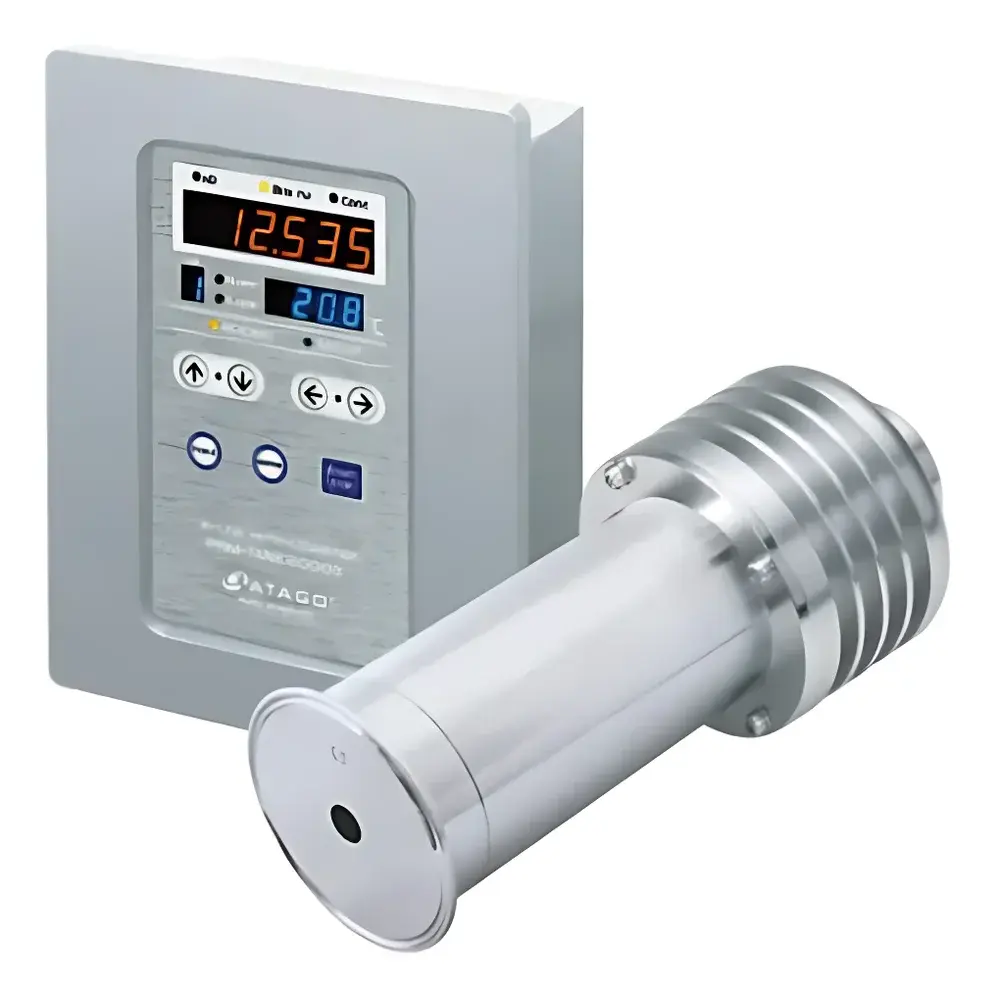
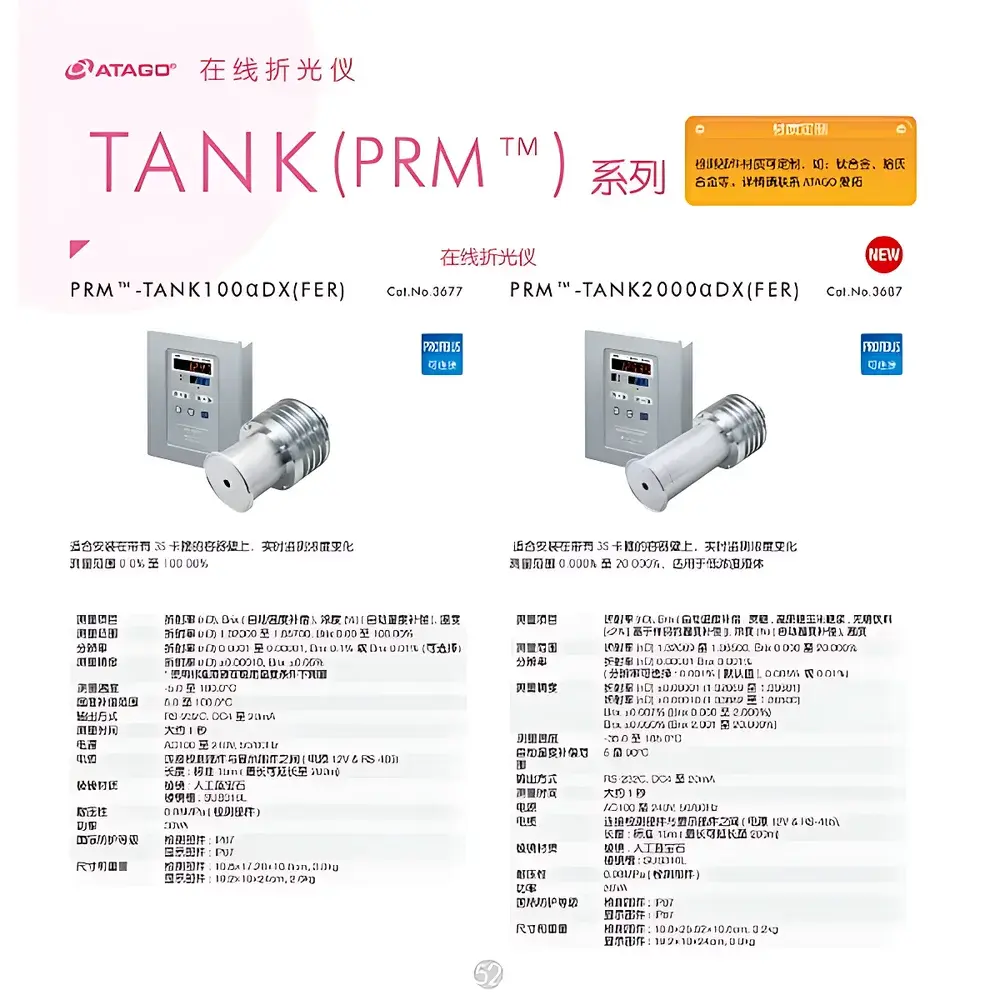
ATAGO PRM-TANK 2000α DX (FER) Online Refractometer
| Brand | ATAGO |
|---|---|
| Origin | Japan |
| Model | PRM-TANK 2000α DX (FER) |
| Refractive Index (nD) Range | 1.32069–1.36500 |
| Brix Range | 0.000–20.000% |
| nD Accuracy | ±0.00001 (1.32069–1.33681), ±0.00010 (>1.33682) |
| Brix Accuracy | ±0.007% (0.000–2.000%), ±0.050% (>2.001%) |
| Automatic Temperature Compensation | 5–90°C |
| Output | RS-232C, 4–20 mA DC |
| Cable Length | Standard 15 m (up to 200 m extendable) |
| Alarm Function | Configurable upper/lower limits |
Overview
The ATAGO PRM-TANK 2000α DX (FER) Online Refractometer is an industrial-grade process analytical instrument engineered for continuous, real-time measurement of refractive index (nD), Brix, and derived concentration in liquid streams. It operates on the principle of critical-angle refractometry—where a collimated light beam passes through a sapphire prism in direct contact with the process fluid; the angle at which total internal reflection occurs is precisely measured via high-resolution photodetector arrays and converted into refractive index using Snell’s law. This optical method delivers inherently stable, calibration-free performance over extended periods when installed in-line or in bypass configurations. Designed specifically for fermentation, dilution, cleaning-in-place (CIP), and blending applications, the PRM-TANK 2000α DX (FER) integrates seamlessly into automated control systems while maintaining ATAGO’s legacy of metrological rigor established over eight decades of refractometer development.
Key Features
- High-precision sapphire measuring prism with chemical resistance to acids, alkalis, and organic solvents—rated for continuous operation in aggressive industrial environments.
- Compact, lightweight silver-anodized aluminum housing (IP65-rated) optimized for space-constrained installations without compromising thermal stability or mechanical robustness.
- Automatic temperature compensation (ATC) across 5–90°C using dual platinum resistance thermometers (PT100) embedded in the prism block—ensuring traceable accuracy per ISO 21541 and ASTM D1218 standards.
- Dual analog/digital output architecture: isolated 4–20 mA current loop for PLC/DCS integration and RS-232C serial interface for configuration, diagnostics, and raw data logging.
- Configurable alarm thresholds with relay output for out-of-specification detection—supports fail-safe interlocks in GMP-compliant pharmaceutical or food-grade processes.
- Extended cable capability: standard 15 m separation between sensor head and display/control unit, extendable up to 200 m using shielded twisted-pair RS-485 wiring—enabling remote mounting in hazardous or inaccessible zones.
Sample Compatibility & Compliance
The PRM-TANK 2000α DX (FER) is validated for use with aqueous solutions, sugar syrups, ethanol-water mixtures, acid/base cleaners, buffer solutions, and low-viscosity fermentation broths (e.g., beer wort, soy sauce mash, antibiotic culture media). It is not intended for opaque suspensions, emulsions, or highly viscous fluids (>500 mPa·s) where light scattering compromises signal integrity. The instrument complies with IEC 61000-6-2 (immunity) and IEC 61000-6-4 (emissions), carries CE marking for machinery directive 2006/42/EC, and meets ATEX Zone 2 / IECEx Zone 2 requirements when paired with appropriate barrier systems. Its measurement uncertainty budget is documented per ISO/IEC 17025 guidelines, supporting audit readiness for FDA 21 CFR Part 11–governed environments where electronic records and signatures are required.
Software & Data Management
Configuration and monitoring are performed via ATAGO’s proprietary PC-based utility (PRM-ConfigTool), which supports firmware updates, calibration verification logs, alarm history export (CSV), and time-stamped trend visualization. All parameter changes—including setpoints, units, and temperature compensation coefficients—are recorded with user ID and timestamp, satisfying ALCOA+ principles (Attributable, Legible, Contemporaneous, Original, Accurate, Complete, Consistent, Enduring, Available) for GLP/GMP documentation. Data transmission adheres to Modbus RTU protocol over RS-485, enabling native integration with Siemens SIMATIC, Rockwell Allen-Bradley, and Yokogawa CENTUM VP platforms without middleware.
Applications
- Fermentation process control: real-time Brix tracking during ethanol, citric acid, or monoclonal antibody production to optimize feed rate and harvest timing.
- Cleaning validation: quantitative verification of rinse water purity in CIP cycles across dairy, beverage, and biopharma facilities—replacing subjective conductivity checks.
- Concentration blending: closed-loop feedback control of syrup dilution in soft drink bottling lines or pharmaceutical excipient preparation.
- Quality gate monitoring: inline verification of incoming raw material concentration (e.g., glycerin, propylene glycol, sodium hydroxide solutions) prior to formulation.
- Sustainability metrics: reduction of water, energy, and chemical consumption by eliminating offline lab sampling and enabling predictive maintenance of heat exchangers based on concentration drift trends.
FAQ
What is the maximum allowable process pressure for the PRM-TANK 2000α DX (FER) sensor head?
The standard wetted parts are rated for continuous operation up to 1.0 MPa (10 bar) at 20°C. Optional high-pressure variants support up to 3.0 MPa upon request.
Can the instrument be recalibrated in the field without returning to a service center?
Yes—two-point calibration using certified NIST-traceable sucrose standards (e.g., 5.000% and 15.000% Brix) is supported via the front-panel menu or PRM-ConfigTool software.
Is the 4–20 mA output linear with respect to Brix or refractive index?
The output is programmable: users may assign it to represent either Brix (% w/w), nD, or temperature—each with independent zero/span scaling.
How frequently should verification checks be performed in regulated environments?
Per USP and EU GMP Annex 15, daily system suitability testing using a control standard is recommended; full calibration verification every 72 hours or per batch, whichever is more frequent.
Does the device support HART communication protocol?
No—HART is not implemented. For digital fieldbus integration, RS-485 Modbus RTU is the native protocol; HART-capable transmitters require external converters.
Related Products