
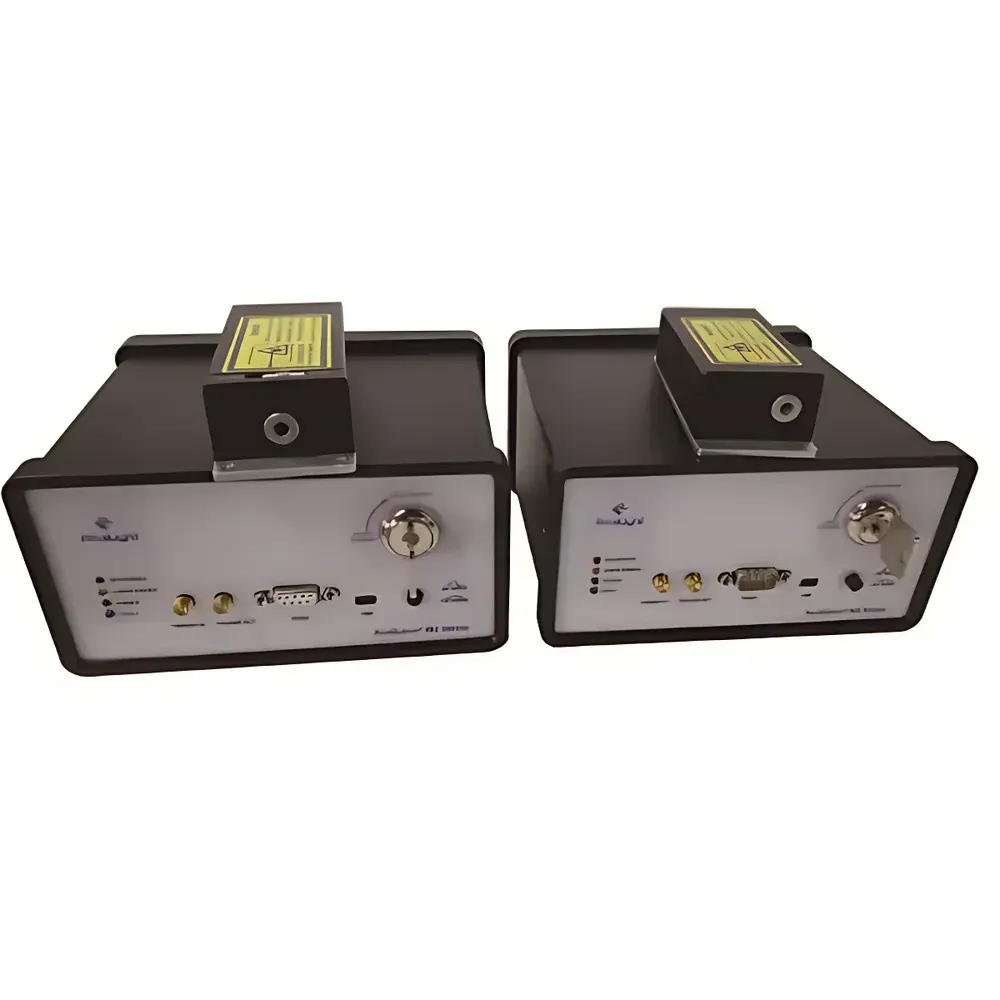
RealLight MCC Series 750 ps Microchip Laser
| Brand | RealLight |
|---|---|
| Model | MCC Series |
| Wavelengths | 1064 / 532 / 355 / 266 / 213 nm |
| Pulse Width | 750 ps (1064/532 nm), 650 ps (355/266/213 nm) |
| Max. Repetition Rate | 10–15 kHz |
| Max. Pulse Energy | 100 µJ (1064 nm) |
| Beam Mode | TEM₀₀ |
| Polarization Ratio | >100:1 |
| Power Stability (8 h) | ±3% |
| Divergence (Full Angle, 1/e²) | Horizontal 5–12 mrad, Vertical 5–10 mrad |
| Trigger Interface | TTL 5 V, SMA |
| Input Power | 100–240 VAC, 50/60 Hz |
| Laser Head Dimensions | 45 × 30 × 120 mm |
| Power Supply Dimensions | 168 × 88 × 140 mm |
| Operating Temperature | 15–35 °C |
| Storage Temperature | 0–60 °C |
| Control Interface | RS232, USB |
| System Power Consumption | ≤20–35 W (model-dependent) |
Overview
The RealLight MCC Series microchip laser is a compact, passively Q-switched, diode-pumped solid-state (DPSS) laser engineered for high-precision applications requiring stable nanosecond-to-picosecond pulse generation. Based on monolithic Nd:YAG or Nd:YVO₄ gain media with semiconductor saturable absorber mirror (SESAM) technology, the MCC platform delivers transform-limited, tail-free pulses with exceptional temporal fidelity and spatial coherence. Its integrated pump module and laser crystal architecture eliminate alignment sensitivity and thermal drift, enabling robust operation in laboratory, industrial, and field-deployable environments. Designed for demanding photonic systems integration, the MCC series supports both internal and external triggering with TTL-compatible synchronization, and features hermetically sealed laser heads optimized for OEM integration and secondary development.
Key Features
- Ultra-short pulse width: 750 ps at 1064 nm and 532 nm; 650 ps at 355 nm, 266 nm, and 213 nm — suitable for time-resolved spectroscopy and nonlinear frequency conversion.
- High pulse energy stability: ±3% RMS power stability over 8 hours, ensuring reproducible experimental outcomes under continuous operation.
- TEM₀₀ beam profile with M² 100:1 — ideal for interferometric setups, harmonic generation, and coupling into single-mode fibers.
- Multi-wavelength platform: Five discrete output wavelengths (1064, 532, 355, 266, 213 nm) generated via intracavity harmonic conversion, each with independently optimized cavity design and thermal management.
- Compact form factor: Laser head dimensions of 45 × 30 × 120 mm facilitate integration into space-constrained optical benches, portable instruments, and embedded systems.
- Flexible triggering architecture: Rising-edge trigger mode up to 20 kHz; gated trigger mode above 20 kHz — compatible with standard oscilloscopes, data acquisition systems, and real-time control hardware.
- OEM-ready interface: RS232 and USB communication protocols enable remote parameter configuration, status monitoring, and firmware updates per IEC 62443-3-3 guidelines for industrial device security.
Sample Compatibility & Compliance
The MCC series is designed to meet the mechanical, thermal, and electromagnetic compatibility requirements for use in ISO/IEC 17025-accredited laboratories and regulated industrial settings. All models comply with IEC 60825-1:2014 (Laser Product Safety) Class IV classification when operated without attenuation, and incorporate interlock circuitry conforming to EN 61511 for functional safety in process-critical instrumentation. The sealed laser head construction satisfies IP52 environmental rating for dust resistance and limited drip protection, supporting deployment in controlled cleanroom environments (ISO 14644 Class 5–7). While not inherently FDA 21 CFR Part 11 compliant as a standalone device, the RS232/USB interface supports integration into validated software platforms that implement electronic signature, audit trail, and role-based access control per GxP requirements.
Software & Data Management
RealLight provides a cross-platform control application (Windows/macOS/Linux) with native support for LabVIEW™, MATLAB®, and Python (via PySerial and NumPy APIs). The software enables real-time monitoring of pulse energy, repetition rate, and internal temperature; logging of operational parameters with timestamped CSV export; and configurable trigger delay calibration. Audit trails record all user-initiated parameter changes, including operator ID, timestamp, and pre-/post-change values — essential for GLP/GMP traceability. Firmware updates are delivered via signed binary packages verified using SHA-256 checksums and X.509 certificate validation, aligning with NIST SP 800-193 guidelines for firmware integrity assurance.
Applications
- Laser-induced breakdown spectroscopy (LIBS): High peak power and narrow pulse width enhance plasma initiation efficiency and spectral resolution in elemental analysis of solids, liquids, and gases.
- Optical parametric oscillator (OPO) pumping: Stable TEM₀₀ beam and low timing jitter (<100 ps RMS) ensure efficient and spectrally stable signal/idler generation across UV–IR ranges.
- Laser ultrasonics: Picosecond-scale pulses enable high-resolution subsurface defect imaging in composites, ceramics, and aerospace alloys without surface contact.
- Time-of-flight lidar and rangefinding: Precise pulse timing and low divergence support sub-millimeter ranging accuracy at distances exceeding 1 km in atmospheric conditions.
- Nonlinear optical metrology: Harmonic outputs serve as calibrated sources for autocorrelator calibration, SHG intensity mapping, and two-photon absorption cross-section measurements.
- Laser ablation and micromachining: Controlled pulse energy and diffraction-limited focus enable sub-10 µm feature fabrication in polymers, thin films, and biological tissues.
- Laser desorption/ionization mass spectrometry (LDI-MS): Short pulse duration minimizes thermal damage to labile biomolecules while maintaining sufficient ion yield for high-sensitivity detection.
FAQ
What is the maximum achievable pulse energy at 213 nm?
The MCC-213-1-004 model delivers up to 4 µJ per pulse at 10 Hz repetition rate. Pulse energy scales inversely with repetition frequency due to thermal loading constraints in deep-UV nonlinear crystals.
Can the laser head be mounted in non-horizontal orientations?
Yes — the monolithic microchip design is insensitive to gravity-induced misalignment. Mounting orientation does not affect beam pointing stability or pulse characteristics, provided thermal dissipation paths remain unobstructed.
Is wavelength tuning possible within a single model?
No — each MCC variant is factory-optimized for a fixed fundamental or harmonic wavelength. Multi-wavelength operation requires separate laser heads or external nonlinear modules.
What cooling method is used?
Conductive air cooling only; no forced airflow or liquid cooling is required. Thermal management relies on aluminum housing conduction and passive heatsinking, consistent with Class I laser safety enclosure design principles.
Are custom pulse widths available below 650 ps?
Not within the standard MCC series. Sub-500 ps performance requires chirped-pulse amplification or mode-locked oscillators, which fall outside the microchip laser architecture’s design envelope.




