
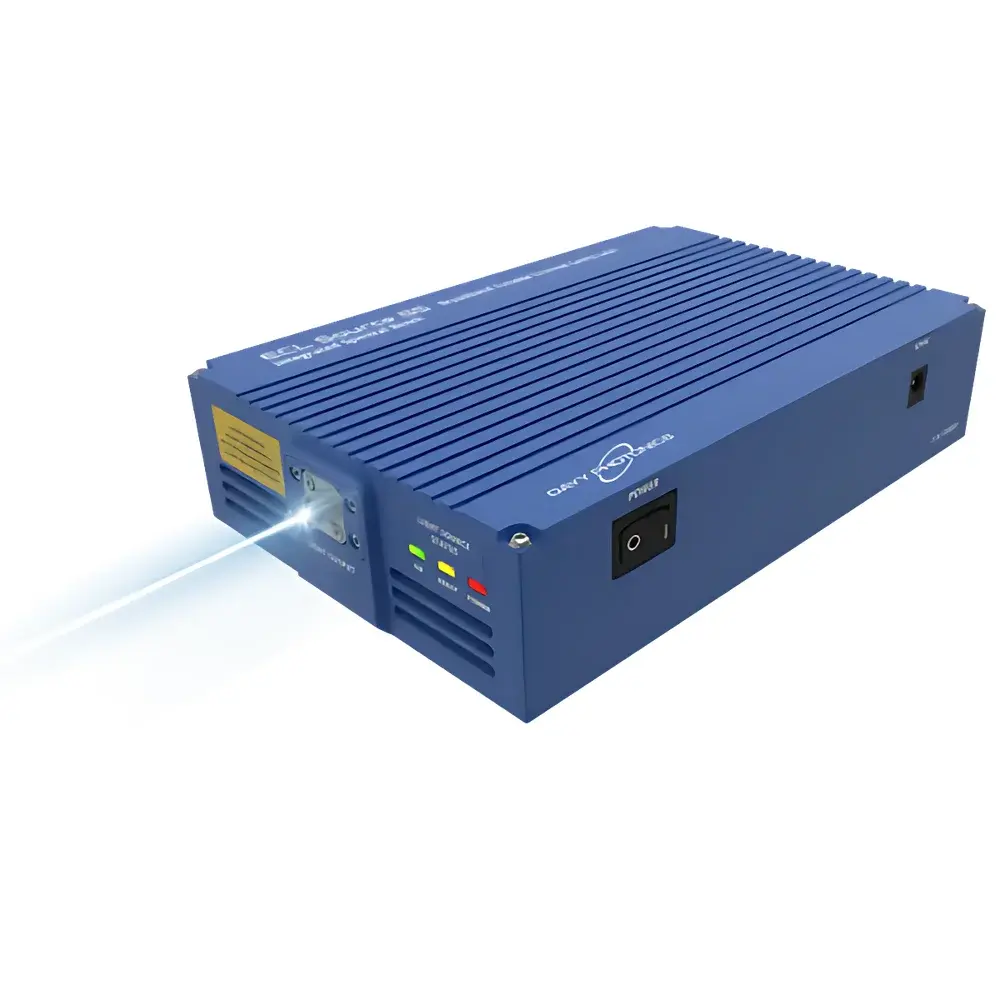
DAYY Photonics ECL-4500 Series Broadband Tunable External Cavity Laser
| Brand | DAYY Photonics |
|---|---|
| Origin | Canada |
| Manufacturer Type | Authorized Distributor |
| Product Origin | Imported |
| Model | ECL-4500 Series |
| Tuning Range | Standard 45–200 nm, Extended up to 500 nm |
| Spectral Linewidth (FWHM) | ~0.5 nm @ 1550 nm |
| Output Power | >10 mW per wavelength |
| Simultaneous Wavelengths | Up to 4 |
| Tuning Speed | kHz-rate continuous electronic tuning |
| Tuning Mechanism | Solid-state, no moving parts, voltage-controlled |
| Fiber Coupling | Polarization-maintaining (PM), single-mode (SM), or free-space options |
| Interfaces | USB, RS-232, Ethernet |
| Software | GUI + Python/C++ API for automated test systems |
Overview
The DAYY Photonics ECL-4500 Series is a high-performance, electronically tunable external cavity laser (ECL) engineered for precision spectroscopic applications requiring broad, continuous, and repeatable wavelength coverage across the near-infrared (NIR) and short-wave infrared (SWIR) spectrum (745–1775 nm). Unlike mechanically tuned or thermally stabilized lasers—whose range is limited to a few nanometers and subject to hysteresis and long settling times—the ECL-4500 leverages monolithic solid-state tuning via analog voltage control, enabling kHz-rate, hysteresis-free spectral scanning without mechanical actuators or thermal drift. Its external cavity architecture incorporates a high-stability Littrow or Littman-Metcalf configuration with diffraction grating feedback, optimized for narrow linewidth (~0.5 nm FWHM at 1550 nm) and excellent side-mode suppression ratio (SMSR >55 dB). Designed from inception for scalability, the platform supports both single-gain-chip configurations (standard models) and multi-gain-chip integration (extended-range variants), allowing seamless expansion of spectral coverage while preserving optical coherence and power stability.
Key Features
- Electrically driven, millisecond-scale wavelength tuning—no moving parts, no thermal inertia, no mode hops across full scan range
- Configurable center wavelengths from 785 nm to 1680 nm, with 14 standard options covering key telecom, biomedical, and sensing bands
- Standard tuning ranges: 45–200 nm; extended-range variants support up to 500 nm total coverage via gain chip stacking and cavity reconfiguration
- Simultaneous multi-wavelength operation: up to four discrete, independently addressable output wavelengths within a single laser head
- Integrated dual-stage broadband optical isolator (>40 dB isolation from 750–1700 nm) minimizes back-reflection sensitivity and ensures stable lasing under real-world optical loading conditions
- Output options include polarization-maintaining (PM), single-mode (SM), or free-space collimated beams—each delivering >10 mW per selected wavelength
- Industrial-grade communication interfaces: USB 2.0 (CDC class), RS-232 (TTL/RS-232 level), and 10/100BASE-T Ethernet for remote control and synchronization in automated test environments
- Firmware-upgradable controller with real-time wavelength calibration traceable to NIST-traceable reference sources
Sample Compatibility & Compliance
The ECL-4500 Series is compatible with standard SMF-28, PM1550, or custom fiber pigtails (FC/APC, FC/PC, or SMA905 connectors), and supports free-space coupling into interferometers, spectrometers, or OCT sample arms without alignment degradation. All units undergo rigorous burn-in and wavelength accuracy verification per IEC 61290-1-3 (optical amplifier testing) and ISO/IEC 17025-accredited calibration protocols. The laser’s electronic tuning architecture complies with IEC 61326-1 (EMC for laboratory equipment) and meets RoHS 3 and REACH material restrictions. For regulated environments—including FDA-regulated OCT system development or telecom component qualification—the firmware supports audit-ready logging (timestamped wavelength/power records), user-access controls, and optional 21 CFR Part 11-compliant electronic signature modules when deployed with DAYY’s certified LabControl Suite.
Software & Data Management
DAYY provides a cross-platform graphical user interface (LabView-compatible Windows/macOS/Linux) featuring real-time spectral visualization, multi-channel sweep sequencing, and hardware-synchronized trigger I/O (TTL input/output for lock-in detection or camera gating). A documented Python 3.8+ SDK and C++ DLL enable direct integration into custom automation frameworks (e.g., Python-based PyVISA test sequences or MATLAB Instrument Control Toolbox workflows). All data exports conform to HDF5 v1.12+ standards with embedded metadata (wavelength axis, power calibration coefficients, temperature logs, and serial-number-tagged instrument provenance). Remote management is supported via RESTful API over Ethernet, including JSON-RPC command sets for CI/CD pipeline integration and cloud-based instrument monitoring.
Applications
- Optical component characterization: WDM filter passband mapping, FBG reflectivity profiling, and isolator/isolator PDL measurement across C+L+U bands
- Telecom test infrastructure: BER testing of coherent receivers, dispersion compensation validation, and DWDM channel alignment under dynamic load
- Medical and industrial OCT: Swept-source OCT (SS-OCT) at 1050 nm (retinal imaging), 1300 nm (dermatology), and 1600 nm (deep-tissue collagen contrast)
- High-resolution absorption spectroscopy: Gas sensing (CH₄, CO₂, NH₃) using tunable diode laser absorption spectroscopy (TDLAS) with kHz-rate multi-line fitting
- Biophotonics instrumentation: Multi-spectral photoacoustic excitation, fluorescence lifetime imaging (FLIM) pump source multiplexing, and Raman excitation wavelength optimization
- Quantum optics experiments: Pump-probe setups requiring synchronized, widely tunable seed sources for OPO/OPA pumping or atomic vapor cell interrogation
FAQ
What is the typical wavelength accuracy and long-term stability of the ECL-4500?
Wavelength accuracy is ±0.15 nm (±20 GHz) over 24 hours at constant ambient temperature (23 ±1 °C), verified against an onboard wavemeter referenced to a stabilized HeNe laser. Drift is <±0.05 nm over 8 hours under active temperature stabilization.
Can the ECL-4500 be integrated into a GLP/GMP-compliant manufacturing test station?
Yes—optional firmware enables 21 CFR Part 11-compliant audit trails, electronic signatures, and role-based access control. Calibration certificates are issued with ISO/IEC 17025 accreditation upon request.
Is multi-wavelength operation truly simultaneous, or time-multiplexed?
All four wavelengths are generated concurrently from independent cavity modes; no time-division multiplexing is used. Each output maintains its specified linewidth and power stability during concurrent emission.
Does the laser support external modulation or direct current modulation?
The ECL-4500 is designed for CW operation only. For intensity modulation, we recommend pairing with an external Mach-Zehnder or electro-absorption modulator (EAM); direct modulation of the gain chip is not supported.
What is the maximum optical feedback level the laser can tolerate without instability?
With the integrated dual-stage isolator, the system tolerates up to –30 dB optical feedback (i.e., 0.1% reflected power) across its full tuning range—validated per Telcordia GR-468-CORE reliability testing.





