
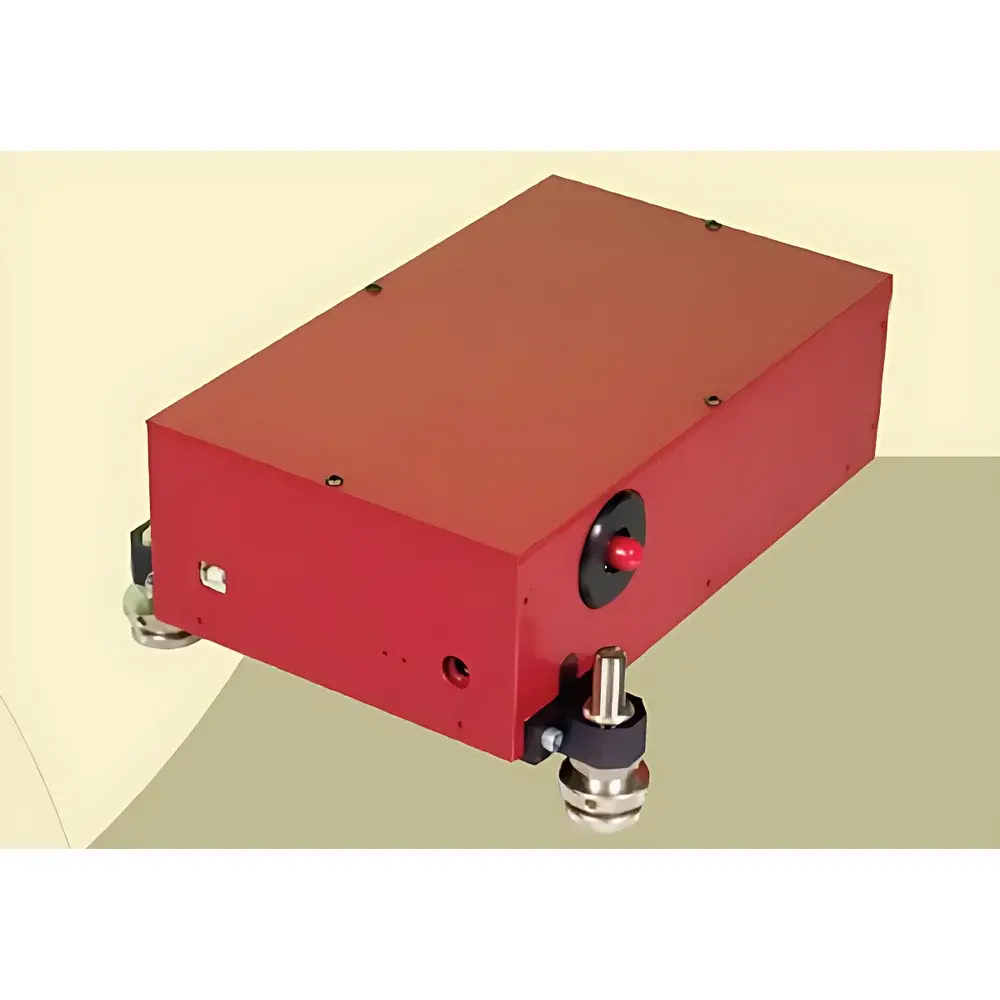
Avesta ASP-IR Mid-Infrared Scanning Spectrometer
| Brand | Avesta |
|---|---|
| Origin | Russia |
| Model | ASP-IR |
| Instrument Type | Laboratory Benchtop Scanning Spectrometer |
| Spectral Range (nm) | 500–3450 (model-dependent: ASP-IR-1.7: 500–1700 |
| ASP-IR-2.6 | 900–2600 |
| ASP-IR-3.5 | 1200–3450) |
| Resolution (free-space input) | 0.5 nm / 0.8 nm / 1.2 nm |
| Resolution (400 µm fiber input) | 0.7 nm / 1.0 nm / 1.5 nm |
| Scan Speed | up to 400 nm/s |
| Signal-to-Noise Ratio | 5000:1 |
| Optical Design | Czerny-Turner monochromator (f = 150 mm, f/# = 1:13) |
| Input Slit | 15 µm |
| Output Slit | 20 µm |
| Detector | Thermoelectrically cooled InGaAs (ASP-IR-1.7) or二级-cooled InAs (ASP-IR-2.6 & ASP-IR-3.5) |
| NEP | 0.6 nW (0.15 pJ) / 42 nW (2.5 pJ) / 145 nW (7 pJ) |
| Dynamic Range | 3×10⁵ / 7×10⁵ / 6×10⁴ |
| ADC | 16-bit |
| Interface | USB 2.0 |
| Dimensions (mm) | 225×136×81 (ASP-IR-1.7), 295×136×81 (ASP-IR-2.6/3.5) |
| Weight | 2.9 kg / 3.6 kg |
| Trigger Input | Yes (TTL-compatible, for pulsed laser synchronization) |
Overview
The Avesta ASP-IR is a high-performance, benchtop mid-infrared scanning spectrometer engineered for precision wavelength characterization of continuous-wave (CW) and pulsed laser sources in research and industrial laboratory environments. Unlike array-based Fourier-transform or dispersive spectrometers requiring costly InSb or MCT detectors, the ASP-IR employs a mechanically scanned Czerny-Turner monochromator architecture with thermoelectrically or dual-stage cooled semiconductor detectors—enabling high spectral fidelity without cryogenic infrastructure. Its core measurement principle relies on wavelength-selective dispersion via ruled diffraction gratings (600 or 400 lines/mm), followed by point-detection using optimized InGaAs or InAs photodiodes. This design delivers exceptional resolution (down to 0.5 nm in free-space configuration) across three calibrated spectral variants: ASP-IR-1.7 (500–1700 nm), ASP-IR-2.6 (900–2600 nm), and ASP-IR-3.5 (1200–3450 nm). The instrument is particularly suited for applications demanding real-time, single-shot spectral monitoring of tunable lasers, OPOs, QCLs, and supercontinuum sources where temporal synchronization and optical alignment stability are critical.
Key Features
- Three interchangeable spectral configurations optimized for distinct mid-IR sub-bands, each with grating, detector, and optical path calibrated for maximum quantum efficiency and linearity
- Sub-nanometer spectral resolution (0.5 nm typical, free-space input) enabled by precision-machined 15 µm input slit, 20 µm output slit, and low-aberration 150 mm focal length optics
- High-speed mechanical scanning up to 400 nm/s—compatible with transient emission profiling and rapid laser tuning verification
- Dual-input flexibility: collimated free-space beam coupling and standardized SMA-905 fiber port (400 µm core, NA 0.22), eliminating re-alignment when switching modalities
- Integrated TTL trigger input for precise synchronization with external pulse generators or laser Q-switches—essential for time-resolved spectral acquisition of ns- or ps-duration pulses
- USB 2.0 interface with vendor-provided SDK (C/C++, Python, LabVIEW) supporting full remote control, data streaming, and integration into automated test benches
- Compact, vibration-resistant aluminum chassis (225 × 136 × 81 mm for ASP-IR-1.7; 295 × 136 × 81 mm for longer-wavelength models) designed for space-constrained optical tables and OEM integration
Sample Compatibility & Compliance
The ASP-IR accepts both spatially filtered free-space beams (M² < 1.3 recommended) and multimode fiber-coupled inputs (400 µm core, numerical aperture ≤ 0.22). It is compatible with Class 3B and Class 4 laser sources operating within its specified spectral windows, provided appropriate beam attenuation and safety interlocks are implemented per IEC 60825-1:2014. While not certified as a medical device, the spectrometer supports GLP-compliant workflows through timestamped, audit-trail-enabled data logging (via optional software add-on). Its analog signal chain and 16-bit digitization meet requirements for traceable calibration under ISO/IEC 17025:2017 for spectral radiance and wavelength accuracy validation. No intrinsic compliance with FDA 21 CFR Part 11 is claimed; however, raw binary data export (IEEE 754 float32 format) enables third-party validation and electronic signature integration in regulated QC environments.
Software & Data Management
The ASP-IR ships with Avesta’s SpectraView software—a cross-platform application (Windows/macOS/Linux) providing real-time spectrum visualization, peak search, FWHM calculation, background subtraction, and multi-scan averaging. All acquired spectra are saved in HDF5 format, preserving metadata including timestamp, detector temperature, scan velocity, slit settings, and trigger status. The included SDK enables direct memory-mapped access to raw ADC frames, facilitating custom spectral processing pipelines (e.g., Savitzky-Golay smoothing, baseline correction, or machine-learning-assisted line identification). Export options include CSV, ASCII, and MATLAB .mat files. For regulated laboratories, optional SpectraView Pro adds electronic signature support, user role management, and immutable audit logs compliant with ALCOA+ principles.
Applications
- Characterization of tunable diode lasers, external cavity diode lasers (ECDLs), and distributed feedback (DFB) lasers in telecom and gas sensing R&D
- Wavelength calibration and mode-hop detection in optical parametric oscillators (OPOs) and difference-frequency generation (DFG) systems
- Real-time spectral monitoring of ultrafast amplifier chains and chirped-pulse amplification (CPA) setups
- Quality control of mid-IR light sources used in photoacoustic spectroscopy, FTIR auxiliary validation, and laser-induced breakdown spectroscopy (LIBS)
- Academic teaching labs requiring robust, alignment-free spectral instrumentation for undergraduate optics and photonics curricula
- OEM integration into portable gas analyzers or process-monitoring systems where size, power consumption, and trigger synchronization are limiting factors
FAQ
What laser repetition rates can the ASP-IR synchronize with via its trigger input?
The TTL-compatible trigger input accepts signals from DC to 10 MHz, supporting single-shot acquisition of individual pulses from nanosecond- or picosecond-duration lasers, as well as gated averaging over arbitrary pulse trains.
Is fiber coupling mandatory, or can the instrument operate exclusively in free-space mode?
Free-space operation is fully supported and often preferred for maximum resolution; the fiber port is an optional convenience feature—not a requirement for basic functionality.
Does the ASP-IR require external cooling or vacuum pumping?
No. All detector variants use thermoelectric (Peltier) cooling only; no liquid nitrogen, Stirling coolers, or vacuum housings are needed.
How is wavelength calibration performed, and what is its long-term stability?
Factory calibration uses NIST-traceable Hg/Ar emission lines; drift is typically < ±0.1 nm over 8 hours at constant ambient temperature (23 ± 1 °C), verified by optional internal reference LED.
Can multiple ASP-IR units be synchronized for multi-channel spectral acquisition?
Yes—via shared external clock and trigger distribution using standard BNC cabling; firmware supports master-slave timing coordination with sub-microsecond jitter.





