
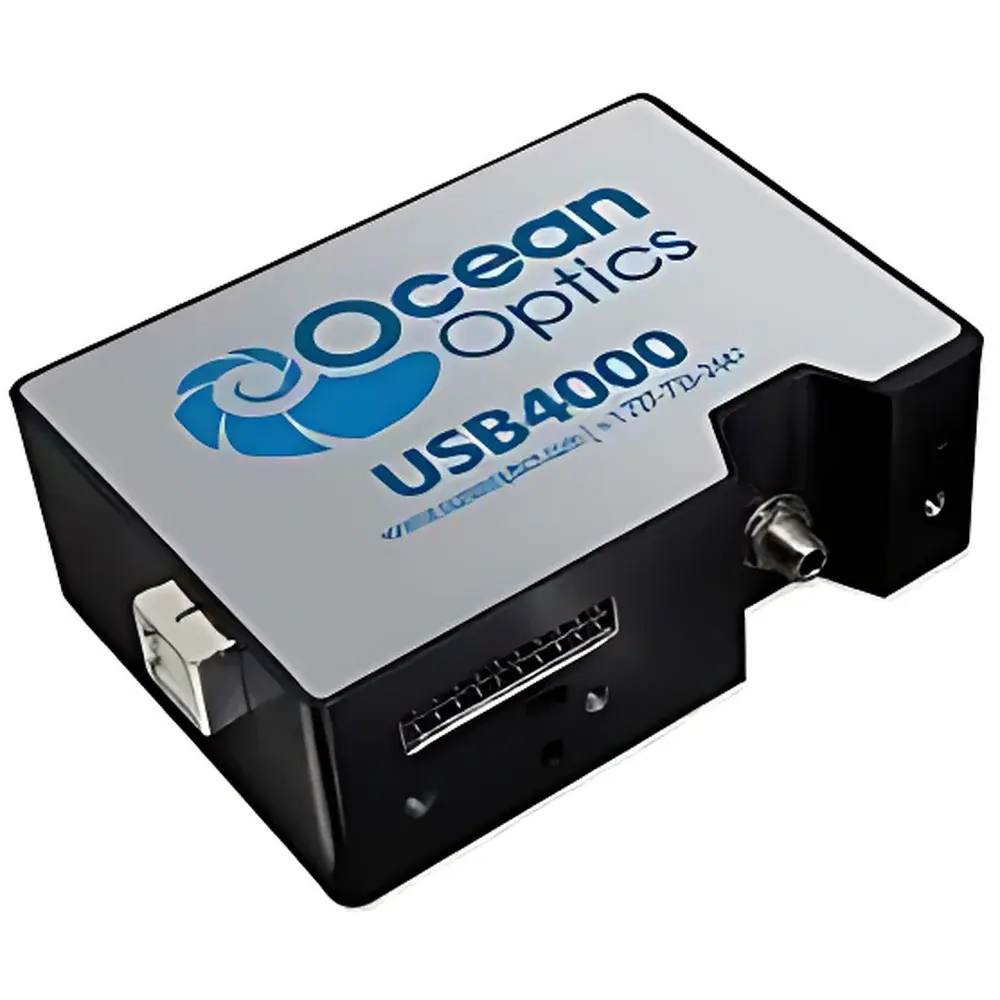
Ocean Optics USB4000 Fiber Optic Spectrometer
| Brand | Ocean Optics |
|---|---|
| Origin | USA |
| Model | USB4000 |
| Detector | Toshiba TCD1304AP linear CCD array (3648 pixels) |
| Spectral Range | 350–1000 nm (configurable down to 200 nm with UV-enhanced optics) |
| Optical Resolution | ~1.5 nm FWHM |
| Integration Time | 10 µs – 10 s |
| Signal-to-Noise Ratio | 300:1 (full spectrum) |
| A/D Resolution | 16-bit |
| Dark Noise | 50 counts RMS |
| Dynamic Range | 2 × 10⁸ (system), 1300:1 (single acquisition) |
| Stray Light | <0.05% @ 600 nm, <0.10% @ 435 nm |
| Linearity | >99.8% |
| Input/Output | 8 programmable digital I/O lines via 22-pin connector |
| Trigger Modes | 4 (edge, level, external pulse, software) |
| Interface | USB 2.0 (480 Mbps), RS-232, SPI, I²C |
| Power | 5 VDC @ 250 mA |
| Dimensions | 89.1 × 63.3 × 34.4 mm |
| Weight | 190 g |
Overview
The Ocean Optics USB4000 Fiber Optic Spectrometer is a compact, high-performance benchtop spectrometer engineered for precision spectral measurement in research laboratories, industrial process monitoring, and educational settings. Based on the Czerny-Turner optical design with an f/4 asymmetric configuration, the instrument accepts light via SMA905-terminated optical fiber (0.22 NA), disperses it using a user-selectable holographic or ruled grating, and detects the resulting spectrum with a Toshiba TCD1304AP linear CCD array comprising 3648 pixels (8 µm × 200 µm). Its fixed 42 mm input / 68 mm output focal length architecture ensures consistent optical throughput and wavelength calibration stability. The detector’s deep well capacity (100,000 electrons) and low dark noise (50 counts RMS) support quantitative measurements across demanding applications—from transient laser-induced fluorescence to low-light absorption spectroscopy. With native USB 2.0 connectivity and full cross-platform driver support (Windows, macOS, Linux), the USB4000 delivers laboratory-grade data acquisition without requiring proprietary hardware controllers.
Key Features
- Ultrafast temporal resolution: Software-controllable integration time from 10 µs to 10 s enables capture of nanosecond-scale pulsed events—critical for time-resolved laser diagnostics, plasma emission analysis, and flash photolysis.
- Modular optical configuration: Interchangeable slits (5–200 µm), 14 standard gratings (UV-VIS-NIR), OFLV order-sorting filters, and UV-enhanced coatings (e.g., UV4 window) allow spectral range and resolution tailoring per application.
- Embedded programmable microcontroller: Integrated 8-channel digital I/O (TTL-compatible) supports synchronized triggering, external device control (e.g., shutters, LEDs, pumps), and real-time process feedback loops via the 22-pin expansion port.
- High-fidelity spectral fidelity: >99.8% pixel-to-pixel linearity, <0.05% stray light at 600 nm, and 16-bit A/D conversion ensure traceable, reproducible quantification compliant with ASTM E308 and ISO/CIE colorimetry standards.
- Robust mechanical architecture: Aluminum alloy housing (190 g, palm-sized footprint) provides thermal and mechanical stability for field-deployable or OEM-integrated use without active cooling.
Sample Compatibility & Compliance
The USB4000 interfaces seamlessly with standard 0.22 NA silica-core optical fibers (SMA905), enabling non-invasive sampling from cuvettes, flow cells, remote probes, or integrating spheres. Its 350–1000 nm baseline range—extendable to 200–1100 nm with optional UV-NIR gratings and enhanced coatings—supports compliance-critical analyses including USP spectrophotometric assay validation, EPA Method 415.3 (DOC analysis), and ISO 13485-aligned QC workflows. Firmware and driver stacks are designed to support audit-ready data integrity: metadata tagging (timestamp, integration time, calibration ID), raw-data export in CSV/HDF5 formats, and compatibility with GLP/GMP-compliant LIMS integration via standardized API protocols. While not FDA 21 CFR Part 11-certified out-of-the-box, its deterministic I/O behavior and immutable spectral logging make it suitable for validated environments when deployed with appropriate procedural controls.
Software & Data Management
OceanView spectroscopy software (v2.x+) provides real-time visualization, spectral math (absorbance, transmittance, derivative), multi-curve overlay, and automated peak detection. All spectral acquisitions include embedded metadata: integration time, detector temperature (via onboard thermistor), grating ID, and calibration file hash. Raw spectra are stored in vendor-neutral formats (CSV, ASCII, HDF5) to facilitate third-party processing in Python (NumPy/SciPy), MATLAB, or LabVIEW. For OEM integration, Ocean Optics supplies comprehensive SDKs supporting C/C++, .NET, Java, and Python—enabling custom GUI development, batch automation, and synchronization with PLCs or DAQ systems via RS-232, SPI, or I²C. USB enumeration follows USB Device Class Definition for Communications Devices, ensuring plug-and-play reliability without driver conflicts.
Applications
- Chemical kinetics: Monitoring rapid reaction progress via time-series absorbance at specific wavelengths (e.g., nitrate reduction, enzyme catalysis).
- LED and laser diode characterization: Spectral centroid, FWHM, and peak wavelength tracking under pulsed or CW operation.
- Color measurement: CIE XYZ, L*a*b*, and spectral power distribution (SPD) calculation per ISO/CIE 15, CIE 170-2, and ANSI C78.377.
- Environmental sensing: In-situ water quality analysis (nitrate, chlorophyll-a, CDOM) using submersible fiber probes.
- Teaching labs: Hands-on instruction in optical physics, quantum mechanics (atomic emission), and analytical chemistry principles.
FAQ
What is the shortest achievable integration time, and how is it implemented?
The minimum integration time is 10 µs, achieved via hardware-level electronic shuttering of the Toshiba CCD—bypassing mechanical limitations and enabling single-pulse capture of Q-switched lasers or spark emissions.
Can the USB4000 operate without a computer?
No. It requires host-based firmware execution; however, its embedded microcontroller allows autonomous triggering and I/O sequencing once configured via USB.
Is calibration traceable to NIST standards?
Yes. Ocean Optics provides factory calibration certificates traceable to NIST SRMs (e.g., HG/Ne, HgAr lamps), and users may perform recalibration using certified reference sources and OceanView’s built-in routines.
How does the USB4000 handle spectral stray light in UV-VIS measurements?
OFLV (order-sorting) filters suppress second-order diffraction, while the optimized Czerny-Turner path and black-anodized internal baffling limit stray light to <0.05% at 600 nm—meeting ASTM E275 requirements for photometric accuracy.
What operating systems are officially supported?
Windows (98 through 11), macOS (10.13+), and major Linux distributions (Ubuntu, CentOS) with kernel 3.10+, all via signed drivers and documented USB HID class implementation.






