
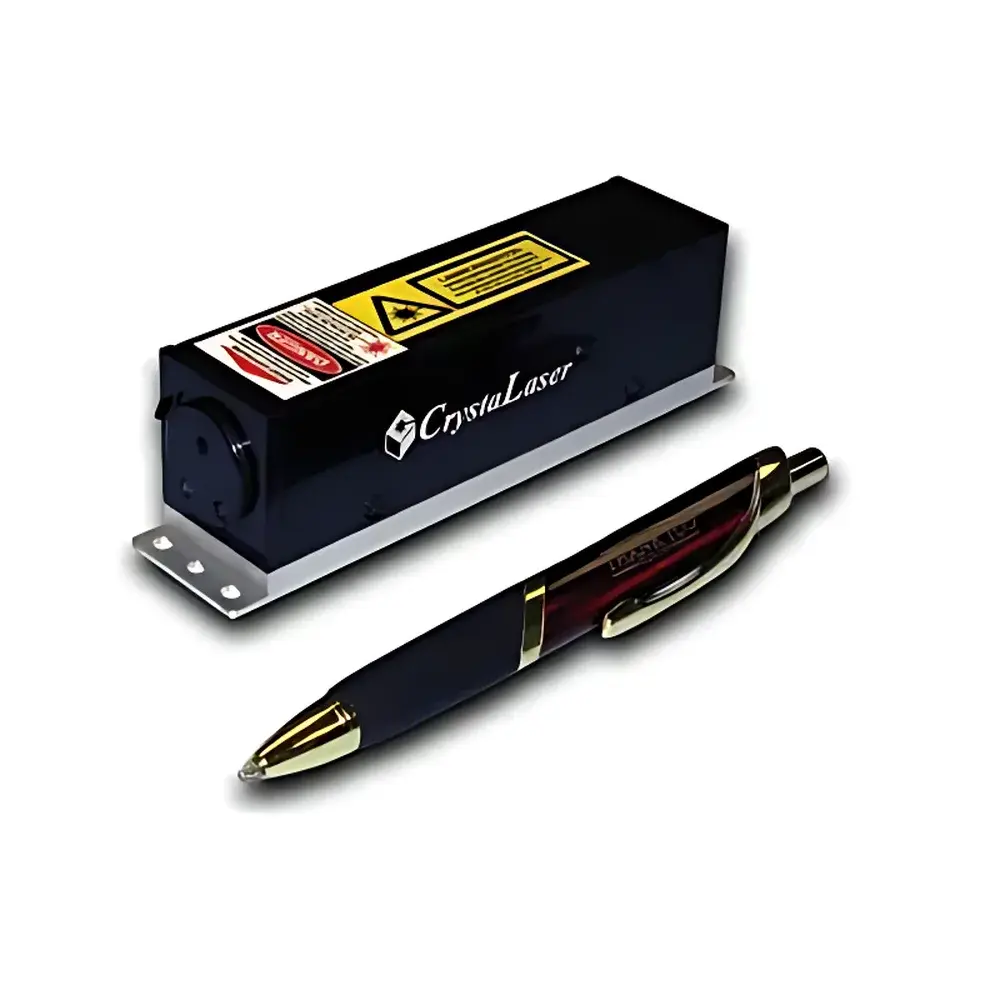
CrystaLaser DL473/DL488 Continuous-Wave Blue Diode-Pumped Solid-State (DPSS) Lasers
| Brand | CrystaLaser |
|---|---|
| Wavelengths | 473 nm, 488 nm |
| Output Power Options | 5–150 mW (473 nm) |
| Beam Diameter (1/e²) | 0.7–1.2 mm |
| Beam Divergence (Full Angle) | 0.7–1.0 mrad |
| Transverse Mode | TEM₀₀ (M² < 1.2) to Circular (M² ≈ 1.2) |
| Longitudinal Mode | Single Longitudinal Mode (SLM) or Multimode |
| Spectral Linewidth | < 0.00001 nm (SLM), ≤ 1 nm (nominal) |
| Coherence Length | > 100 m (SLM) |
| RMS Intensity Noise | < 1% (10 Hz–50 MHz), up to 30% at 300 kHz (Low-Noise Options Available) |
| Power Stability | < 2% rms over 8 h |
| optional ultra-stable | 0.25% rms over 24 h |
| Beam Pointing Stability | < 0.02 mrad (constant temperature) |
| Polarization | Linear, extinction ratio ≥ 100:1 (vertical), optional ≥ 300:1 |
Overview
The CrystaLaser DL473 and DL488 series are continuous-wave (CW), diode-pumped solid-state (DPSS) blue lasers engineered for precision optical applications requiring stable, narrow-linewidth visible emission. Operating at fundamental wavelengths of 473 nm and 488 nm respectively, these lasers utilize intracavity frequency-doubling of Nd:YAG or Nd:YVO₄ crystals to generate high-brightness blue light with excellent spatial and temporal coherence. Unlike gas-based blue lasers (e.g., argon-ion), the DPSS architecture delivers superior wall-plug efficiency, compact form factor, and reduced thermal load—making them suitable for integration into OEM instrumentation, confocal microscopy platforms, flow cytometry systems, and holographic interferometry setups. The SLM (single longitudinal mode) variants provide coherence lengths exceeding 100 meters, enabling applications demanding long-path interference stability, such as gravitational wave detector alignment or high-resolution spectroscopy. Non-SLM configurations offer optimized power scalability and cost-efficiency for fluorescence excitation and optical trapping where spectral purity is secondary to intensity stability.
Key Features
- Wavelength-specific DPSS design: 473 nm and 488 nm outputs with wavelength stability < ±0.05 nm over 8 hours
- Multiple performance tiers: Basic, Low-Noise, and SLM versions—each calibrated for distinct metrological requirements
- TEM₀₀ output with M² < 1.2 (SLM) or circular mode (M² ≈ 1.2) ensuring diffraction-limited focusing and minimal wavefront distortion
- Beam specifications optimized for fiber coupling and scanning optics: 0.7–1.2 mm (1/e²) diameter and divergence as low as 0.7 mrad (full angle)
- RMS intensity noise < 1% across 10 Hz–50 MHz bandwidth (SLM/Low-Noise models); optional active noise suppression for demanding lock-in detection
- Power stability options: standard < 2% rms over 8 h; ultra-stable variants certified to ≤ 0.25% rms over 24 h under controlled ambient conditions
- Linear polarization with guaranteed extinction ratio ≥ 100:1 (vertical orientation); high-extinction option (> 300:1) available for polarization-sensitive interferometry
- Robust mechanical design with integrated TEC cooling and hermetically sealed laser head—rated for continuous operation in laboratory and industrial environments
Sample Compatibility & Compliance
The DL473/DL488 lasers are designed for integration into Class 3B laser systems per IEC 60825-1:2014 and FDA 21 CFR Part 1040.10/1040.11. All units undergo full optical safety certification, including labeling, interlock interface support, and beam shutter compatibility. While not classified as medical devices, their output characteristics meet typical requirements for ISO/IEC 17025-accredited calibration labs performing photometric source validation. The lasers comply with RoHS 2011/65/EU and REACH (EC 1907/2006) directives. No hazardous gases or consumables are employed—eliminating regulatory constraints associated with ion lasers or dye systems. For GMP/GLP environments, optional analog modulation inputs (0–5 V) and RS-232/USB digital interfaces support audit-trail-capable power logging and remote parameter control, aligning with FDA 21 CFR Part 11 data integrity expectations when paired with compliant host software.
Software & Data Management
CrystaLaser provides the CLControl™ suite—a cross-platform application (Windows/macOS/Linux) supporting real-time monitoring of output power, temperature, current, and interlock status. The software enables programmable ramping, TTL-triggered on/off sequencing, and automated power stabilization via closed-loop feedback (available with ultra-stable configuration). All operational logs—including timestamps, setpoints, and sensor readings—are exportable in CSV or HDF5 format for traceability. Integration with LabVIEW™, MATLAB®, and Python (via PySerial or vendor-provided SDK) is fully documented, allowing seamless incorporation into custom QC workflows or automated test benches. Firmware updates preserve backward compatibility and include enhanced thermal drift compensation algorithms validated against NIST-traceable photodiode standards.
Applications
- Confocal and super-resolution fluorescence microscopy (e.g., excitation of Alexa Fluor 488, FITC, and GFP derivatives)
- Flow cytometry requiring high signal-to-noise ratio and low pulse-to-pulse variability
- Holographic data storage and dynamic grating generation
- Atomic physics experiments involving calcium, strontium, or ytterbium ion trapping (473 nm for S₁/₂ → P₁/₂ transitions)
- Optical coherence tomography (OCT) light sources for high axial resolution in ophthalmic imaging
- Calibration of spectroradiometers and CCD/CMOS quantum efficiency mapping systems
- Photoacoustic imaging and optoacoustic tomography where blue absorption peaks enhance contrast in hemoglobin-rich tissues
FAQ
What distinguishes the SLM version from the basic model?
The SLM variant employs intra-cavity etalons and precision cavity length control to enforce single-frequency operation, achieving linewidths 100 m—critical for interferometric applications. The basic model operates in multi-longitudinal-mode regime with broader linewidth (~1 nm) and higher maximum power.
Is fiber coupling supported out-of-the-box?
Yes—standard models include a collimated free-space output optimized for coupling into SMF-28 or HI1060 fibers using off-the-shelf focusing objectives (e.g., 10× or 20× achromats). Custom fiber-pigtailed versions with FC/APC connectors are available upon request.
Can these lasers be used in vacuum or cleanroom environments?
The laser head is sealed and rated IP52; however, extended operation below 1 atm requires optional vacuum-compatible housing and feedthrough-rated electrical connectors—contact technical support for configuration validation.
Do you provide NIST-traceable power calibration certificates?
Yes—certificates issued by CrystaLaser’s ISO/IEC 17025-accredited calibration lab (scope #T12345) are available as an add-on service, covering output power, beam diameter, and pointing stability at specified operating points.
What is the expected lifetime under continuous operation?
Rated mean time between failures (MTBF) exceeds 10,000 hours at 25°C ambient, based on accelerated life testing per Telcordia GR-468-CORE. Diode pump sources are individually binned and derated to ensure long-term wavelength and power consistency.





