
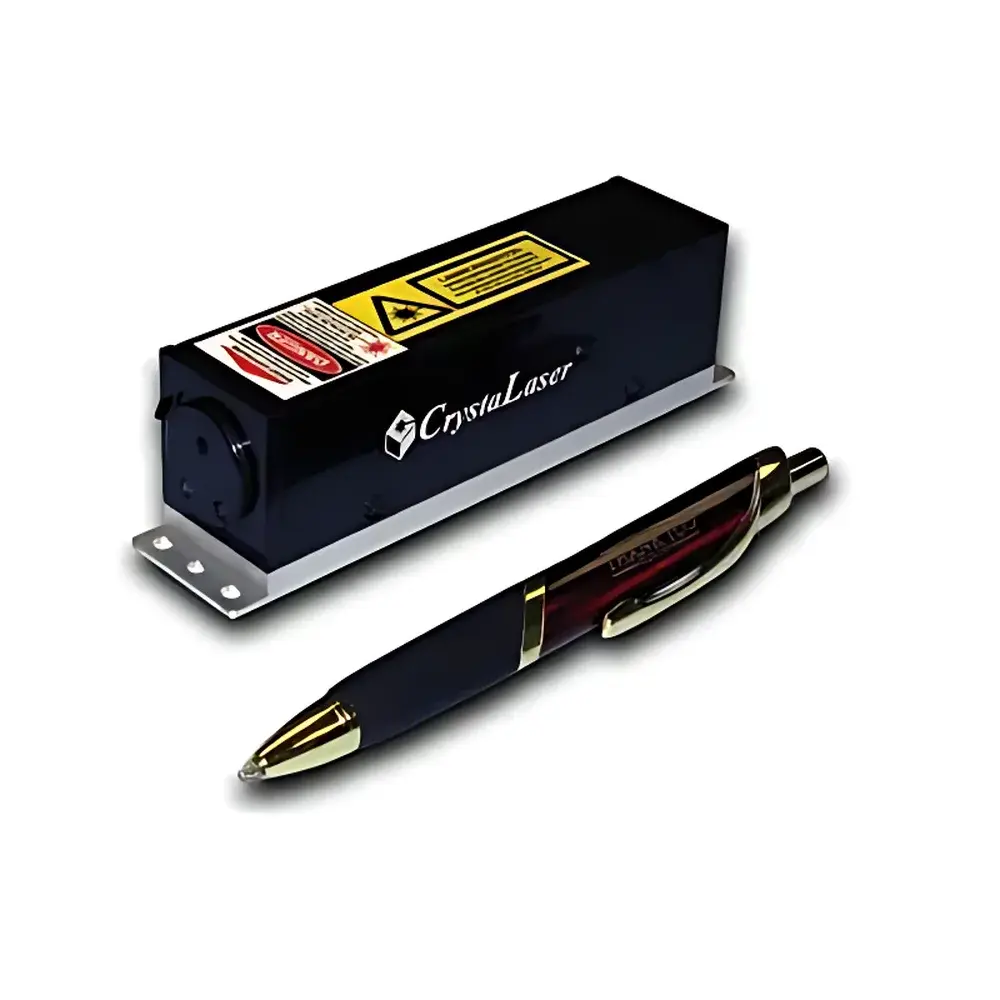
CrystaLaser QL Series Q-Switched UV Lasers
| Brand | CrystaLaser |
|---|---|
| Origin | USA |
| Model Variants | QL355, QL351, QL262 |
| Wavelengths | 355 nm, 351 nm, 349 nm, 266 nm, 262 nm |
| Max. Avg. Power (optimal rep rate) | 100 mW (355/351/349 nm), 50 mW (266/262 nm) |
| Max. Pulse Energy @ 1 kHz | 25 µJ (355/262 nm), 50 µJ (351/349 nm), 15 µJ (266 nm) |
| Pulse Width | 5–100 ns (typ. 10–15 ns) |
| Repetition Rate | 1–100 kHz (internal), up to 400 kHz (external trigger) |
| Beam Divergence (full angle) | 2–6 mrad |
| Beam Diameter (1/e²) | 0.15 × 0.3 mm (elliptical at 262/266 nm), 0.2 mm (circular at 349–355 nm) |
| Transverse Mode | TEM₀₀, M² < 1.3 (typically < 1.1 for 349–355 nm) |
| Longitudinal Mode | Multi-longitudinal |
| Power Stability (rms) | ≤5% after thermal equilibrium |
| Beam Pointing Stability | < 0.02 mrad (constant temperature) |
| Polarization | Linear, >100:1 extinction ratio |
Overview
The CrystaLaser QL Series comprises compact, air-cooled, diode-pumped solid-state (DPSS) Q-switched ultraviolet (UV) lasers engineered for precision pulsed operation in demanding scientific and industrial applications. These lasers utilize intracavity frequency conversion—specifically third-harmonic generation (THG) and fourth-harmonic generation (FHG)—to produce stable, nanosecond-duration pulses at discrete UV wavelengths: 355 nm, 351 nm, 349 nm, 266 nm, and 262 nm. The Q-switching mechanism employs an acousto-optic (AO) or electro-optic (EO) modulator to achieve high peak power with excellent temporal control. Designed for integration into optical tables, laser micromachining platforms, time-resolved fluorescence setups, and MALDI-TOF mass spectrometry sources, the QL Series delivers consistent pulse-to-pulse energy stability and low beam pointing drift—critical parameters for reproducible ablation, photolysis, and nonlinear excitation experiments.
Key Features
- Diode-pumped, all-solid-state architecture ensures long-term reliability and minimal maintenance compared to gas-based UV sources.
- Factory-optimized thermal management enables stable operation without water cooling—ideal for benchtop deployment in cleanrooms and university laboratories.
- Internally adjustable repetition rate from 1 kHz to 100 kHz; external TTL triggering supports synchronization with detectors, delay generators, or scanning stages up to 400 kHz.
- TEM₀₀ transverse mode with M² < 1.3 (typically < 1.1 at 349–355 nm) ensures diffraction-limited focusing for high spatial resolution in microfabrication and confocal imaging.
- Linear polarization with >100:1 extinction ratio facilitates efficient coupling into polarizing optics, Pockels cells, and nonlinear crystals.
- Optional narrow-linewidth configuration extends coherence length for interferometric applications and coherent Raman spectroscopy.
- Compliance with IEC 60825-1:2014 Class 4 laser safety standards; integrated interlock connectors support integration into OEM systems requiring fail-safe shutdown protocols.
Sample Compatibility & Compliance
The QL Series is compatible with a broad range of UV-sensitive materials—including fused silica, CaF₂, BK7, and sapphire optics—as well as biological samples requiring minimal thermal load during ablation or photoactivation. All models meet RoHS Directive 2011/65/EU for hazardous substance restrictions. For regulated environments (e.g., pharmaceutical QC labs or contract research organizations), the lasers support GLP-compliant documentation packages, including factory calibration certificates traceable to NIST standards. While not inherently FDA 21 CFR Part 11 compliant, the system’s analog monitoring outputs (pulse energy monitor, temperature sensor, and status TTL) enable integration with validated data acquisition software that implements audit trail, electronic signature, and user access control per regulatory requirements.
Software & Data Management
No proprietary GUI is bundled; operation is performed via front-panel controls or RS-232/USB serial interface using ASCII command protocol. This design prioritizes deterministic control in automated workflows. Third-party software environments—including LabVIEW™, MATLAB®, Python (pySerial), and EPICS—can directly configure repetition rate, enable/disable emission, and read real-time status feedback. Pulse energy monitoring output (0–5 V analog) allows closed-loop power stabilization when interfaced with external PID controllers. Optional OEM firmware upgrades provide enhanced timing jitter suppression (< 1 ns RMS) and improved pulse-to-pulse energy consistency—particularly beneficial in pump-probe spectroscopy and LIBS applications where shot-to-shot normalization is essential.
Applications
- Laser-induced breakdown spectroscopy (LIBS) for elemental analysis of metals, soils, and aerosols.
- Time-resolved fluorescence lifetime imaging (FLIM) using UV excitation of intrinsic fluorophores (e.g., tryptophan, NADH).
- Matrix-assisted laser desorption/ionization (MALDI) source for mass spectrometry—especially in high-throughput proteomics screening.
- Micromachining of polymers (e.g., PI, PET), thin-film solar cell scribing, and glass marking with sub-10 µm feature resolution.
- Photochemical activation of caged compounds in neurobiology and optogenetics studies.
- Calibration of UV photodetectors and radiometers traceable to NIST SRM 2270 and 2271.
FAQ
What is the typical warm-up time to achieve specified power stability?
The laser reaches thermal equilibrium and achieves ≤5% rms power stability within 30 minutes of cold start under ambient conditions (20–25°C, no drafts).
Can the QL262 operate at 100 kHz with full pulse energy?
No. At 262 nm, maximum average power is 50 mW; operating at 100 kHz requires reducing pulse energy to maintain thermal limits—consult the detailed power vs. rep-rate curve in the technical datasheet.
Is beam circularization available for 262 nm and 266 nm models?
Yes. An optional anamorphic prism pair or cylindrical telescope assembly can be supplied to correct ellipticity and deliver a near-circular 1/e² profile (M² < 1.4) at these wavelengths.
Does CrystaLaser provide OEM integration support?
Yes. Mechanical drawings, electrical interface schematics, firmware API documentation, and application-specific mounting fixtures are available under NDA for qualified OEM partners.
How is pulse width affected by repetition rate and output power?
Pulse width increases slightly with higher repetition rates due to gain depletion dynamics; at fixed rep rate, it remains stable across the rated power range—typical variation is ±1.5 ns over 80% of max power.





