
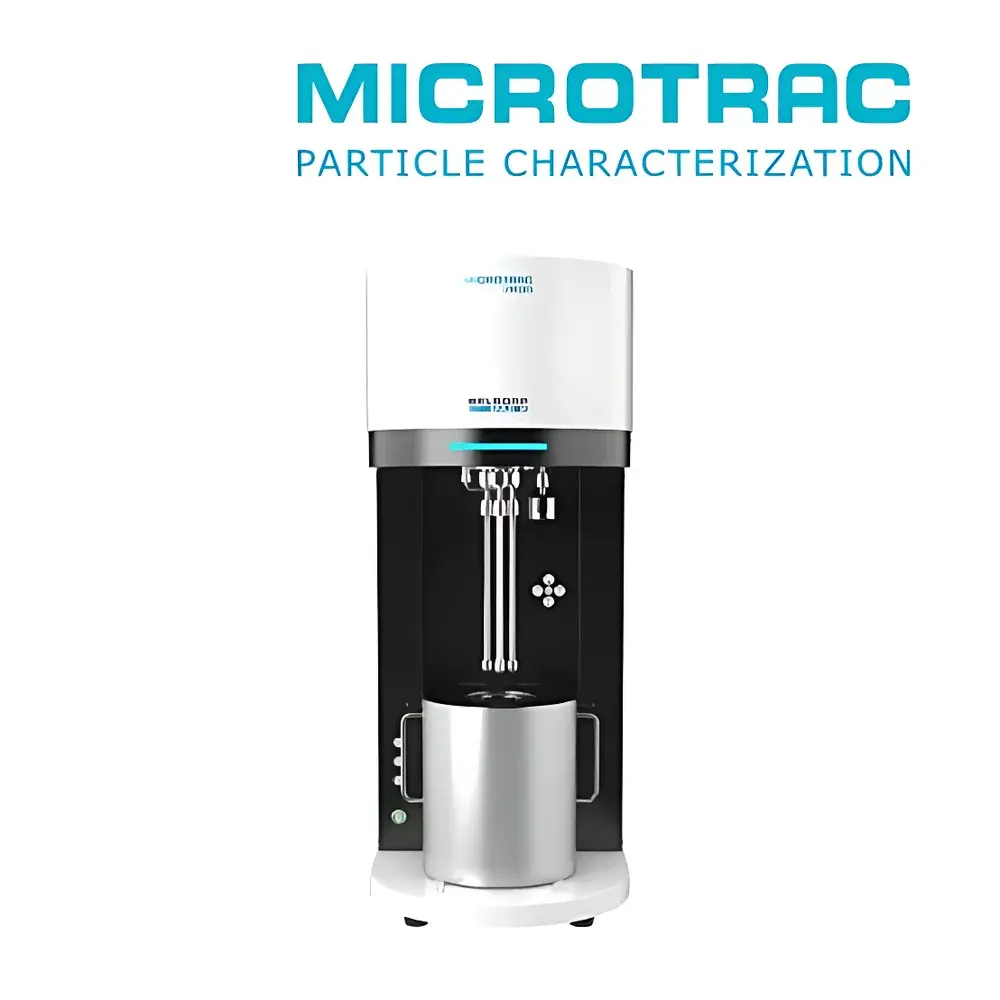
BELSORP MAX X Advanced Static Vapor Adsorption Analyzer by Microtrac
| Brand | Microtrac |
|---|---|
| Origin | Japan |
| Model | BELSORP MAX X |
| Instrument Type | Static Vapor Adsorption Analyzer |
| Pressure Sensor Ranges | 1000 Torr / 10 Torr / 0.1 Torr |
| Temperature Control | Heated Manifold (50 °C standard, optional 80 °C), Air-Bath Sample Chamber |
| Gas Path | Electropolished Stainless Steel with Metal-Sealed Pneumatic Valves |
| Free Space Compensation | Patented Advanced Free Space Measurement (AFSM™) Technology |
| Vapor Compatibility | H₂O, Ethanol, Benzene, and other non-corrosive VOCs (up to 40 °C standard |
| Gas Inlets | Standard 3-port corrosion-resistant |
| Measurement Modes | High-Precision Mode (3 sample + 1 reference station) & Multi-Station Mode (4 sample stations + dedicated P₀ port) |
| Software | BELCONTROL OS with real-time trend logging, system diagnostics, email status alerts, and multilingual UI (English/Japanese) |
| Compliance Support | Designed for GLP/GMP-aligned workflows |
Overview
The BELSORP MAX X is a high-precision static vapor adsorption analyzer engineered by Microtrac (Japan) for quantitative characterization of surface area, pore size distribution, and vapor–solid interaction thermodynamics. It operates on the gravimetrically referenced volumetric principle—measuring pressure changes in a closed, thermostatically controlled system under ultra-high vacuum conditions (<1×10⁻⁷ Pa base pressure). Unlike dynamic or flow-through systems, the BELSORP MAX X relies on equilibrium-based isotherm acquisition across a broad relative pressure range (P/P₀ = 10⁻⁸ to 0.99), enabling rigorous application of IUPAC-recommended models including BET, BJH, DFT, and NLDFT. Its core innovation lies in AFSM™ (Advanced Free Space Measurement), a patented real-time compensation methodology that continuously monitors reference cell volume fluctuations—eliminating reliance on liquid nitrogen level estimation and correcting for environmental drift caused by ambient temperature/pressure shifts, cryogen dissolution effects, and thermal expansion of manifold components.
Key Features
- Triple-range high-accuracy pressure sensing (1000 Torr / 10 Torr / 0.1 Torr) with <±0.05% full-scale repeatability, optimized for both macro- and microporous material analysis.
- Electropolished stainless-steel gas/steam pathways and metal-sealed pneumatic valves ensure minimal dead volume, zero elastomer contact, and long-term resistance to condensable vapors and mild corrosives.
- Integrated heated manifold (50 °C standard, upgradeable to 80 °C) and thermally insulated air-bath sample chamber prevent vapor condensation and enable stable isothermal conditions during water, ethanol, benzene, and other VOC adsorption measurements.
- Dual operational modes: High-Precision Mode (3 sample stations + 1 dedicated reference station for AFSM™-driven free-space correction) and Multi-Station Mode (4 parallel sample stations + independent P₀ measurement port) — configurable per analytical objective.
- Gas Dosage Optimization (GDO) algorithm reduces total measurement time by 50–70% through adaptive equilibration point selection based on prior isotherm data and inlet pressure feedback control calibrated to cylinder regulator output.
- Modular gas selection architecture supports up to 12 independent non-corrosive gas/vapor inlets via optional multi-port selector valve — ideal for comparative adsorption studies across CO₂, Kr, NH₃, H₂, CH₄, O₂, and H₂O.
Sample Compatibility & Compliance
The BELSORP MAX X accommodates diverse physical forms: powders (including air-sensitive materials handled under glovebox-integrated loading), granules, monoliths, fibers, thin films, and coated substrates. Standard sample tubes accept outer diameters of φ9 mm or φ14 mm; custom tubes are available for oversized or low-mass samples (e.g., <10 mg catalysts). All thermal treatment options—including in-situ heater (for degassing up to 400 °C), liquid nitrogen Dewar, and water-jacketed bath—support ASTM D3663, ISO 9277, and USP compliant protocols. The system’s architecture aligns with GLP and GMP documentation standards: BELCONTROL software maintains timestamped, user-attributed audit trails for all method parameters, calibration events, and raw sensor outputs — fully traceable for FDA 21 CFR Part 11 validation.
Software & Data Management
BELCONTROL, the embedded operating system, provides guided workflow navigation—from sample mass entry and pretreatment definition (heating rate, dwell time, vacuum level) to isotherm acquisition and post-processing. Real-time trend logging captures pressure, temperature, valve actuation, and thermal stability metrics at 100 ms resolution. Overlay functionality enables direct comparison of isotherms across ports; system diagnostics identify valve leakage, sensor drift, or thermal gradient anomalies before measurement initiation. Automated email notifications report completion status and flag deviations from preset tolerance thresholds. Data export conforms to ASTM E1382-compliant CSV and proprietary .bel formats, interoperable with BELMASTER analysis suite for advanced DFT kernel selection, hysteresis loop deconvolution, and isosteric heat mapping.
Applications
The BELSORP MAX X serves critical R&D and QC functions across industrial sectors requiring precise surface–vapor interaction data. In battery materials science, it quantifies electrolyte wettability on separator membranes and cathode coatings via water and carbonate vapor uptake. Catalyst developers use CO₂ and NH₃ isotherms to assess acid–base site density and micropore accessibility in zeolites and MOFs. Pharmaceutical formulation teams evaluate excipient hygroscopicity (water activity, deliquescence RH) and active ingredient–polymer compatibility using dynamic vapor sorption (DVS)-equivalent protocols. Additional applications include VOC capture capacity screening for activated carbons, hydrophobicity/hydrophilicity ranking of functionalized silica, pore blocking assessment in filtration media, and moisture-induced degradation kinetics in cementitious binders and semiconductor dielectrics.
FAQ
What distinguishes AFSM™ from conventional free-space correction methods?
AFSM™ replaces static geometric volume assumptions with continuous real-time monitoring of reference cell compressibility, compensating for thermal, barometric, and cryogenic perturbations without requiring manual LN₂ level tracking or calibration gas injections.
Can the BELSORP MAX X perform kinetic adsorption measurements?
Yes — time-resolved pressure transients are captured at user-defined intervals during dose–equilibrate cycles, enabling diffusion coefficient calculation, uptake rate profiling, and activation energy estimation via Arrhenius analysis.
Is compliance with 21 CFR Part 11 achievable out-of-the-box?
The BELCONTROL platform includes electronic signatures, role-based access control, and immutable audit logs — meeting foundational technical requirements; full validation requires site-specific IQ/OQ/PQ execution per internal SOPs.
How does the instrument handle low-surface-area materials like dense ceramics or metals?
Kr adsorption at 77 K is supported via optional cryogenic accessories; combined with the 0.1 Torr sensor and extended equilibration algorithms, detection limits reach <0.01 m²/g with <3% RSD across replicate runs.
Are third-party DFT models supported in BELMASTER?
BELMASTER natively integrates NLDFT kernels for carbon, silica, alumina, and titania; custom kernel import (via ISO-standardized .dft files) is supported for validated proprietary models.



