
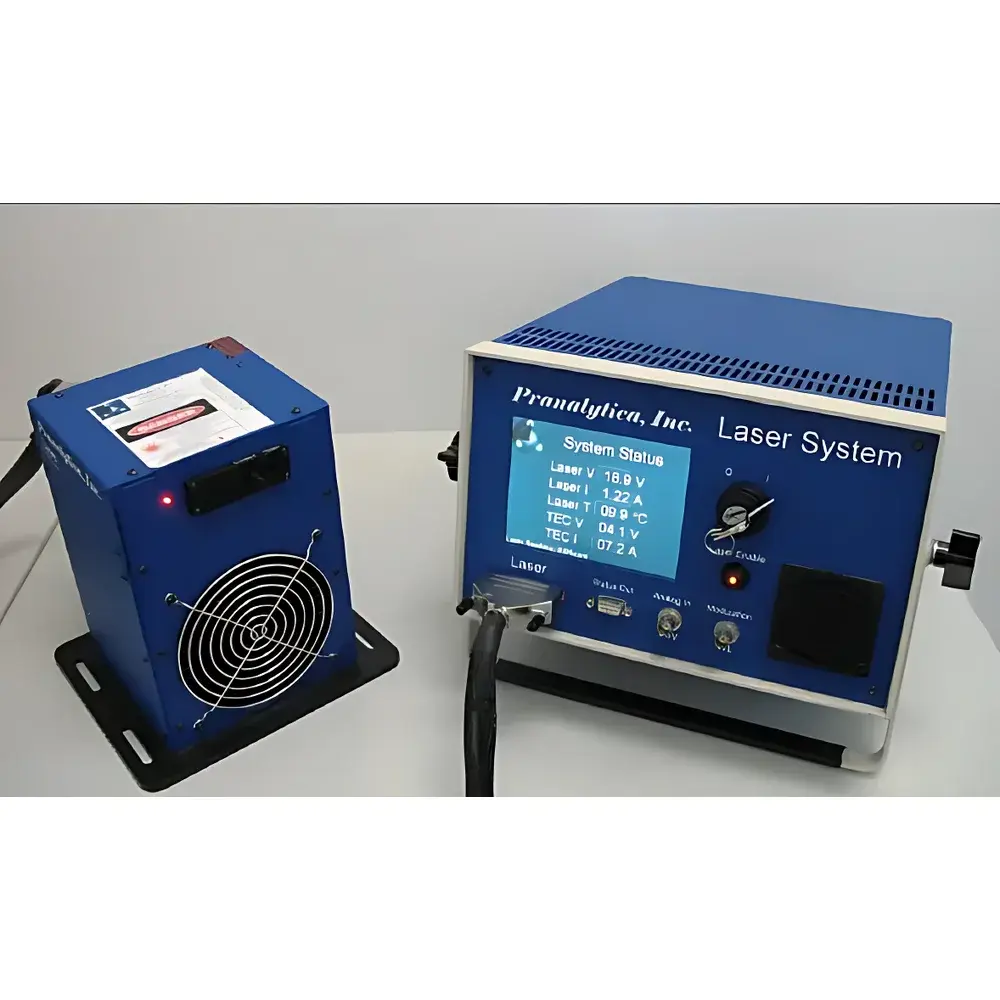
Pranalytica 1101-46-CW High-Power Continuous-Wave Quantum Cascade Laser System
| Brand | Pranalytica |
|---|---|
| Origin | USA |
| Manufacturer Type | Authorized Distributor |
| Product Category | Imported |
| Model | 1101-46-CW-XXXX |
| Configuration | Integrated CW QCL System with TEC-cooled Laser Head, Driver, and Collimated Output |
| Wavelength | Centered at 4.6 µm (Broadband, ~150 nm FWHM) |
| Output Power | ≥0.75 W to >2.0 W (Model-Dependent, Room-Temperature CW Operation) |
| Beam Quality | Near-Diffraction-Limited |
| Modulation Bandwidth | DC–100 kHz (TTL), up to 1 GHz with Optional RF Driver |
| Dimensions (Laser Head) | 13 cm × 17 cm × 15 cm |
| Weight (Laser Head) | 1.9 kg |
| Dimensions (Power Supply) | 28 cm × 18 cm × 37 cm |
| Weight (Power Supply) | 10 kg |
| Input Voltage | 110/220 V AC, 4 A max |
| Operating Temperature | 15–35 °C |
| Lifetime | >3,000 hours at full power under thermal cycling |
Overview
The Pranalytica 1101-46-CW is a fully integrated, high-power continuous-wave (CW) quantum cascade laser (QCL) system engineered for demanding mid-infrared (MIR) spectroscopic and industrial applications. Unlike conventional interband diode lasers, the QCL operates on intersubband transitions within a repeated stack of precisely engineered quantum wells—typically exceeding 500 periods—enabling photon emission per electron injection across multiple stages. This unipolar architecture yields intrinsic advantages in wavelength flexibility, power scalability, and thermal robustness in the 3.8–12+ µm spectral range. The 1101-46-CW variant is specifically optimized for broadband operation centered at 4.6 µm (±75 nm), delivering spectrally broad, high-brightness output ideal for absorption-based gas sensing where multiple molecular rovibrational lines fall within a single gain profile. Its monolithic packaging integrates thermoelectric cooling (TEC), collimation optics, and hermetic sealing—ensuring stable, maintenance-free CW operation under ambient laboratory or field-deployable conditions without external water cooling or vibration isolation.
Key Features
- Room-temperature CW output power options: ≥0.75 W, ≥1.0 W, ≥1.5 W, or >2.0 W—among the highest commercially available for single-emitter MIR QCLs
- Broadband emission centered at 4.6 µm with ~150 nm spectral width (FWHM), enabling simultaneous detection of multi-species gas signatures without mechanical tuning
- Integrated TEC-controlled laser head with collimated, near-diffraction-limited beam (M² < 1.3), eliminating alignment-sensitive external optics
- Front-panel TTL modulation interface supporting 1 kHz–100 kHz square-wave modulation (3 dB bandwidth); optional RF drivers extend modulation capability to 1 GHz for heterodyne or lock-in applications
- Comprehensive hardware protection suite: over-current, over-temperature, reverse-polarity, and soft-start sequencing with 5-second ramp-up delay to prevent current overshoot
- MIL-STD-810G-compliant mechanical design validated for shock, vibration, and thermal cycling—suitable for mobile platforms and harsh environments
- OEM-ready architecture with standardized electrical interfaces (SMA modulation input, DB9 status/control), compact footprint (laser head: 13 × 17 × 15 cm), and low acoustic noise
Sample Compatibility & Compliance
The 1101-46-CW is inherently compatible with standard open-path, multipass cell, and photoacoustic detection configurations used in trace gas analysis. Its 4.6 µm output strongly overlaps fundamental vibrational bands of CO, NO, NO₂, N₂O, CH₄, and numerous volatile organic compounds (VOCs), making it suitable for ASTM D6348-13 (gaseous emissions), ISO 14001 monitoring protocols, and EPA Method TO-14A/TO-15 validation workflows. The system meets IEC 61000-6-3 (EMI emission) and IEC 61000-6-2 (immunity) standards. All firmware and control logic are designed to support GLP/GMP audit trails when integrated with compliant data acquisition software; while the base unit does not include FDA 21 CFR Part 11–compliant electronic signature functionality, it provides timestamped analog/digital status outputs (power, temperature, fault flags) for third-party validation.
Software & Data Management
The system operates as a stand-alone instrument with no mandatory proprietary software dependency. Analog voltage outputs (0–5 V) provide real-time monitoring of laser current, case temperature, and output power (via integrated photodiode). Digital status signals (TTL-level) indicate operational state, fault conditions, and interlock status. For automated integration, Pranalytica provides documented RS-232 and USB-CDC command sets—including commands for current setpoint adjustment, temperature setpoint tuning, modulation enable/disable, and diagnostic readouts. These interfaces are fully compatible with LabVIEW™, Python (pySerial), MATLAB®, and EPICS-based control systems. Raw spectral data acquisition requires external spectrometers or detectors; however, the laser’s stable, low-noise CW output ensures high signal-to-noise ratio (>60 dB) in direct absorption or wavelength-modulated spectroscopy (WMS) implementations.
Applications
- Defense & Security: Infrared countermeasure (IRCM) source calibration, standoff explosive vapor detection (e.g., TNT, RDX), chemical warfare agent identification (e.g., sarin, mustard gas), and container screening via backscatter or transmission MIR imaging
- Medical Diagnostics: Non-invasive breath analysis for ammonia (renal/liver dysfunction), acetone (diabetes monitoring), isoprene (oxidative stress), and halogenated anesthetics (sevoflurane, desflurane) using cavity-enhanced absorption spectroscopy
- Environmental Monitoring: Real-time stack emission monitoring (NOx, SO2, CO), urban air quality networks, marine vessel exhaust characterization, and agricultural methane flux quantification via eddy covariance or differential optical absorption spectroscopy (DOAS)
- Industrial Process Control: In-situ natural gas composition analysis (CH4/C₂H₆ ratio), semiconductor fab tool gas purity verification (NH₃, HF, SiH₄), pharmaceutical lyophilization endpoint detection, and refinery flare gas composition profiling
- Research Instrumentation: Pump source for difference-frequency generation (DFG) in THz generation, local oscillator in heterodyne receivers, and excitation source in time-resolved MIR pump-probe spectroscopy of carrier dynamics in 2D materials
FAQ
Is the 1101-46-CW compatible with external wavelength meters or optical spectrum analyzers?
Yes—the collimated free-space output is polarization-maintained and fiber-coupling ready (with optional FC/APC or SMA-905 adapters). Its broadband nature requires calibrated MIR spectrometers (e.g., FTIR or grating-based) operating above 4 µm for spectral characterization.
Can the laser be operated in pulsed mode?
No—the 1101-46-CW is optimized exclusively for true CW operation. For nanosecond pulsing, Pranalytica offers separate pulsed QCL models (e.g., 1101-XX-PUL series) with active Q-switching capability.
What is the recommended warm-up time before achieving spectral stability?
Full thermal stabilization occurs within 15 minutes after power-on; however, usable output is available within 90 seconds. Spectral centroid drift remains below ±0.15 nm over 8-hour continuous operation at constant ambient temperature.
Does the system include beam profiling or power calibration certificates?
Each unit ships with a factory-measured power-vs-current curve and collimation divergence report. NIST-traceable power calibration is available as an optional add-on service (ISO/IEC 17025 accredited).
Are custom wavelengths or output powers available beyond the 4.6 µm / 2 W configuration?
Yes—Pranalytica supports OEM requests for discrete-wavelength DFB-QCL variants (3.6–12.5 µm), narrow-linewidth external-cavity systems (EC-QCL), and multi-element arrays. Lead times and minimum order quantities apply.





