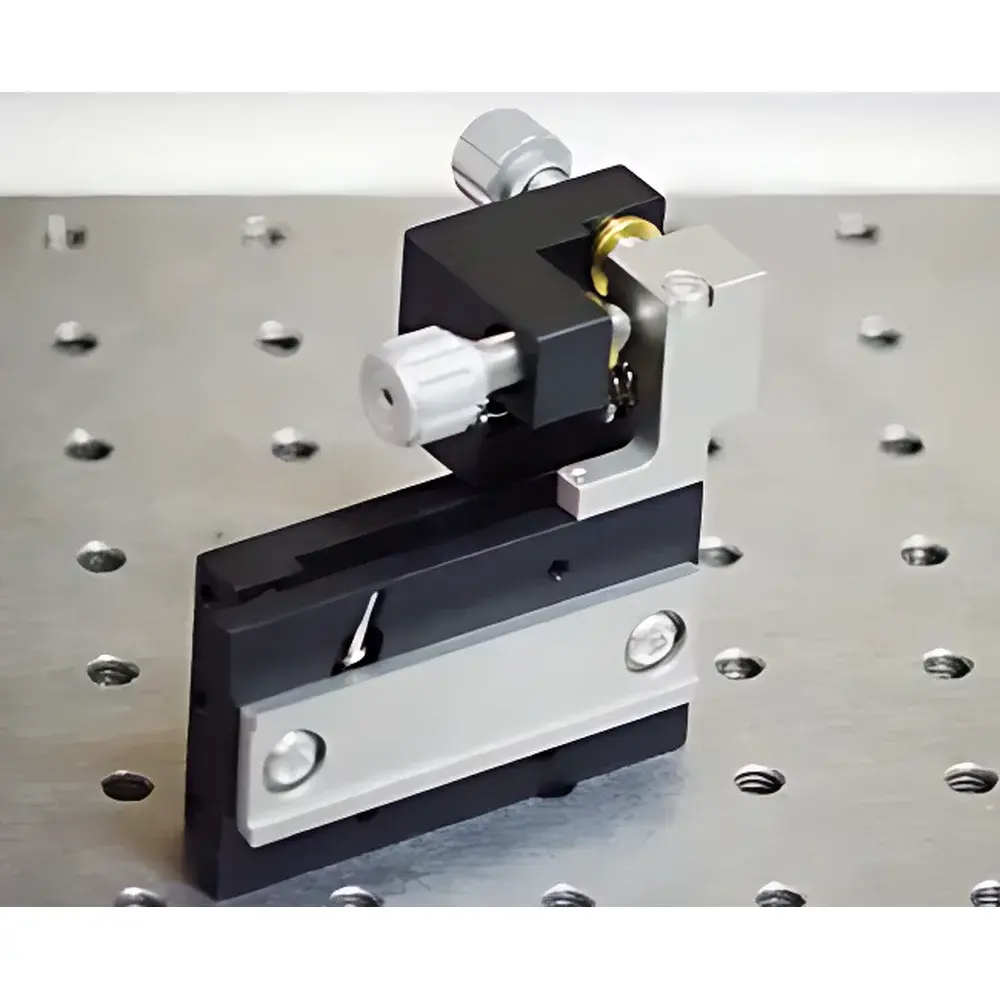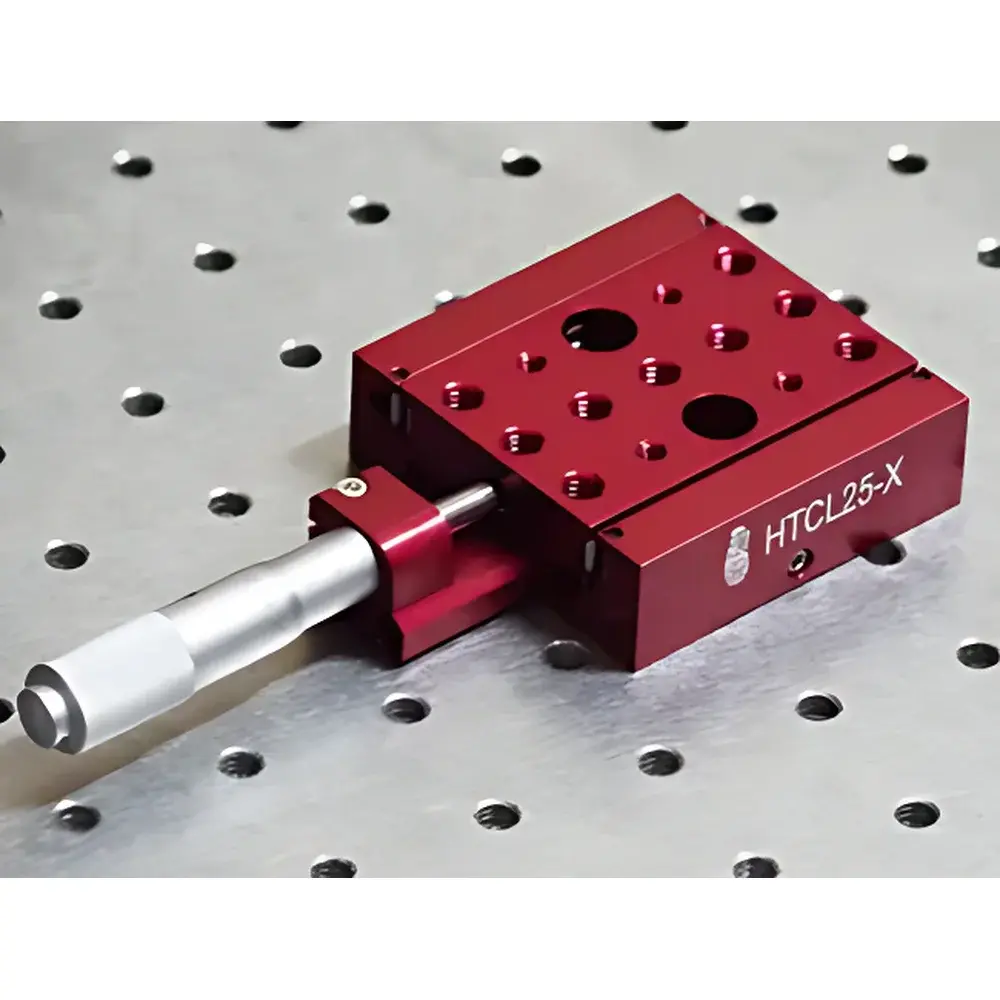
HTCL25-X Manual Translation Stage with 25 mm Travel, Differential Micrometer Drive, Center-Driven Configuration

| Brand | HanDing / HT |
|---|---|
| Origin | Jiangsu, China |
| Manufacturer Type | Authorized Distributor |
| Country of Origin | China |
| Model | HTCL25-X |
| Product Category | Manual Translation Stage |
| Travel Range | 25 mm |
| Drive Mechanism | Precision Differential Micrometer (Center-Mounted) |
| Guidance System | Linear Ball Bearing Rails |
| Backlash Compensation | Spring-Loaded Preload |
| Mounting Pattern | Standard ISO/Metric Tapped Holes on Top and Base Plates |
| Compliance | Designed for ISO/IEC 17025-aligned optical alignment workflows |
Ask about pricing, availability and specifications.
Overview
The HTCL25-X is a high-precision manual translation stage engineered for stable, repeatable linear positioning in demanding optical laboratory environments. Built upon a rigid aluminum alloy base with hardened stainless steel components, it employs a dual-rail linear ball bearing guidance system to ensure minimal wobble, high straightness (< 5 µm over full travel), and consistent runout performance. Its core motion actuation relies on a calibrated differential micrometer—featuring a 10 µm per division resolution and 0.5 mm coarse thread pitch—mounted centrally to minimize moment arm-induced tilt during adjustment. This center-driven architecture, combined with spring-loaded preload on the lead screw nut, actively eliminates axial backlash and ensures zero-play engagement across the entire 25 mm travel range. The stage conforms to standard optical mounting conventions, with both top and base plates machined to ISO 15389-compatible hole patterns (M4 and M6 threaded holes on 25 mm grid spacing), enabling seamless integration into multi-axis kinematic platforms or custom optomechanical assemblies.
Key Features
- Precision differential micrometer drive with tactile feedback and engraved scale for sub-10 µm manual resolution
- Center-mounted actuation point to reduce angular deviation and improve positional fidelity during fine adjustments
- Dual parallel linear ball bearing rails providing low-friction, high-stiffness motion with < 2 µm repeatability (typ.)
- Integrated spring-preloaded nut mechanism eliminating mechanical backlash without requiring user recalibration
- Top and base plates feature standardized metric tapped hole arrays (M4 at 25 mm pitch; M6 at 50 mm pitch) compliant with Thorlabs, Newport, and Standa mounting ecosystems
- Anodized aluminum housing offering corrosion resistance and dimensional stability under ambient lab conditions (20 ± 2 °C, 40–60% RH)
Sample Compatibility & Compliance
The HTCL25-X is designed for passive optical component positioning—including mirrors, lenses, fiber couplers, detectors, and interferometric reference arms—within Class 1000 cleanroom-adjacent or general-purpose optics labs. It does not incorporate active sensing or environmental control, and therefore requires external stabilization (e.g., optical table damping, temperature-controlled enclosures) for sub-micron stability applications. The mechanical design adheres to principles outlined in ISO 10110-7 (optical element mounting) and supports traceable alignment procedures required under ISO/IEC 17025 for calibration laboratories. While not certified to UL or CE for industrial automation use, its construction meets RoHS 2011/65/EU material restrictions and carries no hazardous substance declarations per REACH Annex XIV.
Software & Data Management
As a purely manual mechanical stage, the HTCL25-X operates without embedded electronics, firmware, or digital interfaces. No software drivers, SDKs, or configuration files are provided or required. Position tracking must be performed externally using calibrated imaging systems (e.g., CCD-based centroid analysis), laser interferometers, or contact displacement sensors. For laboratories maintaining GLP/GMP-compliant documentation, users are advised to log micrometer dial readings alongside timestamped experimental notes and environmental monitoring data (temperature, humidity) to support auditability and measurement uncertainty budgets per GUM (JCGM 100:2008).
Applications
- Coarse-to-fine alignment of collimated beams in interferometer cavity setup (Michelson, Mach–Zehnder)
- Adjustment of focal plane position in confocal microscopy or optical coherence tomography (OCT) sample arms
- Iterative optimization of coupling efficiency between free-space optics and single-mode fibers
- Calibration artifact staging in metrology labs using autocollimators or electronic levels
- Modular integration into multi-degree-of-freedom platforms for spectroscopic sample scanning (e.g., FTIR, Raman mapping stages)
- Teaching laboratories for demonstrating mechanical amplification, hysteresis, and thermal drift effects in precision motion systems
FAQ
Is the HTCL25-X compatible with vacuum environments?
No. The anodized aluminum body, lubricated ball bearings, and polymer micrometer O-rings are not rated for UHV or HV operation. Outgassing and cold-welding risks preclude use below 10⁻³ mbar.
Can I mount this stage vertically or inverted?
Yes, but gravitational loading will increase bearing wear and may affect repeatability beyond ±3 µm. Use only with counterbalanced payloads ≤ 2 kg and avoid dynamic loads.
Does it include mounting hardware?
No. Standard M4 and M6 socket head cap screws (grade 8.8) must be sourced separately per application-specific torque requirements.
What is the maximum recommended payload?
2.5 kg for horizontal orientation; 1.2 kg for vertical orientation with static load only. Exceeding these limits may compromise rail preload integrity and long-term travel linearity.
Is calibration data provided with shipment?
No factory calibration certificate is included. Users requiring NIST-traceable verification must engage an accredited metrology service for stage travel error mapping per ISO 230-2 Annex B.