
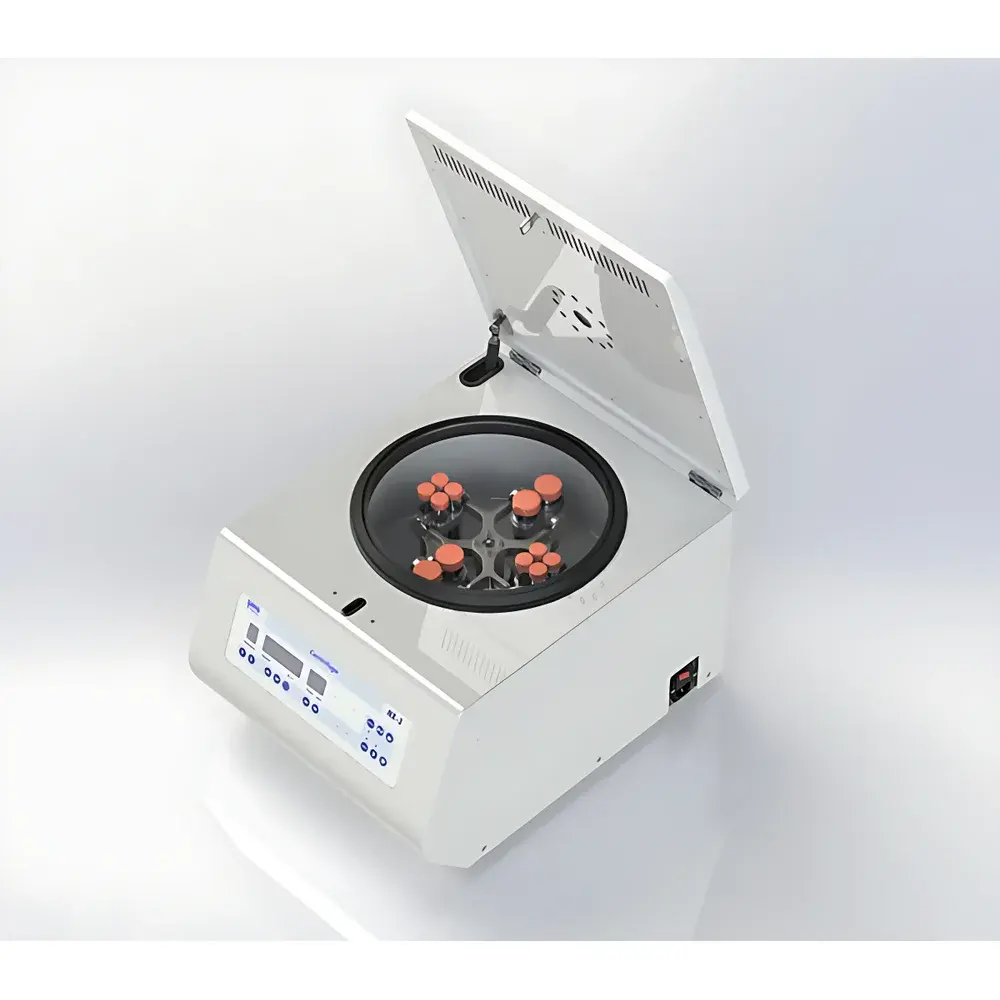
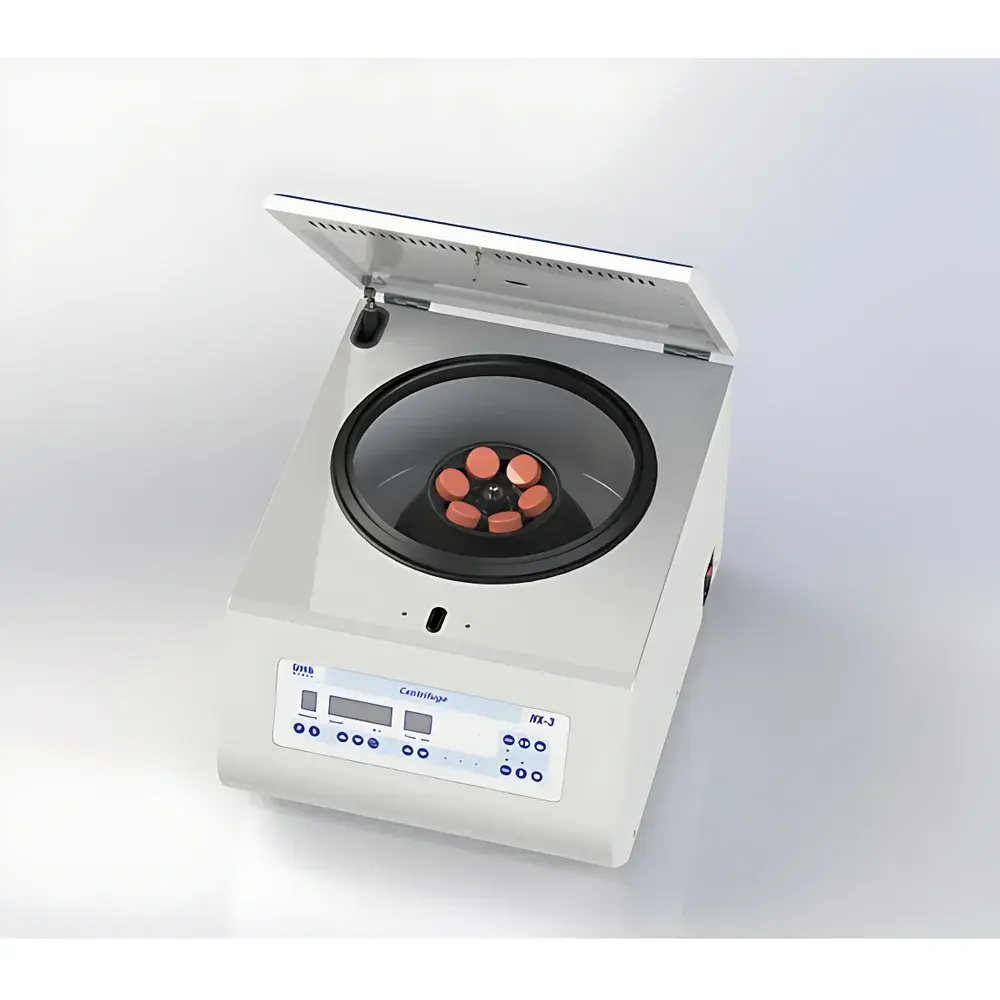
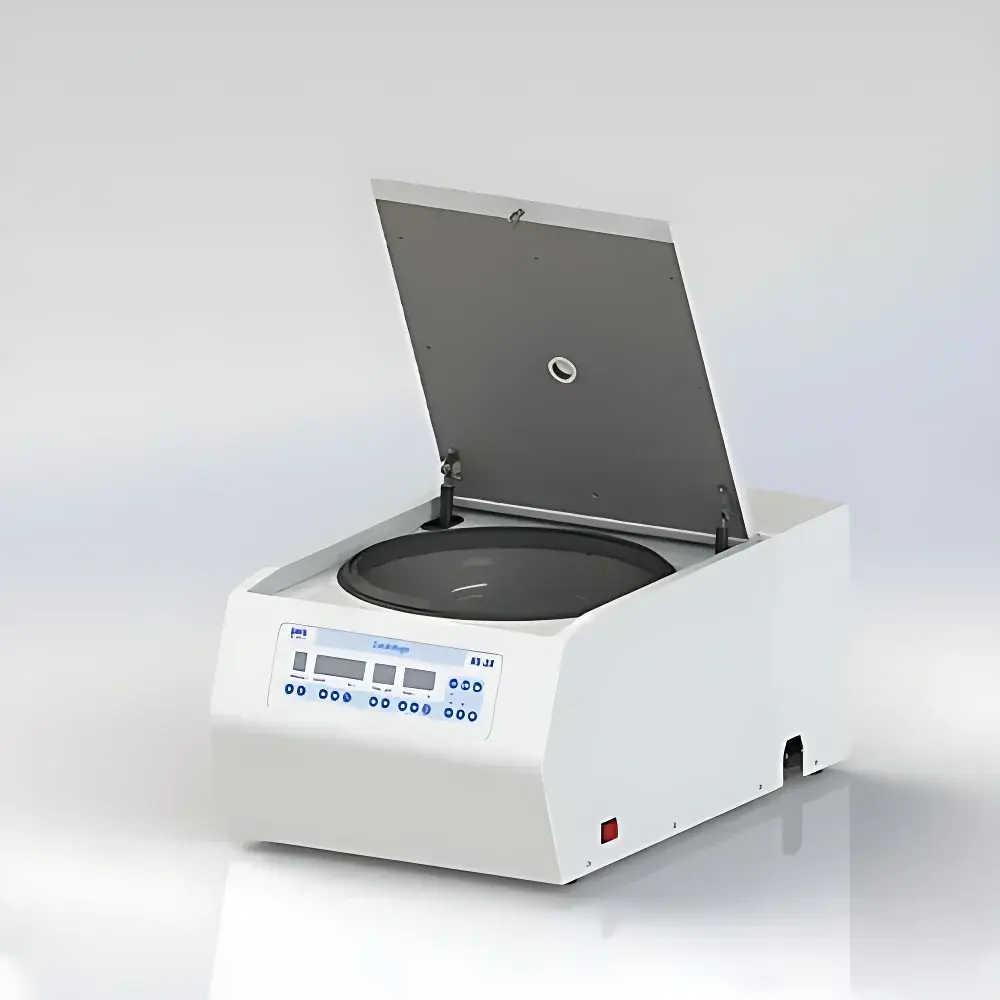
DHS NX-3 Universal Benchtop Centrifuge
| Brand | DHS |
|---|---|
| Origin | Tianjin, China |
| Model | NX-3 |
| Type | Benchtop Centrifuge |
| Category | High-Speed Centrifuge (10,000–30,000 rpm range) |
| Max Speed | 15,000 rpm |
| Max RCF | 25,500 × g |
| Max Capacity | 4 × 250 mL |
| Dimensions | 530 × 417 × 335 mm |
| Power Supply | 220 V / 50 Hz, 750 W |
| Weight | 40 kg |
| Temperature Rise | <12 °C |
| Speed Range | 300–15,000 rpm (increment: 100 rpm) |
| Timer Range | 1–99 min or continuous (increment: 1 min) |
| Program Storage | 9 user-defined protocols |
| Rotor Recognition | Automatic |
| Display | High-brightness LED |
| Drive System | Frequency-controlled brushless motor |
| Control System | Microprocessor-based |
Overview
The DHS NX-3 Universal Benchtop Centrifuge is an engineered solution for routine and demanding separation tasks in life science, clinical, and industrial laboratories. Designed around a robust frequency-controlled brushless motor and precision-machined rotor architecture, the NX-3 delivers high reproducibility across a wide operational envelope—from low-speed pelleting of whole blood and cell suspensions to high-speed clarification of subcellular organelles and nucleic acid preparations. Its dual-capability platform supports both high-RCF angular configurations (up to 25,500 × g) and high-capacity horizontal rotor formats (up to 4 × 250 mL), enabling seamless transition between speed-critical and volume-critical workflows without requiring multiple dedicated instruments. The centrifuge operates under ISO 13485-aligned manufacturing practices and conforms to IEC 61010-1 safety standards for laboratory electrical equipment, ensuring compliance with international lab infrastructure requirements.
Key Features
- Automatic rotor identification system prevents mismatched rotor–speed combinations and enforces safe operating limits per ISO 20957-3.
- Microprocessor-based control with 9 programmable protocols—each storing speed, time, acceleration/deceleration profiles, and rotor ID—for repeatable method execution.
- High-brightness LED display with intuitive navigation interface; supports real-time monitoring of rpm, RCF, elapsed time, and remaining time.
- Compact footprint (530 × 417 × 335 mm) optimized for space-constrained benchtop environments while maintaining structural rigidity and vibration damping.
- Thermal management design limits internal temperature rise to <12 °C during extended runs, preserving heat-sensitive sample integrity.
- Brushless frequency-controlled motor ensures low maintenance, consistent torque delivery, and silent operation (<65 dB(A) at 15,000 rpm).
Sample Compatibility & Compliance
The NX-3 accommodates diverse sample formats through interchangeable rotor systems—including 7 angular rotors and 3 horizontal rotors—each certified for specific tube geometries and maximum loads. Compatible vessels include PCR plates (up to 66 mm height), deep-well plates, microtiter plates, spin columns, conical-bottom 15 mL and 50 mL tubes, round-bottom 15 mL tubes, and clinical vacuum blood collection tubes (5 mL and 10 mL). All rotors are validated for use under GLP-compliant workflows and support traceable documentation when paired with optional audit-trail-enabled software (see Software & Data Management). The instrument meets CE marking requirements per Directive 2014/30/EU (EMC) and 2014/35/EU (LVD), and its mechanical design adheres to ISO 20957-3:2021 for stationary fitness equipment—adapted for laboratory centrifuge safety classification.
Software & Data Management
While the NX-3 operates as a standalone unit via its front-panel interface, it supports optional PC-based data logging and remote configuration via RS-232 or USB-to-serial interface (cable sold separately). The companion software enables export of run logs—including date/time stamp, rotor ID, set parameters, actual performance metrics, and error codes—in CSV format for integration into LIMS or electronic lab notebooks (ELN). Audit trail functionality complies with FDA 21 CFR Part 11 requirements when deployed with user authentication, electronic signatures, and immutable log archiving. All firmware updates are delivered via signed binary packages to ensure system integrity.
Applications
- Cell culture harvest and bacterial pellet concentration (e.g., E. coli, yeast, mammalian suspension cells).
- Clinical specimen processing: serum/plasma separation from whole blood, PBMC isolation, urinalysis sedimentation.
- Molecular biology workflows: plasmid DNA purification, RNA precipitation, column-based clean-up steps.
- Protein biochemistry: membrane fractionation, organelle isolation (mitochondria, lysosomes), virus pelleting.
- Quality control in biomanufacturing: filter integrity testing, buffer exchange validation, residual host cell protein removal verification.
- Environmental and food safety labs: pathogen enrichment, particulate matter recovery from water or homogenized food matrices.
FAQ
Does the NX-3 support regulatory-compliant documentation for GMP environments?
Yes—when used with the optional audit-trail software package and configured with role-based access control, the system satisfies core elements of FDA 21 CFR Part 11 and EU Annex 11 for electronic records and signatures.
Can I use third-party rotors or adapters with the NX-3?
No. Only DHS-certified rotors and adapters (catalog numbers beginning with 0401293-) are validated for mechanical integrity, balance tolerance, and RCF accuracy. Use of non-certified components voids warranty and compromises safety certification.
What is the maximum allowable imbalance tolerance for horizontal rotors?
The NX-3’s automatic imbalance detection system triggers immediate deceleration if load asymmetry exceeds ±0.5 g across opposing buckets—verified per ISO 20957-3 Annex D test procedures.
Is refrigeration available for the NX-3 model?
No. The NX-3 is a non-refrigerated benchtop centrifuge. For temperature-sensitive applications requiring active cooling, DHS offers the NX-3R series (sold separately) with Peltier-based thermal control (–10 °C to +40 °C).
How often does the centrifuge require calibration verification?
Annual verification of speed accuracy (±1% of set rpm) and timer fidelity (±0.5%) is recommended per ISO/IEC 17025 guidelines; full mechanical inspection every 2 years by authorized DHS service personnel.



