
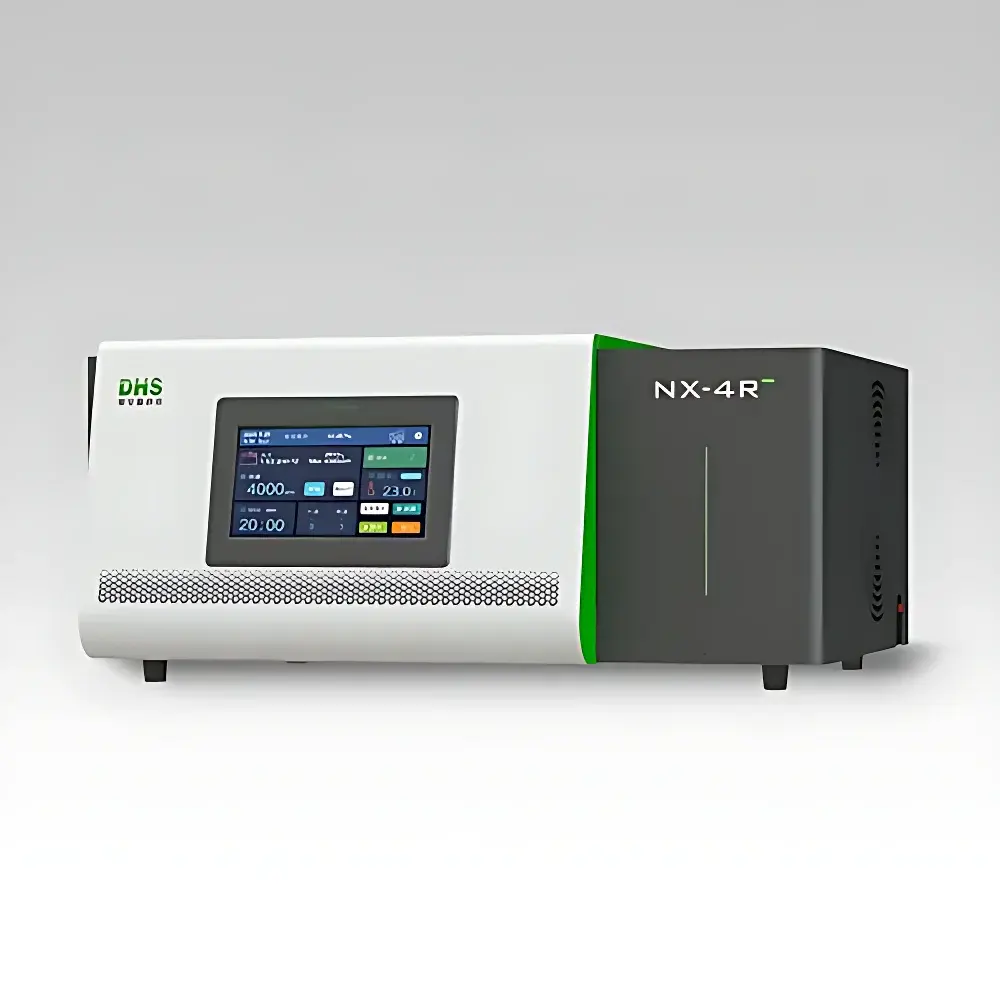
DHS NX-4R Pro Benchtop Refrigerated Centrifuge
| Brand | DHS |
|---|---|
| Origin | Tianjin, China |
| Model | NX-4R Pro |
| Instrument Type | Benchtop Centrifuge |
| Cooling Function | Refrigerated |
| Rotor Configuration | Horizontal (Swinging-Bucket) & Fixed-Angle Options |
| Maximum Capacity | 4 × 1000 mL |
| Maximum Speed | 21,000 rpm |
| Maximum RCF | 33,500 × g |
| Temperature Range | –20 °C to +40 °C |
| Dimensions (W × H × D) | 855 × 395 × 730 mm |
| Drive System | Brushless DC Motor with PWM Speed Control |
| Acceleration/Deceleration Profiles | 9-step ramp, 10-step brake |
| Rotor Recognition | Automatic electronic identification |
| Safety Features | Electronic imbalance detection, overspeed protection, overtemperature cutoff, door interlock |
| Display | 10-inch full-color capacitive touchscreen |
| Program Storage | 100 user-defined multi-segment protocols (up to 10 steps per program) |
| Rotor Material | Carbon-fiber fixed-angle rotor (6 × 250 mL, max. RCF 18,530 × g) |
| Refrigeration System | CFC-free imported compressor |
| Compliance | Designed for GLP-compliant workflows |
Overview
The DHS NX-4R Pro Benchtop Refrigerated Centrifuge is an engineered solution for high-throughput, temperature-sensitive separation tasks in academic, clinical, and industrial laboratories. Based on the principle of sedimentation under controlled centrifugal force, this instrument leverages precise rotational dynamics and active refrigeration to isolate subcellular components, microorganisms, macromolecules, and particulate suspensions with reproducible efficiency. Its dual capability—high-speed performance up to 21,000 rpm and sustained thermal control between –20 °C and +40 °C—makes it suitable for applications requiring strict thermal stability, such as nucleic acid purification, bacterial pellet recovery, plasma fractionation, and enzyme isolation. The unit’s structural architecture integrates a brushless DC motor, dynamic PWM-based speed regulation, and a CFC-free compression cooling system, ensuring minimal thermal drift and mechanical vibration during extended runs.
Key Features
- High-capacity horizontal rotor configuration supporting up to 4 × 1000 mL bottles—ideal for large-volume sample processing in bioprocessing and environmental labs.
- Carbon-fiber fixed-angle rotor (6 × 250 mL) delivering up to 18,530 × g, optimized for rapid pelleting of bacteria, yeast, and mammalian cells without rotor fatigue or thermal degradation.
- Electronic rotor auto-recognition system prevents misconfiguration and ensures protocol-specific safety limits are enforced before run initiation.
- PWM-controlled acceleration and deceleration with 9 ramp and 10 brake profiles minimize shear-induced resuspension and preserve delicate pellet integrity.
- Real-time electronic imbalance monitoring continuously evaluates mass distribution across the rotor assembly and triggers immediate shutdown if deviation exceeds ISO 15838–defined thresholds.
- 10-inch capacitive touchscreen interface displays real-time RCF, temperature, elapsed time, and remaining runtime simultaneously—enabling intuitive parameter verification and intervention.
- Comprehensive safety architecture includes overspeed cutoff, overtemperature lockout, lid interlock, and automatic rotor braking upon abnormal load detection.
Sample Compatibility & Compliance
The NX-4R Pro accommodates a broad range of sample containers—including polypropylene and stainless-steel bottles, conical tubes (15–50 mL), and custom adapters—without compromising seal integrity or thermal uniformity. It supports standard ISO 15838-compliant rotors and meets mechanical safety requirements outlined in IEC 61010-2-020 for laboratory centrifuges. While not certified as a medical device, its design aligns with GLP and GMP operational expectations: temperature logging, run history timestamps, and programmable start/stop conditions facilitate traceability. When integrated with validated LIMS or ELN systems, the centrifuge supports 21 CFR Part 11–compliant electronic records through external data export (CSV/JSON via USB or Ethernet).
Software & Data Management
The embedded firmware enables storage of 100 multi-segment programs, each configurable with up to 10 sequential steps defining speed, time, temperature, acceleration, and deceleration parameters. All executed protocols are timestamped and archived locally with rotor ID, operator ID (if enabled), and ambient conditions. Data export is supported via USB 2.0 port in machine-readable formats compatible with statistical analysis tools (e.g., GraphPad Prism, JMP). No proprietary cloud platform is required; raw logs may be ingested into enterprise-grade QA/QC databases for trending, deviation investigation, and preventive maintenance scheduling.
Applications
- Microbial cell harvesting: Efficient pelleting of E. coli, S. cerevisiae, and filamentous fungi at scalable volumes.
- Clinical specimen preparation: Separation of whole blood into serum/plasma fractions under controlled cold conditions to prevent protease activation.
- Biopharmaceutical upstream processing: Clarification of mammalian cell culture harvests prior to filtration or chromatography.
- Environmental microbiology: Concentration of waterborne pathogens from large-volume samples (e.g., 1 L EPA Method 1623 filtrates).
- Virology research: Ultracentrifugation-compatible pre-clearing steps using high-RCF fixed-angle runs.
- Material science: Density-gradient separation of nanomaterial suspensions and colloidal dispersions.
FAQ
What is the maximum allowable imbalance tolerance before automatic shutdown?
The electronic imbalance detection system halts operation when radial mass asymmetry exceeds ±2 g at 21,000 rpm, conforming to ISO 15838 Annex B guidelines.
Can the NX-4R Pro operate continuously at –20 °C for extended periods?
Yes—the compressor system is rated for uninterrupted operation within the full temperature range; however, maintaining –20 °C at maximum speed requires ≥15-minute pre-cooling and adequate ventilation clearance (≥10 cm on all sides).
Is rotor calibration required by the user?
No—rotor identification is fully automated and factory-calibrated; no periodic recalibration is needed unless physical damage occurs.
Does the centrifuge support remote monitoring or network integration?
It features Ethernet connectivity for firmware updates and log retrieval; however, real-time remote control requires integration with third-party lab automation middleware (e.g., LabVantage, STARLIMS).
Are validation documents (IQ/OQ/PQ) available?
Factory-issued OQ documentation is provided with purchase; IQ and PQ templates aligned with ISO/IEC 17025 are available upon request for qualified laboratories.



