
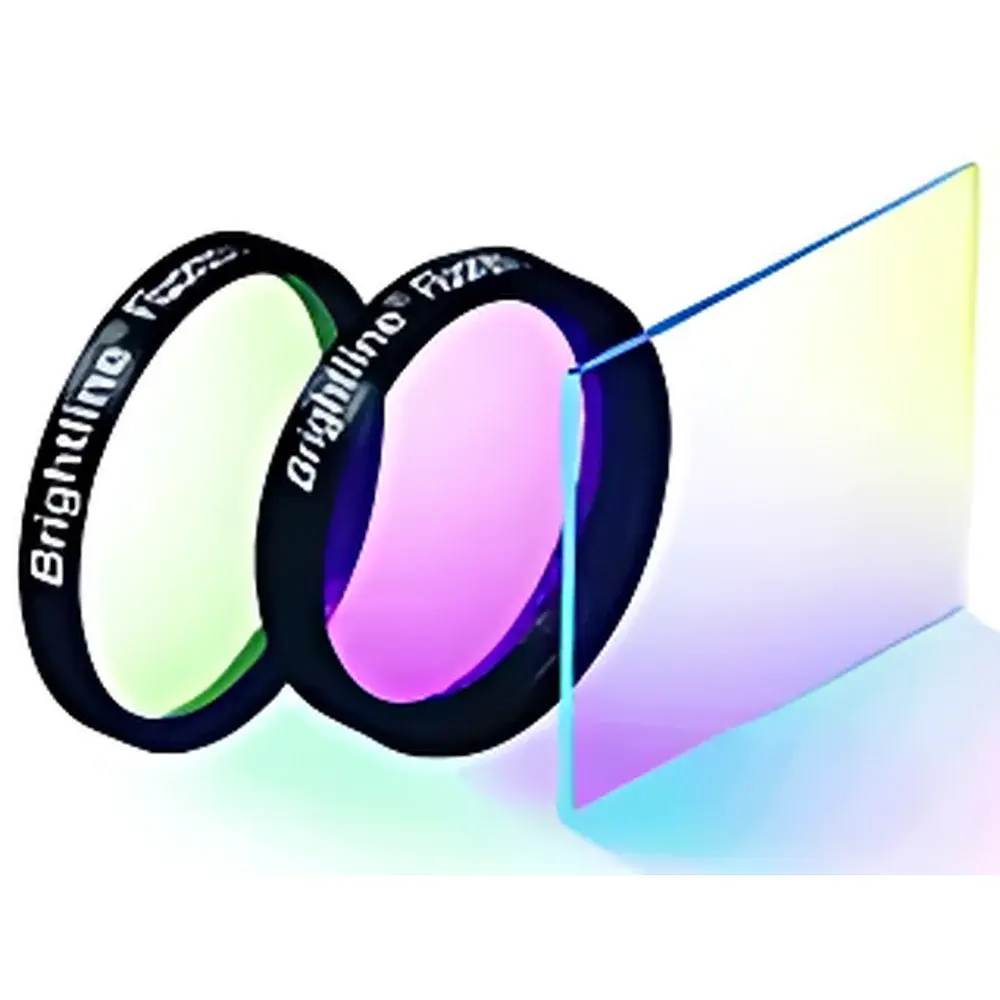
Semrock BrightLine® High-Performance Optical Bandpass Filters
| Brand | Semrock |
|---|---|
| Origin | USA |
| Component Type | Hard-Coated Interference Filter |
| Mounting | 25 mm Diameter Aluminum Ring (Clear Aperture ≥ 21 mm) |
| Compliance | ISO 9001 Manufacturing, RoHS Compliant |
| Warranty | 5-Year Limited Warranty |
| Customization Lead Time | 7 Business Days |
Overview
Semrock BrightLine® optical bandpass filters are precision thin-film interference filters engineered for demanding spectroscopic, fluorescence microscopy, Raman spectroscopy, and laser-based instrumentation applications. Utilizing advanced ion-beam sputtering (IBS) deposition technology, each filter features ultra-stable, hard-coated dielectric multilayer stacks on fused silica substrates—ensuring exceptional environmental stability, minimal thermal drift, and long-term spectral fidelity. Unlike soft-coated or epoxy-bonded alternatives, BrightLine® filters maintain consistent center wavelength (CWL), bandwidth (FWHM), and out-of-band blocking (>OD6 across UV-VIS-NIR) under continuous illumination, temperature cycling, and mechanical handling. These filters operate on the principle of constructive and destructive interference within precisely controlled quarter-wave optical thickness layers, enabling sharp cut-on/cut-off edges, high peak transmission (>90% typical), and deep rejection (OD6–OD8) in adjacent spectral regions.
Key Features
- Ion-beam sputtered (IBS) hard coatings for superior durability, humidity resistance, and laser damage threshold (LDT > 500 MW/cm² for pulsed 1064 nm, 10 ns)
- Center wavelength tolerance: ±0.5 nm (standard); ±0.25 nm available for critical alignment applications
- Bandwidth options from narrow (≤3 nm) to broadband (up to 200 nm FWHM), with precise Gaussian-like passband profiles
- Standard mounting in black anodized aluminum rings (25.0 mm OD, 21.0 mm clear aperture), compatible with standard lens tubes and filter cubes
- No shift in CWL or bandwidth under thermal stress: ΔCWL < 0.005 nm/°C (typical)
- Comprehensive spectral validation: Each filter is individually tested using NIST-traceable spectrophotometry and certified with a full spectral transmission curve (300–1200 nm or extended NIR)
Sample Compatibility & Compliance
BrightLine® filters are designed for integration into OEM instruments and research-grade optical systems requiring regulatory-compliant performance. They meet ISO 10110-7 surface quality standards (scratch-dig 10-5), comply with RoHS Directive 2011/65/EU, and are manufactured under ISO 9001:2015-certified processes. While not medical devices per se, their stability and traceability support use in FDA-regulated analytical platforms—including flow cytometers and clinical microscopes—where spectral consistency directly impacts quantitative assay validity. For GLP/GMP environments, batch-level certification documentation (including lot-specific spectral reports and coating thickness verification) is available upon request. Filters are compatible with standard optical mounts (e.g., Thorlabs SM25, Edmund Optics #67-722), and custom diameters (12.5 mm, 50 mm), thicknesses (1.0–6.0 mm), or substrate materials (CaF₂, UV-grade fused silica) can be supplied without compromising coating integrity.
Software & Data Management
Semrock provides downloadable spectral data files in industry-standard formats (CSV, SDF, and XML) for integration into optical design software (Zemax OpticStudio, CODE V, FRED) and laboratory data acquisition systems (LabVIEW, MATLAB, Python via PyVISA). Each filter’s unique serial number links to its certified spectral curve in Semrock’s online Filter Finder tool—enabling rapid parametric search by CWL, FWHM, blocking range, or application (e.g., “DAPI”, “GFP”, “Cy5”). For enterprise customers, API access to real-time inventory status, calibration history, and replacement tracking is available through Semrock’s secure customer portal—supporting audit readiness under 21 CFR Part 11 when paired with validated electronic lab notebooks (ELNs).
Applications
These bandpass filters serve as core spectral selection elements across multiple disciplines: confocal and widefield fluorescence imaging (e.g., FF01-473/10-25 for Alexa Fluor 488 excitation); multiplexed flow cytometry requiring minimal crosstalk between fluorophores; time-resolved fluorescence lifetime imaging (FLIM) where temporal resolution depends on high signal-to-noise ratio; Raman edge filtering (e.g., FF01-532/10-25 with 532 nm lasers); and quantum optics setups requiring precise single-photon wavelength selection. Their low autofluorescence (<0.01% at 405 nm) and negligible wavefront distortion (<λ/4 PV over clear aperture) make them suitable for adaptive optics and super-resolution modalities such as STED and SIM.
FAQ
What is the typical damage threshold for BrightLine® filters under continuous-wave (CW) laser illumination?
For 532 nm CW lasers, the specified LDT is ≥10 W/cm² (tested per ISO 21254-1); higher thresholds apply for longer wavelengths due to reduced photon energy absorption.
Can I use these filters in vacuum or high-humidity environments?
Yes—IBS coatings are non-hygroscopic and vacuum-compatible (outgassing rate <1×10⁻⁹ Torr·L/s·cm² per ASTM E595), making them suitable for space-qualified instrumentation and environmental monitoring sensors.
Do you offer spectral recalibration services after extended field use?
Semrock provides optional post-deployment spectral verification (traceable to NIST SRM 2036) with certificate of conformance, supporting ISO/IEC 17025-accredited calibration intervals.
Are custom angle-tuned versions available for oblique incidence applications?
Yes—custom designs for 0°–45° AOI are supported, with CWL shift compensation and polarization-dependent loss (PDL) modeling included in the quotation.
How does Semrock ensure lot-to-lot consistency in mass-produced filters?
Each production run undergoes full spectral screening, and coating process parameters (deposition rate, partial pressure, ion energy) are logged and archived for full traceability—enabling statistical process control (SPC) and root-cause analysis per ISO 9001 clause 8.5.2.





