
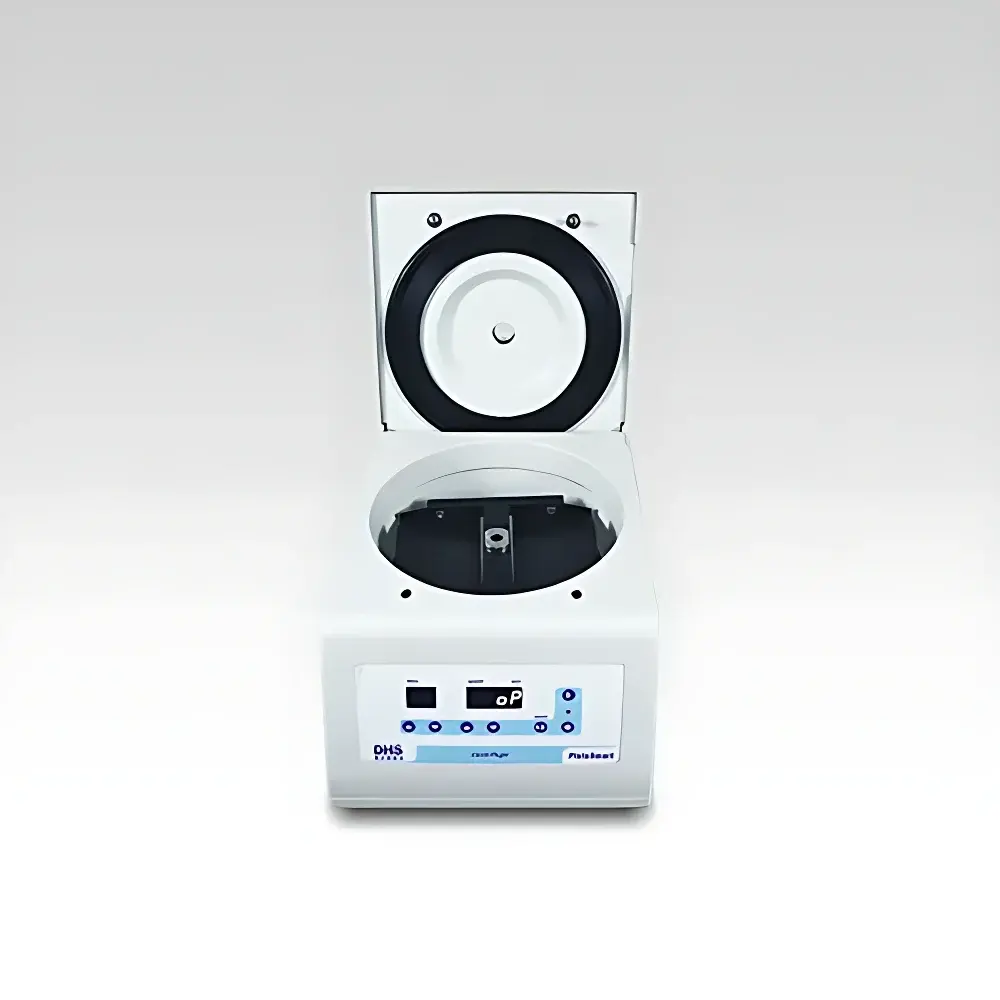
DHS PlateSmart Compact 96-Well Microplate Centrifuge
| Brand | DHS |
|---|---|
| Origin | Tianjin, China |
| Model | PlateSmart |
| Instrument Type | Benchtop Centrifuge |
| Centrifugation Category | Low-Speed Centrifuge |
| Maximum Speed | 2500 rpm |
| Maximum RCF | 650 × g |
| Speed Range | 500–2500 rpm |
| Capacity | 4 × 96-well microplates (ELISA plates) or 2 × deep-well plates or 2 × PCR plates |
| Rotor Type | Horizontal fixed-angle rotor |
| Drive System | High-torque direct-drive disc motor |
| Timer Range | 1–99 min + continuous mode |
| Power Supply | 110–230 V, 50 Hz, 150 W |
| Noise Level | <60 dB(A) |
| Dimensions (W×D×H) | 310 × 380 × 300 mm |
| Net Weight | 12 kg |
| Temperature Rise | <12 °C during operation |
| Safety Features | Interlocked lid with automatic rotor stop |
Overview
The DHS PlateSmart Compact 96-Well Microplate Centrifuge is an engineered solution for rapid, gentle, and reproducible pelleting of liquid phases in standard microtiter formats. Designed specifically for high-throughput life science laboratories, it operates on the principle of horizontal-axis centrifugation—applying uniform radial acceleration across all wells of 96-well, 384-well, PCR, deep-well, and ELISA plates without requiring plate inversion or manual tapping. Unlike vertical “spin-down” devices that rely on gravitational settling or inconsistent impact forces, the PlateSmart delivers controlled, low-shear sedimentation through precisely regulated rotational dynamics. Its optimized rotor geometry ensures minimal cross-well variation (<2% RSD in RCF distribution), making it suitable for applications where sample integrity, positional consistency, and protocol compliance are critical—especially in molecular diagnostics, immunoassay preparation, and nucleic acid extraction workflows.
Key Features
- Horizontal fixed-angle rotor architecture enabling simultaneous processing of up to four 96-well plates—or two deep-well and two PCR plates—without adapter reconfiguration.
- Direct-drive disc motor delivering stable torque output across the full speed range (500–2500 rpm), eliminating belt wear and ensuring long-term rotational accuracy.
- Microprocessor-based control system with digital display, programmable time (1–99 minutes or continuous), and instant-spin (Spin) function for rapid transient pelleting.
- Integrated safety interlock: motor halts immediately upon lid opening; mechanical latch meets IEC 61010-1 mechanical safety requirements.
- Compact footprint (310 × 380 × 300 mm) and lightweight design (12 kg net) facilitate placement inside biosafety cabinets, cold rooms, or crowded benchtop environments.
- Acoustically damped housing maintains noise emission below 60 dB(A) at 1 m distance—compatible with open-plan lab layouts and ISO Class 5 cleanroom-adjacent operations.
Sample Compatibility & Compliance
The PlateSmart supports ANSI/SBS-standard microplates including flat-bottom, U-bottom, and V-bottom 96-well ELISA plates; skirted and semi-skirted 96-well PCR plates; 96-well deep-well plates (up to 2.2 mL well volume); and standard cell culture plates (e.g., 96-well TC-treated). It does not require plate-specific adapters—universal clamping accommodates plate height tolerances from 14.0 to 22.5 mm per ANSI SLAS-1-2019. The device complies with electromagnetic compatibility (EMC) per IEC 61326-1 and electrical safety per IEC 61010-1. While not certified for clinical diagnostic use under FDA 21 CFR Part 820, its operational repeatability and audit-ready parameter logging (via optional RS-232 output) support GLP-aligned documentation practices in QC/QA environments.
Software & Data Management
The PlateSmart features embedded firmware with non-volatile memory for storing up to five user-defined protocols—including speed, time, and Spin-mode presets. Though it lacks onboard data export or cloud connectivity, its RS-232 serial interface (optional cable available) enables integration with LIMS or custom LabVIEW/Python scripts for automated run logging and timestamped parameter capture. All runtime events—including lid open/close cycles, over-speed alerts, and thermal fault detection—are recorded in internal event history (last 50 entries), supporting root-cause analysis during equipment qualification (IQ/OQ). Firmware updates are performed via USB-to-serial bridge using manufacturer-provided utilities—no proprietary software installation required.
Applications
- Pre-centrifugation of ELISA assay plates to eliminate bubbles and ensure uniform coating adherence prior to incubation.
- Rapid post-PCR spin-down to collect condensate from tube lids and prevent cross-contamination in thermal cycling workflows.
- Cell pellet recovery from suspension cultures in 96-well plates prior to lysis or staining protocols.
- Clarification of clarified lysates in high-throughput protein expression screening.
- Removal of residual ethanol or isopropanol after column-based nucleic acid purification steps.
- Consolidation of supernatants in multiplex cytokine assays where precise well-to-well volume consistency affects detection sensitivity.
FAQ
Can the PlateSmart accommodate 384-well plates?
No—it is mechanically optimized for 96-well footprint dimensions per ANSI/SBS standards. Use of 384-well plates may result in unstable rotation or uneven force distribution.
Is rotor balancing required before each run?
No—its fixed horizontal rotor eliminates the need for manual balancing; symmetrical plate loading is sufficient per manufacturer guidelines.
Does it meet FDA 21 CFR Part 11 requirements?
The base unit does not include electronic signature, audit trail, or role-based access control; however, when paired with validated third-party data acquisition software, it can be incorporated into Part 11–compliant workflows.
What maintenance is recommended?
Annual inspection of lid interlock mechanism and rotor mounting threads is advised; no lubrication or calibration is required under normal operating conditions.
Can it be operated inside a refrigerated environment?
Yes—the ambient operating temperature range is 5–40 °C, and internal thermal rise remains below 12 °C, allowing safe use in chilled rooms (e.g., 10 °C) without condensation-related risk.



