
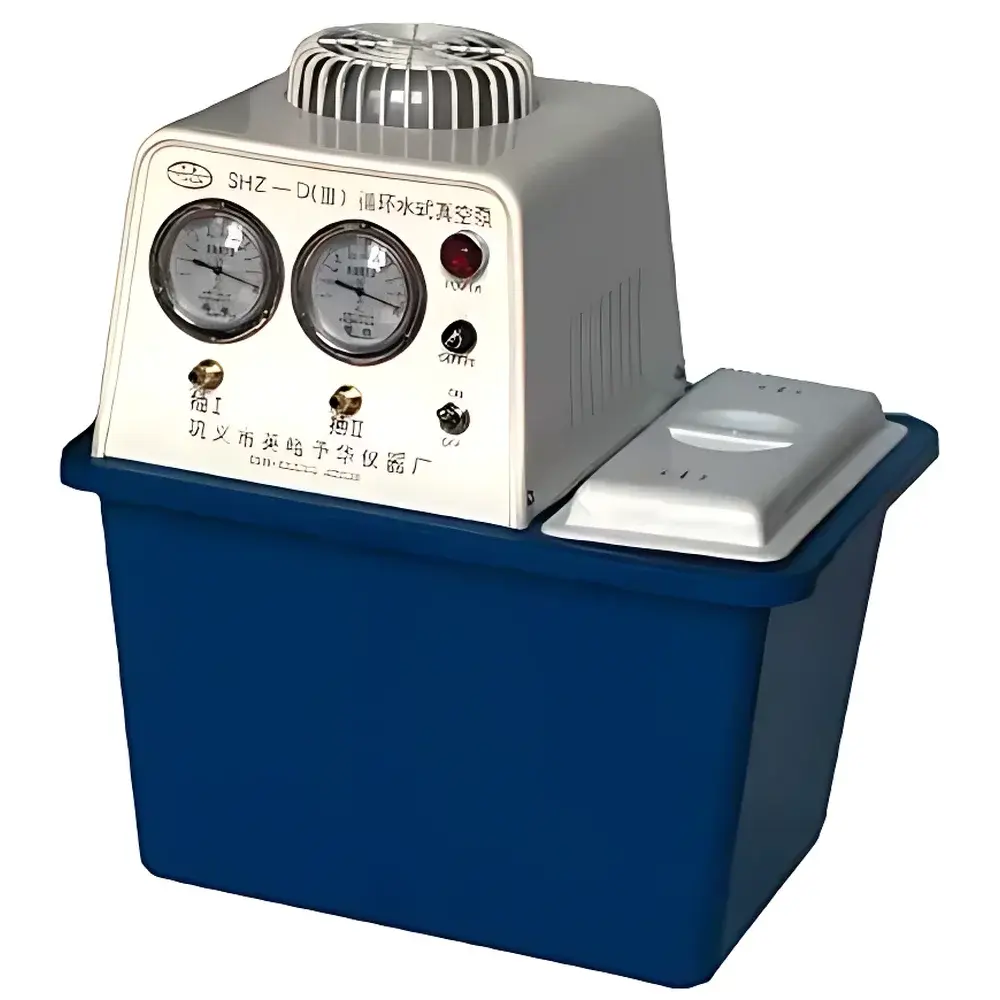
YUHUA SHZ-D(III) Circulating Water Vacuum Pump
| Brand | YUHUA |
|---|---|
| Origin | Henan, China |
| Model | SHZ-D(III) |
| Type | Oil-free circulating water vacuum pump |
| Power | 180 W |
| Voltage/Frequency | 220 V / 50 Hz |
| Flow Rate | 60 L/min |
| Max. Vacuum | −0.098 MPa (≈740 mmHg) |
| Single-Head Suction Capacity | 10 L/min |
| Number of Suction Ports | 2 |
| Water Reservoir Volume | 15 L |
| Dimensions (L×W×H) | 400 × 280 × 420 mm |
| Net Weight | 15 kg |
| Housing Material | 1Cr18 Stainless Steel |
| Compliance | Designed for general laboratory vacuum applications per GB/T 25197–2010 (Chinese standard for laboratory vacuum equipment) |
Overview
The YUHUA SHZ-D(III) Circulating Water Vacuum Pump is an oil-free, water-sealed vacuum generation system engineered for consistent, low-maintenance operation in teaching laboratories, synthetic chemistry workbenches, and small-scale analytical setups. It operates on the principle of water ring vacuum generation: rotating impeller motion creates a liquid ring inside the pump chamber, forming sealed cavities that expand to draw gas through the suction port and compress it for exhaust. This mechanism eliminates the need for lubricating oil—preventing hydrocarbon contamination of vacuum lines and samples—while delivering stable vacuum levels up to −0.098 MPa (equivalent to ~740 mmHg or ~130 mbar abs). Its compact footprint (400 × 280 × 420 mm), lightweight stainless steel (1Cr18) housing, and integrated 15 L transparent or opaque water reservoir support space-constrained environments without compromising thermal stability or long-term corrosion resistance.
Key Features
- Dual independent suction ports with individual vacuum gauges—enabling simultaneous, isolated vacuum control for two apparatuses (e.g., rotary evaporator + filtration manifold)
- Modular design compatible with optional vacuum regulation valves for fine-tuned pressure control across sensitive distillation or crystallization protocols
- Corrosion-resistant wetted components: stainless steel impeller and pump body (1Cr18 grade), plus chemically inert reservoir seals suitable for mild organic solvents and aqueous acidic/basic vapors
- Low-noise operation (<65 dB(A) at 1 m) achieved via balanced impeller geometry and vibration-damping mounting
- Self-cooling circulation: recirculated water maintains stable operating temperature during extended use; no external coolant required
- Front-access water level indicator and drain valve simplify routine maintenance and reservoir replenishment
Sample Compatibility & Compliance
The SHZ-D(III) is intended for non-hazardous, non-explosive vapor handling under ambient conditions. It is routinely deployed in applications involving water, ethanol, acetone, ethyl acetate, and dilute inorganic acid/base solutions—provided vapors are pre-trapped (e.g., using cold traps or scrubbers) to prevent condensate ingress into the pump chamber. While not certified to ATEX or IECEx standards, its oil-free architecture inherently reduces ignition risk compared to oil-lubricated alternatives. The unit conforms to GB/T 25197–2010 for laboratory vacuum equipment safety and performance, and supports GLP-aligned documentation when paired with calibrated vacuum gauges and logbook-based usage tracking. It is not intended for continuous high-vacuum service (<10 mbar) or aggressive halogenated solvent recovery.
Software & Data Management
This is a manually operated, analog vacuum pump with no embedded microcontroller, digital interface, or data logging capability. Vacuum level is monitored visually via dual Bourdon-tube gauges (0–0.1 MPa range, Class 1.6 accuracy per GB/T 1226). For integration into automated workflows, external pressure transducers (e.g., capacitance manometers) and programmable logic controllers (PLCs) may be connected downstream. No firmware, driver, or cloud connectivity is provided; all operational parameters are set and verified manually per run. Audit trails must be maintained externally—consistent with FDA 21 CFR Part 11 requirements for manual instrumentation used in regulated environments.
Applications
- Routine vacuum filtration of precipitates in undergraduate organic chemistry labs
- Rotary evaporation of heat-sensitive compounds below 60 °C
- Vacuum drying of glassware, catalysts, or hygroscopic reagents
- Gas evacuation prior to Schlenk line purging or inert-atmosphere glovebox transfer
- Supporting vacuum desiccators and aspirator-style reaction monitoring systems
- Multi-station teaching setups: four students can operate independent vacuum lines from a single SHZ-D(III) four-port variant (SHZ-D(III)-4G) without cross-contamination or pressure interference
FAQ
What is the maximum continuous duty cycle for this pump?
Rated for intermittent operation up to 8 hours per day with ≥15-minute cooldown intervals between 2-hour runs. Continuous 24/7 operation is not recommended due to thermal accumulation in the water reservoir.
Can I use tap water as the circulating medium?
Yes—deionized water is preferred for long-term corrosion prevention, but municipal tap water (hardness <200 ppm CaCO₃) is acceptable for short-term academic use. Weekly reservoir flushing is advised if tap water is used.
Is the pump compatible with vacuum ovens or freeze dryers?
No. Its ultimate vacuum limit (−0.098 MPa) and flow capacity (60 L/min) are insufficient for vacuum oven evacuation or primary drying stages in lyophilization. It is suited only for rough vacuum tasks.
How often should the water reservoir be replaced?
Replace water every 48–72 hours under active use, or daily in high-humidity environments, to prevent microbial growth and calcium carbonate scaling.
Does this model meet ISO/IEC 17025 calibration traceability requirements?
The pump itself is not calibratable as a measuring instrument; however, its vacuum gauges may be third-party calibrated annually against NIST-traceable references if used in accredited testing laboratories.



