
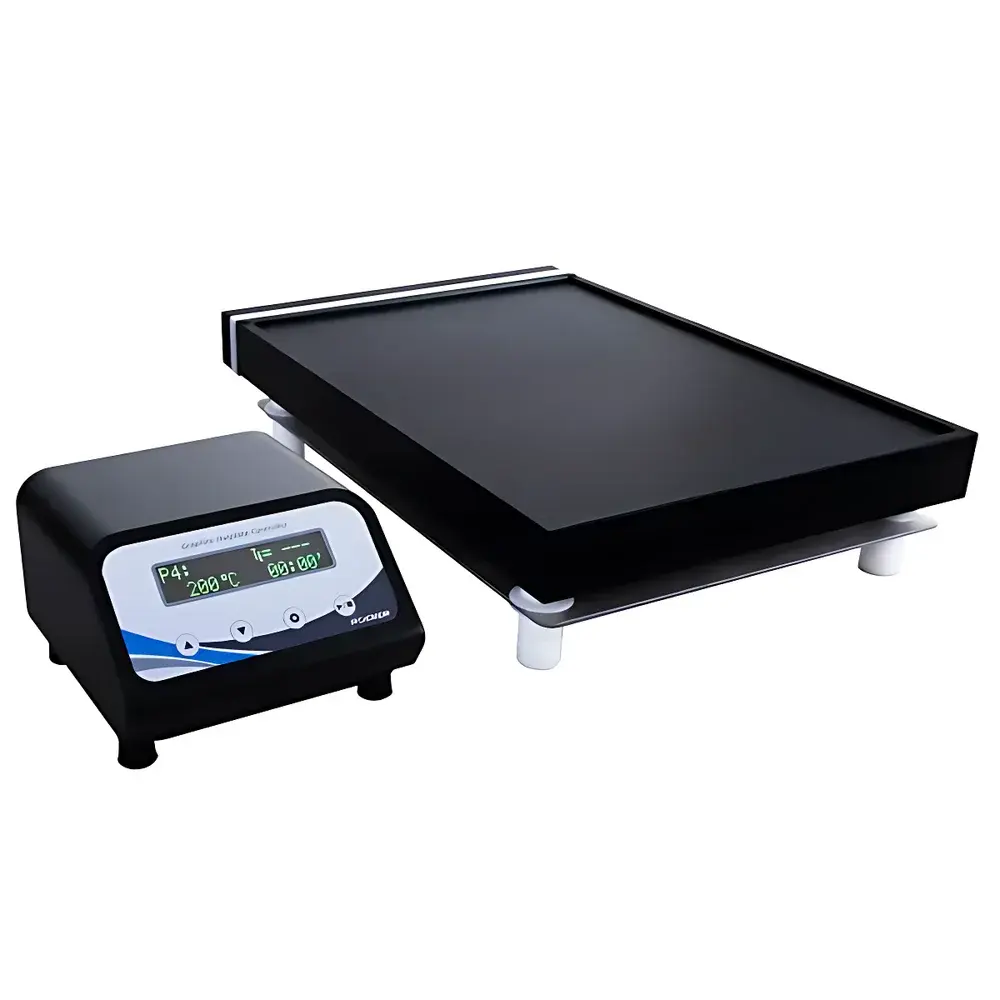
ROCKER Mars430 Graphite Heating Block System
| Brand | ROCKER |
|---|---|
| Origin | Taiwan |
| Model | Mars430 |
| Heating Power | 2000 W |
| Maximum Temperature | 200 °C |
| Temperature Uniformity | ±1 °C |
| Heating Surface Dimensions | 46 × 32 × 11 cm |
| Controller | Dedicated External Controller with OLED Display |
| Temperature Range | Ambient +5 °C to 200 °C |
| Temperature Resolution | 1 °C |
| Temperature Accuracy | ±1 °C @ 150 °C |
| Timer Modes | Countdown (1 min – 99 h 59 min) and Continuous Heating |
| Over-Temperature Protection | 210 °C Cut-Off |
| Compliance | RoHS Certified |
| Construction | Isostatically Pressed Graphite Block with Full PTFE Coating |
| Electrical Input | 220 V, 50/60 Hz |
Overview
The ROCKER Mars430 Graphite Heating Block System is an engineered solution for precise, contamination-free sample preparation in trace metal analysis, acid digestion, and controlled thermal processing. Unlike conventional ceramic or stainless-steel hotplates, the Mars430 utilizes a monolithic isostatically pressed graphite heating block fully coated with chemically inert polytetrafluoroethylene (PTFE). This architecture eliminates metallic leaching pathways and ensures compatibility with aggressive reagents—including concentrated HNO₃, HCl, HF, and aqua regia—commonly employed in EPA Method 3050B, 3051A, and 3052 digestions. The system operates on the principle of conductive heat transfer through high-density graphite, delivering exceptional thermal homogeneity across the entire surface. Its design supports both open-vessel heating and closed-vessel digestion workflows when paired with compatible PTFE-coated graphite blocks, making it suitable for laboratories adhering to ISO/IEC 17025, USP , and ASTM D3682–22 requirements for elemental analysis.
Key Features
- Full PTFE encapsulation of all external surfaces and graphite core — prevents cross-contamination and ensures long-term resistance to strong acids and oxidizers.
- Isostatically pressed graphite heating plate — achieves uniform thermal conductivity (≥120 W/m·K) and minimizes radial temperature gradients (<±1 °C across 46 × 32 cm surface at 150 °C).
- Dual-mode digital controller with OLED interface — enables precise setpoint control (1 °C resolution), real-time temperature monitoring, and programmable countdown timing from 1 minute to 99 hours 59 minutes.
- Independent controller unit (18 × 18 × 10 cm) — physically separated from the heating block to reduce thermal drift and improve operator safety during extended runs.
- Integrated over-temperature safety cutoff at 210 °C — hardware-based fail-safe independent of software logic, compliant with IEC 61000-6-2 EMC and IEC 61010-1 safety standards.
- Modular block compatibility — accepts optional PTFE-coated graphite blocks (sold separately) for 15 mL, 50 mL, and 100 mL digestion tubes, supporting standardized throughput in EPA and ISO digestion protocols.
Sample Compatibility & Compliance
The Mars430 accommodates a wide range of vessel formats via interchangeable graphite blocks, including 70× φ16 mm, 54× φ20 mm, 40× φ25 mm, 54× 15 mL, 24× 50 mL, and 15× 100 mL configurations. All contact surfaces are non-metallic and RoHS-compliant, eliminating risks of Fe, Cr, Ni, or Cu contamination critical for ICP-MS and GF-AAS quantitation at sub-ppt levels. The system meets material compatibility requirements outlined in USP for heavy metals testing and supports GLP documentation through optional external Pt100 probe integration (part no. 178200-45). No moving parts or internal electronics reside within the heating zone — enhancing reliability under continuous operation in regulated QC environments.
Software & Data Management
While the Mars430 operates as a standalone instrument without proprietary software, its controller supports analog output (0–5 V or 4–20 mA) for integration into centralized laboratory data acquisition systems. When used with validated external temperature loggers or LIMS interfaces, the system supports audit-trail generation per FDA 21 CFR Part 11 requirements. Temperature stability logs can be exported manually via timestamped OLED display readings, and the controller retains last-used parameters after power cycling — facilitating repeatable method execution across shifts. Optional PTFE-sheathed Pt100 sensors enable third-party calibration verification traceable to NIST standards.
Applications
- EPA-compliant acid digestion of soils, sediments, and biological tissues for multi-element analysis by ICP-OES and ICP-MS.
- USP and Ph. Eur. 2.4.8 heavy metals testing in pharmaceutical excipients and APIs.
- AOAC 999.10 and ISO 11047:2021 sample prep for lead, cadmium, arsenic, and mercury in food and feed matrices.
- Controlled evaporation and concentration steps in environmental water analysis workflows.
- Pre-digestion conditioning of polymer and composite samples prior to microwave-assisted digestion.
FAQ
Is the Mars430 suitable for hydrofluoric acid (HF) digestion?
Yes — the fully PTFE-coated graphite construction provides full resistance to HF up to 200 °C, provided vessels remain sealed and fume hood ventilation is maintained.
Can the controller be mounted remotely?
Yes — the dedicated controller connects via shielded cable (standard length 1.5 m, extendable to 5 m with signal integrity verification) and may be wall-mounted or placed on benchtop away from thermal radiation.
Does the system support GLP-compliant calibration records?
While the unit itself does not store calibration history, its stable thermal profile (±1 °C uniformity) and compatibility with external NIST-traceable Pt100 probes enable full compliance with ISO/IEC 17025 calibration management procedures.
What maintenance is required?
No routine maintenance beyond periodic visual inspection of PTFE coating integrity and cleaning with deionized water and lint-free wipes; graphite substrate requires no replacement under normal operating conditions.
Is firmware upgrade capability available?
No — the controller uses hardened embedded logic with fixed functionality optimized for regulatory stability; changes to operational parameters require physical recalibration by authorized service personnel only.



