
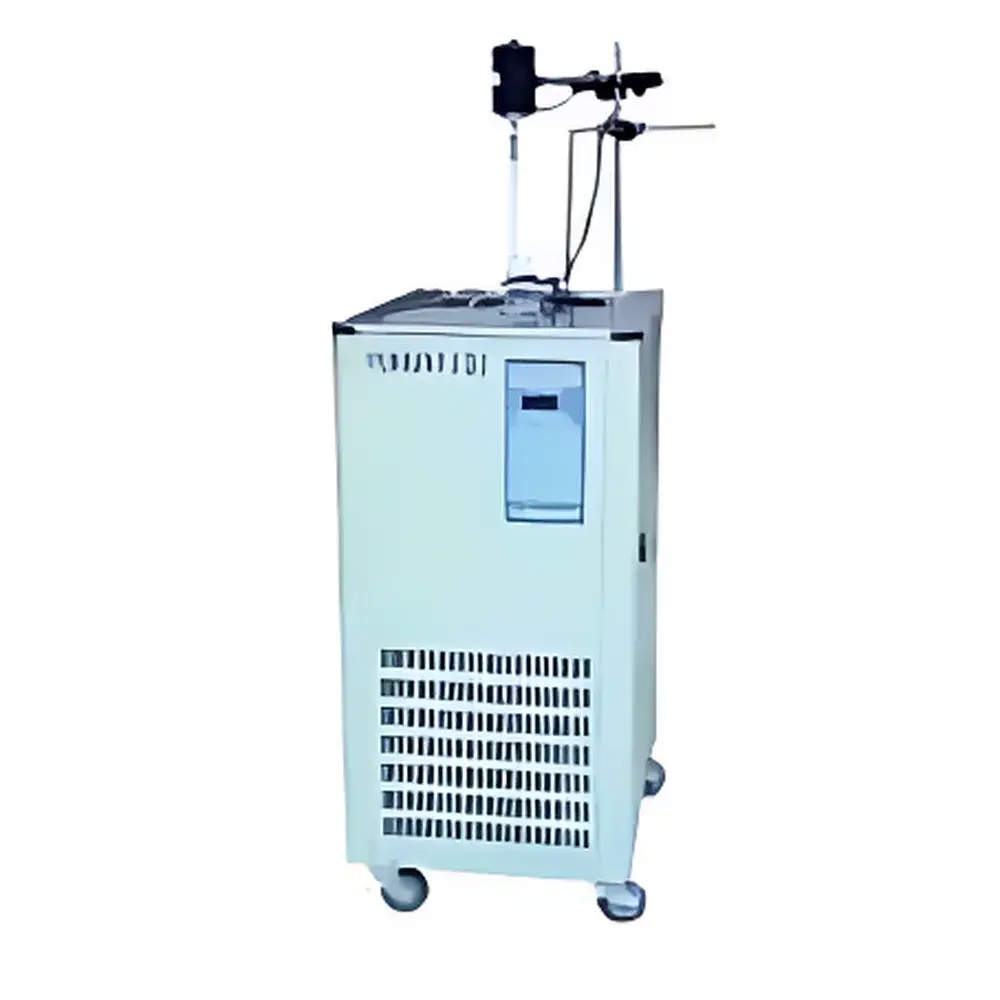
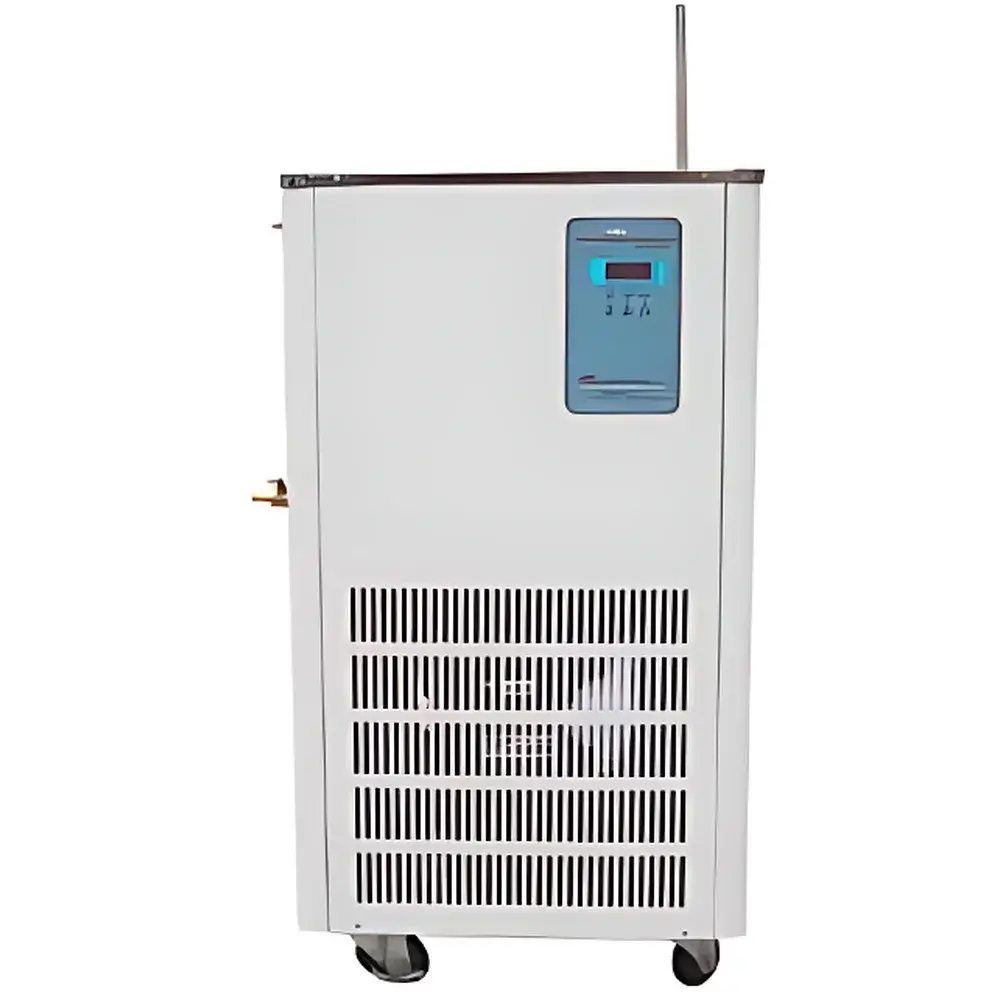
YUHUA DLSB-5/60 Cryogenic Constant-Temperature Circulator
| Brand | YUHUA |
|---|---|
| Model | DLSB-5/60 |
| Cooling Capacity | 2036–330 W (at –60 °C) |
| Minimum No-Load Temperature | –62 °C |
| Temperature Range | –60 °C to Room Temperature |
| Temperature Stability | ±0.2 °C |
| Reservoir Volume | 5 L |
| Flow Rate | 20 L/min |
| Head | 4–6 m |
| Power Supply | 220/380 V, 50 Hz |
| Dimensions (L×W×H) | 680 × 500 × 780 mm |
| Weight | 25 kg |
| Construction | Corrosion-Resistant Fluid Path |
| Control | Microprocessor-Based Digital Temperature Controller |
| Compressor | Imported Hermetic Scroll Compressor |
Overview
The YUHUA DLSB-5/60 Cryogenic Constant-Temperature Circulator is a mechanically refrigerated, closed-loop liquid circulation system engineered for precise thermal management in demanding laboratory and industrial applications. It operates on the principle of vapor-compression refrigeration using a high-efficiency hermetic scroll compressor—sourced from internationally recognized manufacturers—to achieve stable, continuous cooling down to –62 °C under no-load conditions, with operational setpoint control from –60 °C to ambient temperature. Unlike open-bath chillers or dry ice-based systems, this circulator delivers consistent, contamination-controlled coolant flow to external equipment via insulated, corrosion-resistant fluid pathways. Its primary function is to maintain thermally sensitive instrumentation—including electron microscopes, X-ray diffractometers, laser sources, vacuum deposition systems, and analytical spectrometers—at rigorously defined operating temperatures while ensuring long-term fluid integrity and minimal thermal drift.
Key Features
- Hermetically sealed, imported scroll compressor delivering reliable performance and extended service life under sustained low-temperature operation.
- Microprocessor-based digital temperature controller with LED display, enabling intuitive setpoint entry, real-time monitoring, and automatic PID adjustment for optimal thermal stability (±0.2 °C).
- Corrosion-resistant internal circulation loop constructed from chemically inert materials (e.g., stainless steel, fluoropolymer-lined components), minimizing metallic ion leaching and preserving coolant purity—critical for ultrahigh-vacuum and semiconductor-grade applications.
- Integrated high-head centrifugal circulation pump (4–6 m head, 20 L/min flow rate) capable of sustaining pressure-driven coolant delivery over extended tubing runs and across multi-instrument manifolds.
- 5-liter insulated reservoir with level sensor and overflow protection, designed for compatibility with standard organic and aqueous heat-transfer fluids (e.g., ethanol/water mixtures, silicone oils).
- Comprehensive electrical safety architecture including overcurrent protection, compressor high-pressure cut-off, and thermal overload relays compliant with IEC 61000-6-2/6-4 electromagnetic compatibility standards.
Sample Compatibility & Compliance
The DLSB-5/60 is compatible with a broad range of heat-transfer media, including water–glycol, ethanol–water, and low-viscosity silicone oils, supporting both aqueous and non-aqueous experimental protocols. Its fluid path design meets ISO 8573-1 Class 4 particulate cleanliness requirements when operated with filtered coolants. While not certified to UL/CSA or CE for medical device integration, the unit conforms to general-purpose laboratory equipment safety guidelines per GB 4793.1–2007 (equivalent to IEC 61010-1). For GLP/GMP-regulated environments, optional audit-trail-capable firmware upgrades (via RS485 interface) support 21 CFR Part 11–compliant data logging when paired with validated third-party software platforms.
Software & Data Management
The base configuration includes a front-panel digital interface with password-protected parameter locking and cycle memory retention. Optional RS485 serial communication enables integration into centralized lab infrastructure via Modbus RTU protocol, allowing remote setpoint modulation, real-time temperature streaming, and alarm status polling. When connected to validated SCADA or LIMS systems, temperature logs—including timestamps, deviation alerts, and compressor runtime metrics—can be archived in CSV or XML format. Firmware updates are performed via secure USB dongle; all calibration coefficients are digitally signed and tamper-evident.
Applications
- Thermal stabilization of high-resolution electron microscopy stages and EDS detectors requiring sub-–40 °C cold-finger operation.
- Coolant supply for vacuum sputtering chambers and magnetron cathodes where temperature-dependent film adhesion and stoichiometry must be tightly controlled.
- Condenser cooling for rotary evaporators processing thermolabile natural products or chiral intermediates.
- Temperature regulation of NMR probe preamplifiers and cryogen-free superconducting magnets.
- Process cooling during low-temperature crystallization studies in pharmaceutical polymorph screening.
- Environmental simulation chambers requiring reproducible thermal ramps between –60 °C and +25 °C at ≤0.5 °C/min rates.
FAQ
What types of heat-transfer fluids are recommended for operation at –60 °C?
Ethanol–water mixtures (e.g., 60:40 v/v) or low-pour-point silicone oils (e.g., DC-200 series) are validated for continuous use at –60 °C. Glycol–water blends are not recommended below –30 °C due to viscosity-induced flow restriction.
Can the DLSB-5/60 be integrated into a multi-zone cooling network?
Yes—the unit supports daisy-chained manifold configurations with flow-balancing valves. Maximum recommended total line length is 15 m (with ≤3 m vertical lift) to maintain rated pressure head and thermal response time.
Is the reservoir accessible for in-situ fluid replacement without system shutdown?
The reservoir features a quick-release cap and drain valve; however, full fluid exchange requires depressurization and brief system pause to avoid air ingestion into the pump head.
Does the unit include factory calibration documentation traceable to NIST standards?
Standard delivery includes a manufacturer’s calibration certificate referencing internal PT100 sensor verification against a metrology-grade dry-block calibrator (±0.05 °C uncertainty); NIST-traceable third-party certification is available as an add-on service.
What maintenance intervals are specified for compressor oil and filter elements?
Under continuous operation at ≤–40 °C, the compressor lubricant and suction-line filter require replacement every 12 months or 8,000 operating hours—whichever occurs first—as per OEM service bulletin YUHUA-DLSB-MNT-2023.



